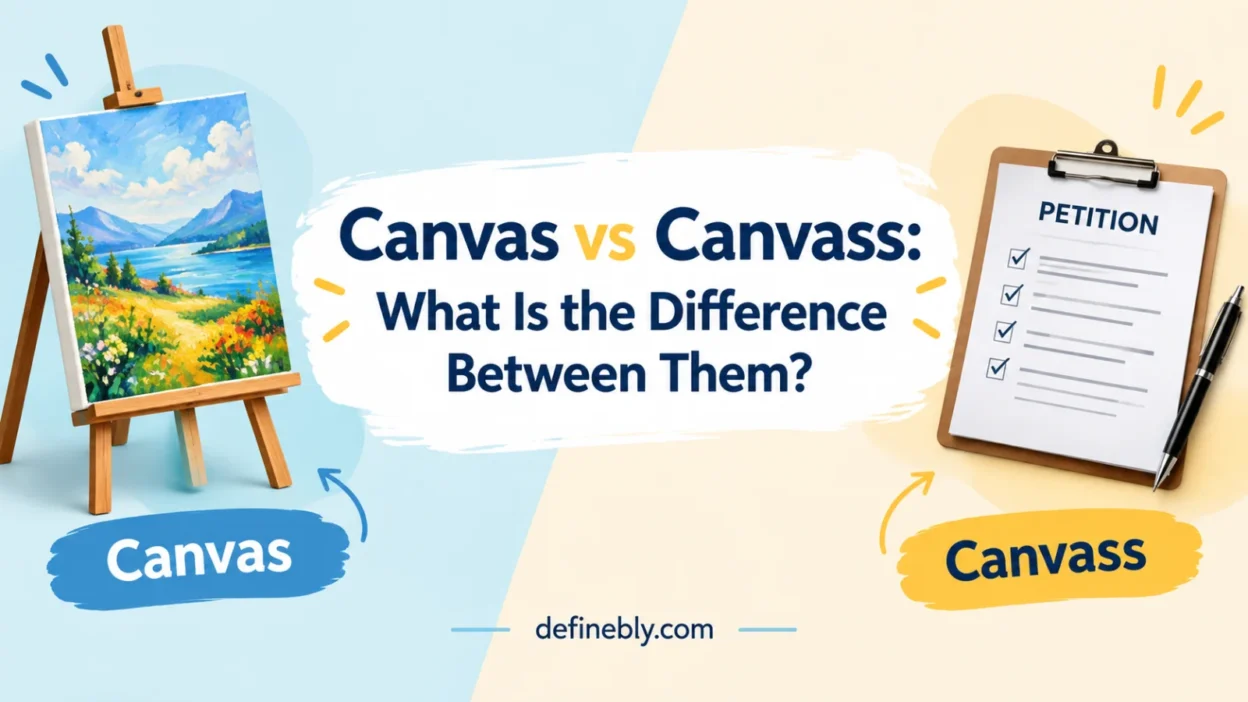
Canvas is a noun for a heavy woven fabric, used for things like paintings, tents, and sails. Canvass is mostly a verb meaning to go around asking people for votes, opinions, or support — though it can also be a noun for that activity itself. They sound exactly alike but do completely different jobs in a sentence.
Here’s the fast way to keep them straight, plus every real-world usage case where people actually get this wrong.
Quick Answer
- Canvas (one “s”) — a fabric, or an artist’s finished painting. Almost always a noun.
- Canvass (two “s”s) — to solicit votes, opinions, or orders; also works as a noun for that activity.
- They’re homophones: identical pronunciation, different meaning and spelling.
- Mnemonic: the extra s in canvass stands for soliciting — canvassers knock on doors and ask.
The Core Difference
Canvas names a physical thing: a tightly woven fabric made from cotton, linen, or hemp, used for tents, sails, boxing-ring floors, tote bags, and the surface artists paint on. It’s an everyday, low-formality word.
Canvass names an action: going door-to-door or through a list of people to gather votes, opinions, or orders. A campaign canvasses a neighborhood. A company canvasses potential customers before a product launch. A detective canvasses a block for witnesses. It’s more common in political, investigative, and business-outreach contexts than in casual conversation.
Noun and Verb Roles at a Glance
| Word | Primary Role | Meaning |
|---|---|---|
| Canvas | Noun | Woven fabric; an artist’s finished piece |
| Canvas | Verb (rare) | To cover something with canvas fabric |
| Canvass | Verb (common) | To solicit votes, opinions, orders, or information |
| Canvass | Noun | The act of soliciting or surveying (e.g., “a door-to-door canvass”) |
Usage by Field
Art and textiles: A painter stretches a canvas before starting a piece. Canvas shoes, canvas bags, and canvas tents all refer to the fabric itself.
Politics and elections: Campaigns canvass neighborhoods to talk with voters. A “final canvass” refers to the official tallying and review of votes after an election.
Investigations: Police canvass a neighborhood after a crime, going door-to-door to ask if anyone saw or heard anything.
Business and sales: Companies canvass potential customers or markets before launching a product, gathering feedback through direct outreach.
Spelling Variants: Canvassing vs. Canvasing
This is where a second, closely related confusion shows up. The standard American spelling doubles the “s” when adding endings:
| Standard (Preferred) | Rare Variant |
|---|---|
| Canvassing | Canvasing |
| Canvassed | Canvased |
| Canvasser | Canvaser |
Stick with the doubled-“s” forms — canvassing, canvassed, canvasser — in virtually all writing. The single-“s” variants appear occasionally in older or informal text but aren’t standard.
A Note on the Merriam-Webster Variant Listing
Merriam-Webster lists “canvas” as a rare variant spelling of the verb canvass in some entries. This is a historical dictionary footnote, not a usage recommendation. In practice, every major style guide and virtually all professional writing treats canvas (fabric) and canvass (solicit) as two distinct words with two distinct spellings. Use canvas for the fabric and canvass for the outreach — that convention is what readers expect and what avoids confusion.
Why the Confusion Exists
Canvas and canvass are true homophones — identical in speech, different in spelling and meaning — which makes the error easy to make while typing quickly, since spell-check won’t catch it (both are real, correctly spelled words).
The words are also historically connected. Canvass grew out of canvas through an old expression involving tossing something in a canvas sheet to examine or shake it out — an image that gradually shifted toward “thoroughly examining opinions” and eventually settled into today’s meaning: actively seeking out people’s votes or views.
Common Mistakes and Fixes
- “We need to canvas the neighborhood before the vote.” → Should be canvass — you’re describing outreach, not fabric.
- “She stretched a canvass over the frame.” → Should be canvas — this is the fabric.
- “Volunteers canvased the block.” → Should be canvassed — the standard past tense doubles the “s.”
- Assuming canvass can’t be a noun → It regularly is, as in “the final canvass of votes.”
Adjacent Words Worth Knowing
Canvasback is a species of North American duck, named for its pale, canvas-colored back — unrelated to either the fabric or the outreach sense, but a common source of search confusion since it shares the “canvas” root.
Example Sentences
- The artist stretched a fresh canvas across the frame before painting.
- Volunteers will canvass the neighborhood this weekend ahead of the election.
- The tent was made of heavy-duty canvas that held up through the storm.
- Detectives canvassed the block, asking residents what they’d seen.
- After the final canvass, officials confirmed the results.
Word History
Canvas traces back to an old term for hemp, the plant fiber the fabric was originally woven from. Canvass developed later, evolving from the same root through the “toss in a canvas sheet” expression, which shifted over time toward the modern sense of actively seeking out opinions. Merriam-Webster records the verb canvass in use since the early 16th century.
Phrases Containing Each Word
- Canvas bag, canvas tent, canvas sail, canvas shoes
- Blank canvas (figurative: a fresh start or open opportunity)
- Canvass the vote, door-to-door canvass, neighborhood canvass
- Canvasser (a person who canvasses)
Frequently Asked Questions
What is the difference between canvas and canvass?
Canvas is a fabric or an artist’s finished piece. Canvass is the act of seeking votes, opinions, or information from people.
Is canvas a noun or a verb?
Almost always a noun. It’s rarely used as a verb, and only then to mean “cover with canvas.”
Is canvass a noun or a verb?
Mostly a verb, but it also works as a noun for the act of surveying or soliciting — as in “a neighborhood canvass.”
How do you remember canvas vs canvass?
The extra “s” in canvass matches “soliciting” — canvassers go out and ask, and that extra letter is your reminder.
What does it mean to canvass a neighborhood?
Going door-to-door to talk with residents, usually to gather opinions, request votes, or share information.
Is canvassing the same as campaigning?
Related but not identical. Canvassing is direct, individual outreach — one specific tactic that’s often part of a broader campaign.
Is canvasing a correct spelling?
Not the standard one. Canvassing, with the doubled “s,” is the standard American spelling; canvasing is a rare variant best avoided in professional writing.
Conclusion
Canvas and canvass sound alike but do very different jobs in a sentence. Canvas names a fabric or a finished painting, while canvass describes the act of seeking out votes, opinions, or information. Once you connect the extra “s” in canvass to its connection with soliciting, the difference is easy to keep straight.