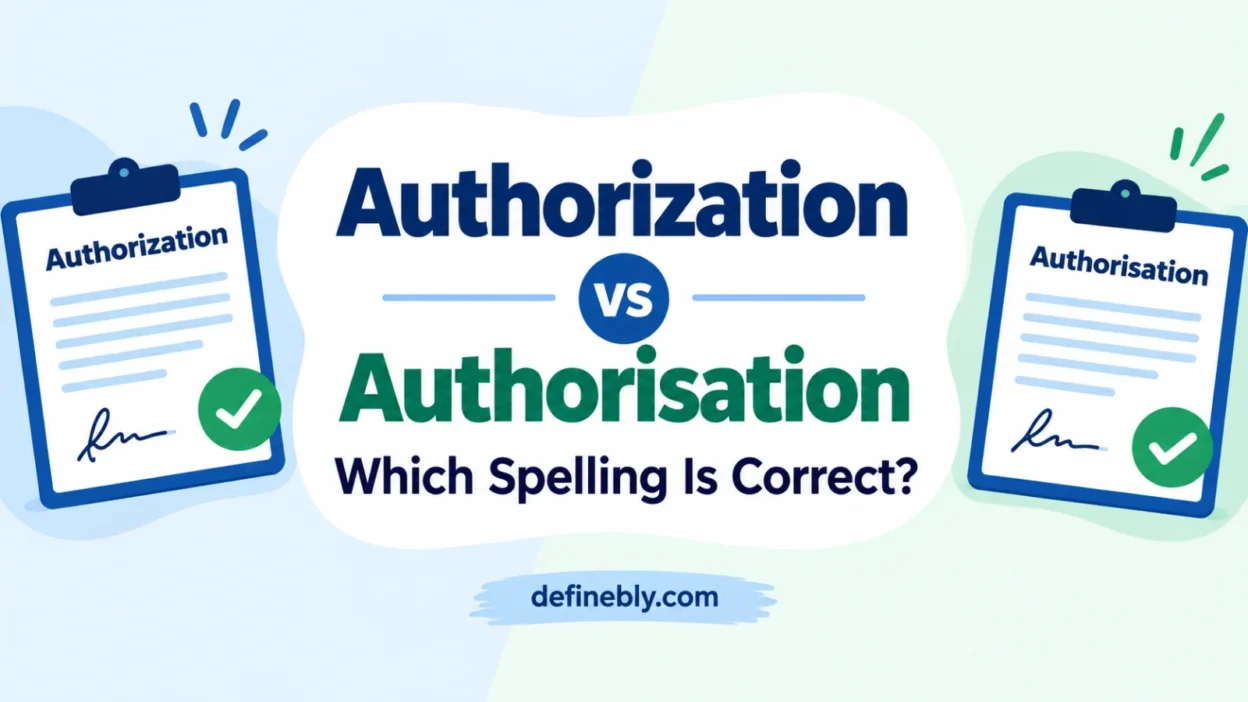
Both spellings are correct. Authorization is standard in American English, and authorisation is standard in British English. Neither one is a typo — they’re the same word, split by two different national spelling traditions.
If you’ve ever typed this word and second-guessed the “z” or the “s,” you’re not alone. It’s one of the most commonly flagged words in cross-border business writing, right alongside organize/organise and recognize/recognise. Here’s exactly how to use each version correctly, and why both exist in the first place.
Quick Answer
- Authorization (with a “z”) — standard in the United States and most US-based software and government forms.
- Authorisation (with an “s”) — standard in the United Kingdom and widely used across the Commonwealth.
- Both mean the same thing: official permission, approval, or the document that grants it.
- The choice is regional style, not grammar or meaning.
- Pick one spelling per document and stay consistent — mixing the two is the actual mistake, not choosing either one.
Why Two Spellings Exist
The split comes from a much larger pattern in English: verbs ending in -ize/-ise and their related nouns ending in -ization/-isation. American English standardized on the “z” spelling in the 19th and 20th centuries, largely following Noah Webster’s push to simplify and regularize American spelling. British English gradually shifted toward “-ise” in everyday use, though it’s worth knowing that “-ize” has deep historical roots in British English too — Oxford University Press style has long favored “-ize” for many of these words, even in the UK.
So the common idea that British English is “the s version” isn’t strictly accurate. It’s a modern style preference, not a hard historical rule.
Style Guide Comparison
| Style Guide | Preferred Spelling |
|---|---|
| Associated Press (AP) | Authorization |
| Chicago Manual of Style | Authorization |
| US Government / federal writing | Authorization |
| Oxford Style Manual | Authorization (Oxford spelling uses “-ize”) |
| Cambridge Dictionary / most UK newspapers | Authorisation |
| UK Government Digital Service | Authorisation |
| Canadian Press Style | Mixed — check publication |
| Australian Government Style Manual | Authorisation |
The takeaway: if you’re writing for a general UK audience, “authorisation” is the safer default even though “authorization” isn’t technically wrong there either — it’s simply less common outside Oxford-style publishing.
Regional Breakdown
- United States: Authorization only. “Authorisation” will look like a misspelling to nearly all American readers.
- United Kingdom: Authorisation is dominant in everyday writing, journalism, and most business communication, though “-ize” spellings still appear in academic and Oxford-affiliated publishing.
- Canada: Genuinely mixed. Government and legal writing often leans British; media and business writing often leans American. Check your employer’s or publication’s style guide rather than assuming.
- Australia and New Zealand: Authorisation is the standard, matching British convention.
- India and much of the Commonwealth: Authorisation is generally preferred, following British-influenced English education.
- International organizations (UN, EU institutions, many NGOs): Usage varies by institution and often follows whichever English variant that body has adopted as its house style.
How Spell-Checkers Handle It
Most of the confusion people experience comes down to software locale settings, not actual uncertainty about grammar:
- Microsoft Word and Google Docs will flag whichever spelling doesn’t match your document’s set language (English US vs. English UK).
- Browsers typically default to US English unless your operating system or browser language is set otherwise.
- If you’re editing a document that keeps flipping one spelling as an error, check the language setting before assuming you made a mistake.
Which One Should You Use?
Match the spelling to your reader, not your personal habit:
- Writing for US readers, US companies, or American legal/government contexts → authorization
- Writing for UK, Australian, or most Commonwealth readers → authorisation
- Writing for a mixed or international audience → choose one and apply it consistently across the entire document, including related words like authorize/authorise and authorized/authorised
- Unsure who’s reading? American spelling is the safer global default, since most software, platforms, and international business writing defaults to US English.
Memory trick: American English trends toward “z” in general (organize, realize, recognize). If you remember that the US leans toward “z” across this entire word family, you’ll get authorization right without having to think about it case by case.
Pronunciation
Both spellings are pronounced identically: aw-thuh-rih-ZAY-shun. The spelling difference is purely visual — it doesn’t change how the word sounds in either American or British English.
The Wider -Ize/-Ise Word Family
This same US/UK pattern shows up across dozens of related words. A few of the most common:
| American (-ize) | British (-ise) |
|---|---|
| Organize | Organise |
| Realize | Realise |
| Recognize | Recognise |
| Customize | Customise |
| Finalize | Finalise |
| Specialize | Specialise |
| Standardize | Standardise |
| Prioritize | Prioritise |
If you’re consistent with one pattern across this whole word family, you’ll rarely get any individual word wrong.
Common Mistakes and Fixes
- Dropping letters: “authoriztion” → should be “authorization.” Not a regional variant, just a typo.
- Mixing spellings in one document: using “authorization” in paragraph one and “authorised” in paragraph three. Pick one and apply it to the whole word family.
- Assuming “authorisation” is wrong: it’s a fully standard, dictionary-recognized British spelling, not an error.
- Confusing authorization with authentication: authorization means granting permission; authentication means verifying identity. A system can authenticate who you are and still deny you authorization to access something.
Formal and Professional Usage
This word shows up constantly in registers where precision matters:
- Legal and contracts: “prior written authorization,” “authorization to act on behalf of”
- Healthcare and insurance: “prior authorization,” “authorization number”
- Banking and finance: “authorization required for transactions above [threshold]”
- HR and employment: “authorized signatory,” “letter of authorization”
In every case, the spelling follows the same US/UK rule — only the region of your reader changes it.
Example Sentences
- The manager authorized the request and issued a formal authorization letter. (American)
- The manager authorised the request and issued a formal authorisation letter. (British)
- The bank required written authorisation before releasing the funds.
- You’ll need authorization from the department head before purchasing new equipment.
Word History
The word traces back to Anglo-French auctorizer and Medieval Latin roots connected to auctor, meaning “originator” or “authority.” It entered English through legal and administrative writing, where the concept of formally granting permission required its own precise term. The verb has been documented in English since the 14th century. The “-ize” and “-ise” spelling split emerged much later, as American and British English diverged in spelling reform during the 18th and 19th centuries — the same divergence responsible for color/colour, center/centre, and dozens of other transatlantic spelling pairs.
Frequently Asked Questions
Is authorization or authorisation correct?
Both are correct. Authorization is standard American English; authorisation is standard British English. The correct one depends on your audience, not the word itself.
Do Americans use authorization or authorisation?
Americans use authorization almost exclusively. Authorisation will typically look like a misspelling in US business, legal, or government writing.
Is authorisation a real word?
Yes. It’s the standard spelling across the UK, Australia, and much of the Commonwealth, and it appears in every major British dictionary.
What’s the difference between authorization and authentication?
Authorization grants permission to do something. Authentication verifies who someone is. A person can be authenticated (identity confirmed) without being authorized (permission granted) to access a specific resource.
Why does British English spell it with an s?
British English generally favors “-ise” endings for this word family as a matter of modern style, though “-ize” spellings have historical roots in British English as well, including in Oxford’s own house style.
Which spelling should I use for an international audience?
Pick one based on your primary readership or your organization’s style guide, then apply it consistently to the whole document — including related words like authorize/authorise.
Is authorization a noun or a verb?
Authorization is a noun. The related verb is authorize (US) or authorise (UK).
Conclusion
The authorization vs authorisation debate comes down to region, not meaning. Use authorization for American audiences and authorisation for British ones, and keep your spelling consistent throughout any single document. When in doubt, match the style your reader expects.