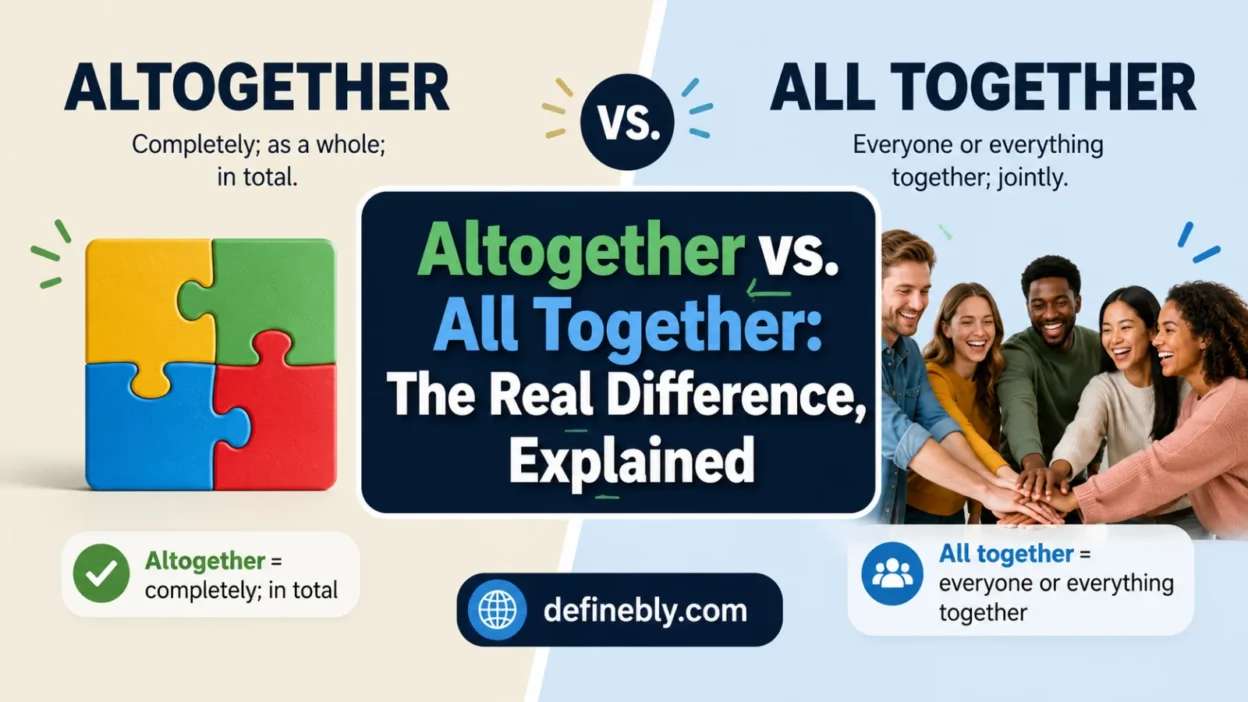
“Altogether” and “all together” sound exactly the same when you say them out loud. That’s the whole problem. On the page, though, they do different jobs. One is a single adverb. The other is a short phrase made of two separate words. Mixing them up is one of the most common small errors in everyday writing, and it’s an easy one to fix once you see the pattern.
Quick Answer
Use altogether when you mean “completely,” “entirely,” or “in total.”
Use all together when you mean “everyone or everything in one place, at once, or as a group.”
If you can swap in “completely” and the sentence still makes sense, go with “altogether.” If you can swap in “in a group” or “at the same time,” go with “all together.”
Why People Confuse Them
They’re pronounced identically, and both contain the idea of “all” plus “together.” That shared sound and shared root make it easy to assume they’re just spelling variants of the same word. They’re not. “Altogether” is one word that has drifted into its own meaning over time. “All together” stayed as two separate words, each keeping its own job in the sentence.
Key Differences At A Glance
| Context | Best Choice | Why |
|---|---|---|
| Describing a total amount | Altogether | Means “in total” — “That’s $40 altogether.” |
| Describing a group acting as one | All together | Means “as a unit” — “We sang all together.” |
| Saying something stopped completely | Altogether | Means “entirely” — “She gave up altogether.” |
| Describing people gathered in one spot | All together | Means “in the same place” — “The kids are all together in the yard.” |
| Summarizing a point | Altogether | Means “on the whole” — “Altogether, it was a good trip.” |
Meaning and Usage Difference
Altogether is an adverb. It modifies a verb, adjective, or the whole sentence, and it means “completely,” “entirely,” or “in total.” It often shows up when adding things up (“That comes to $60 altogether”) or when summarizing (“Altogether, the plan worked”).
All together is a phrase built from “all” plus “together.” It describes people or things that are in the same place, acting at the same time, or grouped as one unit. Because it’s two separate words, you can often slide another word between them: “We are all standing together” still makes sense. You can’t do that with “altogether” — breaking it apart breaks the word.
Tone, Context, and Formality
Both terms are standard in everyday US English and appear in formal and informal writing alike. Neither one signals a more casual or more formal register than the other — the choice is about meaning, not tone. “Altogether” tends to show up in writing that’s summarizing, totaling, or emphasizing completeness (reports, receipts, conclusions). “All together” tends to show up in writing about groups, teamwork, or shared location (event descriptions, instructions, narratives).
Which One Should You Use?
Ask what you’re really saying:
- Talking about a sum, degree, or completeness? Use altogether.
- Talking about people or things being grouped, joined, or acting in unison? Use all together.
A quick test: try inserting a word between “all” and “together.” If the sentence still works (“all of us together,” “all sitting together”), you need the two-word phrase. If inserting a word breaks the sentence, you need the single word “altogether.”
When One Choice Sounds Wrong
“We were altogether at the reunion” sounds off, because you’re describing people gathered in one place — that calls for “all together.” Flip it: “The bill was $85 all together” also sounds off, because you’re describing a total, not a group — that calls for “altogether.” When a sentence about a total or a complete stop uses “all together,” or a sentence about a group uses “altogether,” it reads as a mistake to careful readers.
Common Mistakes (and Quick Fixes)
Mistake: “The team practiced altogether every morning.”
Fix: “The team practiced all together every morning.” (They practiced as a group.)
Mistake: “That project was all together a disaster.”
Fix: “That project was altogether a disaster.” (Meaning “completely.”)
Mistake: Assuming they’re interchangeable because they sound alike.
Fix: Check whether you mean “completely” (altogether) or “in a group” (all together) before choosing.
Everyday Examples
- The bill came to $32.50 altogether.
- Let’s get the family all together for the holidays.
- He wasn’t altogether honest about what happened.
- The choir sang the final verse all together.
- Altogether, it was a productive week at work.
- Put the boxes all together by the door before the movers arrive.
Dictionary-Style Word Details
Verb
- Altogether: Not used as a verb in standard US English. It only functions as an adverb.
- All together: Not used as a verb. It functions as a phrase, typically modifying how an action is done.
Noun
- Altogether: Not used as a standalone noun in standard usage, aside from the informal, dated expression “in the altogether” (meaning “naked”), which is uncommon in modern everyday writing.
- All together: Not used as a noun. It remains a descriptive phrase.
Synonyms
- Altogether: completely, entirely, wholly, totally, in total, on the whole.
- All together: as a group, in unison, collectively, at once, jointly. These are closest plain alternatives rather than exact one-word matches, since “all together” is a phrase, not a single lexical item.
- A clear antonym doesn’t cleanly exist for either term in this comparison; both express degrees of unity or completeness rather than opposition.
Example Sentences
- Altogether, the renovation cost more than we planned.
- The dog stopped barking altogether once the guests left.
- The cousins were all together for the first time in years.
- Please stack the chairs all together in the corner.
Word History
“Altogether” formed centuries ago from the combination of “all” and “together,” eventually fusing into one word with its own specialized meaning of “completely” or “wholly.” “All together” never fused — it remained two separate words describing a group acting or existing as one. Beyond this general pattern, precise dating and origin details are not clearly documented in accessible dictionary sources, so no specific dates are claimed here.
Phrases Containing
- Altogether: “not altogether true,” “altogether different,” “altogether too [something].”
- All together: “all together now,” “all together at last,” “put it all together.”
Conclusion
The sound is identical, but the jobs are not. “Altogether” means completely or in total. “All together” means as a group, in one place, or all at once. When in doubt, try slipping a word between “all” and “together” — if the sentence still holds up, you want the phrase, not the single word.