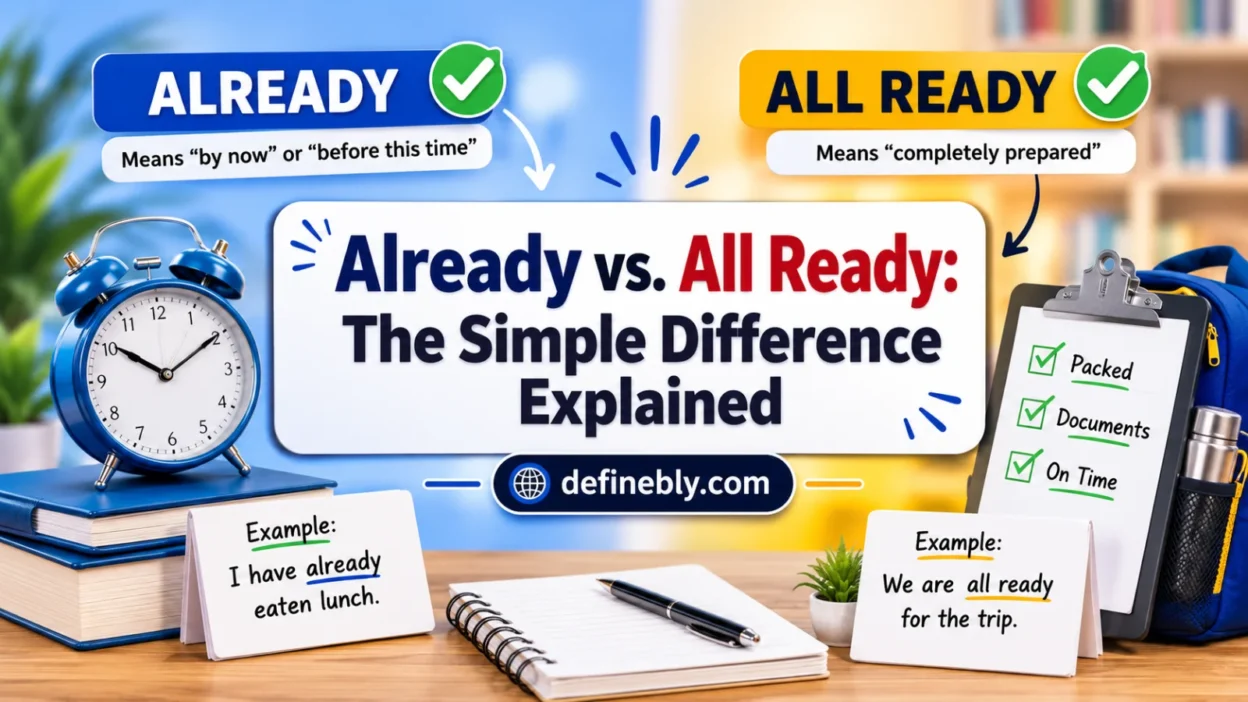
Already (one word) is an adverb about time — it means something happened before now, by a certain point, or sooner than expected. All ready (two words) is a phrase about preparation — it means everyone or everything is completely set to go.
The quickest test: swap in just the word “ready.” If the sentence still works, use all ready. If it breaks, use already.
The team is ready for the game. ✔ → The team is all ready for the game.
I have ready eaten. ✗ → I have already eaten.
Why These Two Get Confused
Spoken at normal speed, already and all ready are identical. Your ear can’t separate them — only your eye can. That alone accounts for most of the confusion.
There’s also a historical reason that makes the pairing feel intuitive: all ready is where already came from. The two started as the same words. Over centuries, the fused spelling already migrated to a new role — tracking time rather than preparation — while all ready stayed behind with its original meaning. Once you know they share a root but diverged in meaning, the distinction makes more instinctive sense.
A Brief History of the Word
Already appears in written Middle English from around 1275, in texts such as Laȝamon’s Brut, where al rædi still meant “completely prepared” — the same sense all ready carries today. Over the following centuries, the fused spelling shifted to its time-based meaning: “by this point” or “sooner than expected.” The OED traces already in its modern temporal sense to the 14th century, with Geoffrey Chaucer among its early users. The two-word phrase all ready never fused because it retained its literal, separable structure — “all” and “ready” each kept independent grammatical roles.
What Each Form Means
Already is a single-word adverb. It tells you when something happened in relation to a reference point in time. It does three things:
Signals something occurred before now or before another action: She had already left when I arrived.
Expresses surprise at how soon something happened: Is it Friday already?
Marks that something is true at this current moment: The store is already open.
All ready is a two-word phrase. “All” adds emphasis — meaning “entirely” or “completely” — to “ready,” which describes a state of preparation. The phrase describes a person, group, or thing that is fully set to proceed:
The team is all ready for the presentation.
We’re all ready whenever you are.
Make sure all the files are all ready before the meeting.
Because all ready is a separable phrase, other words can appear between “all” and “together” without losing the meaning: They were all standing ready. The bags are all packed and ready. You cannot do this with already — it is a single fused word.
Two Tests That Always Work
Test 1 — The “ready” substitution test. Drop “all” and see if just “ready” still works in your sentence. If it does, use all ready. If not, use already.
The crew is ready to launch. ✔ → The crew is all ready to launch.
I have ready seen that film. ✗ → I have already seen that film.
Test 2 — The speed mnemonic. Already means “sooner than expected” — and it takes less time to write than all ready. When the meaning is speed or timing, the faster-to-write one is correct. When the meaning is thorough preparation — making sure all is ready — use the two-word form where “all” keeps its full weight.
Sentence Placement of “Already”
Where already sits in a sentence depends on the verb structure around it.
After a “be” verb or auxiliary: She was already tired. He has already left. They were already prepared.
Before the main verb when there is no auxiliary: I already know. She already called.
At the start of a sentence for emphasis: Already, the queue stretched around the block.
At the end of a sentence, often with mild surprise: It’s noon already? I can’t believe it’s over already.
All four positions are grammatically standard. Placement at the end most often conveys surprise or impatience; placement at the start most often conveys that something is true earlier than the reader might expect.
The Sentence-Final Intensifier — And Where It Came From
Already has one additional use that has nothing to do with time: the sentence-final intensifier expressing impatience or exasperation.
Enough already. Stop it already. Let’s go already.
In these constructions, already doesn’t indicate timing — it signals urgency or frustration. This use of already as an intensifier in American English is a semantic loan from Yiddish shoyn, attested in American English from 1903. Yiddish-speaking communities in New York and other American cities introduced the pattern, and it passed into general American English during the 20th century. Today it is standard informal usage and appears in published writing without register problems.
All ready cannot perform this function. It is always literal, always about preparation.
A Note on Spelling: One L, Not Two
Already is spelled with a single l. The misspelling allready — with two l‘s — appears occasionally and is never correct. When all and ready fused into a single word, standard spelling settled on one l, not two. If you see allready in your own draft, it is a straightforward spelling error with no stylistic defense.
Common Mistakes and Quick Fixes
Mistake: “We are already for the game.”
Fix: “We are all ready for the game.” — describes preparation, not timing.
Mistake: “I have all ready answered that question.”
Fix: “I have already answered that question.” — describes timing, not preparedness.
Mistake: “She is allready here.”
Fix: “She is already here.” — one l, always.
Mistake: Using already to describe a group’s state of readiness.
Fix: “Everyone is all ready” — all is doing real work here, emphasizing the completeness of the preparation for the entire group.
Examples Side by Side
My homework is already done. (adverb — before now)
The homework packets are all ready to hand out. (phrase — fully prepared)
Is it midnight already? (surprise at timing)
The dinner is all ready — come sit down. (fully prepared)
By the time we arrived, the seats were already taken. (happened before a reference point)
All the seats are all ready for the guests. (prepared and waiting)
He stopped calling altogether — wait, he was already done with the relationship. (timing)
They were all ready to move on too. (shared state of readiness)
Quick Practice
Choose the correct form.
- The contracts are [already / all ready] for your signature.
- She couldn’t believe it was January [already / all ready].
- We’re [already / all ready] — let’s go whenever you are.
- Enough [already / all ready]. I’ve heard this story three times.
- By the time help arrived, the damage was [already / all ready] done.
Answers: 1. all ready — 2. already — 3. all ready — 4. already (intensifier) — 5. already
FAQs
What is the fastest way to tell already from all ready apart?
Try replacing the word or phrase with just “ready.” If the sentence holds up — “The team is ready” — use all ready. If “ready” alone breaks the sentence — “I have ready eaten” — use already. This test works in virtually every case.
Can “already” come at the end of a sentence?
Yes, and it commonly does. “It’s over already?” and “I can’t believe it’s Monday already” are both standard. End-position already often carries mild surprise. It can also close sentences as an intensifier expressing impatience: “Enough already.”
Where does “Enough already” come from?
The sentence-final intensifier use of already — as in “Enough already” or “Stop it already” — is a semantic loan from Yiddish shoyn, documented in American English from 1903. It entered general American English through Yiddish-speaking communities and is now standard informal usage.
Is “allready” a word?
No. The only correct one-word spelling is already, with a single l. The misspelling allready (two l‘s) has no standard use in any context.
Does “all ready” always refer to a group?
Not necessarily. All ready can describe a single person, an object, or an event: “I’m all ready to go,” “The report is all ready,” “The room is all ready for the guests.” The “all” emphasizes completeness of preparation rather than requiring a group.
How does “already” work with different verb tenses?
Already is most common with the present perfect (I have already called) and the past perfect (She had already left), but it appears in simple past (He already knew) and present tense (The store is already open) as well. It typically follows the auxiliary verb or the verb “be,” or precedes the main verb when no auxiliary is present.
The Bottom Line
Already is about time — something happened before now or sooner than expected. All ready is about preparation — someone or something is fully set to go. The “ready” substitution test settles virtually every borderline case in seconds, and the one-l spelling rule settles the rest. When impatience needs expressing at the end of a sentence, already is the one that carries it — a habit borrowed from Yiddish and now completely at home in American English.
Conclusion
The difference comes down to one simple question: time or preparation? “Already” points to when something happened. “All ready” points to how prepared something is. Run the quick “ready” substitution test whenever you’re unsure, and you’ll get it right every time.