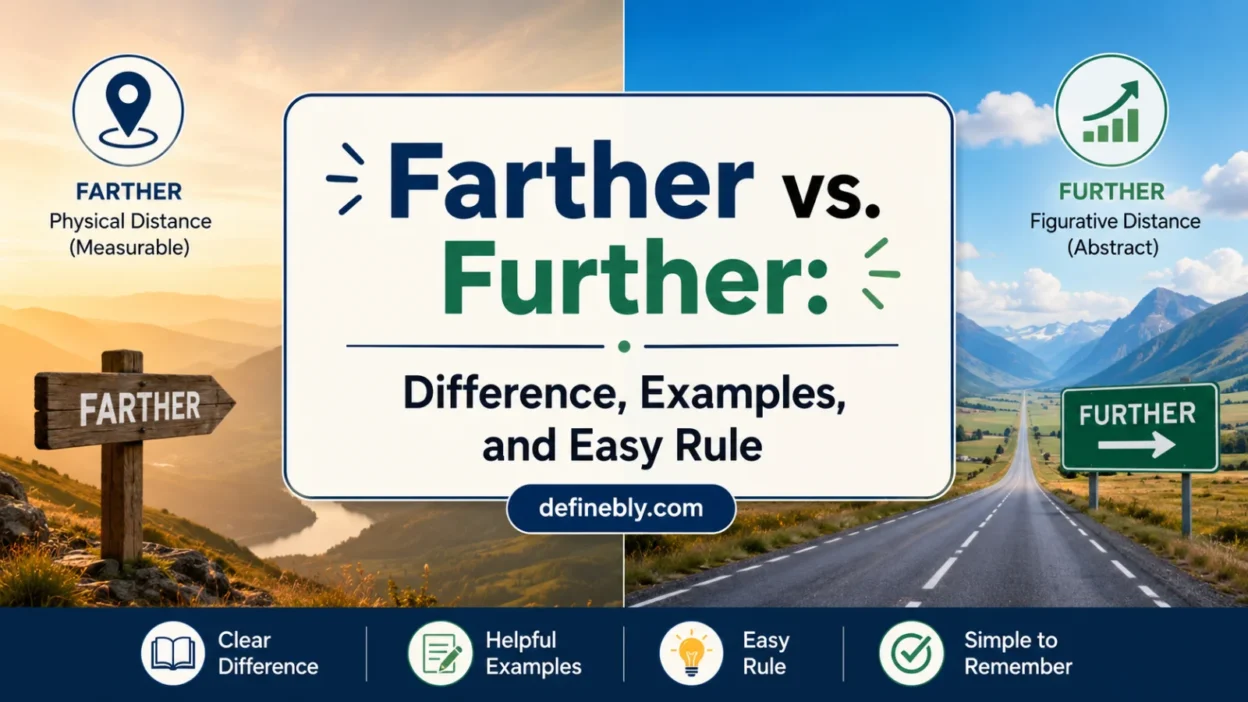
Farther usually refers to physical distance.
Further usually refers to figurative distance, additional information, progress, or advancement.
Correct:
- The gas station is farther down the road.
- We need to discuss this further.
The easiest rule is this: farther for measurable distance, further for more or beyond.
Quick Answer
Use farther when you mean a real distance that could be measured.
Correct:
- The airport is farther away than I thought.
- We walked farther than we planned.
- The cabin is farther from town than the hotel.
Use further when you mean more, additional, continued, figurative, or advanced.
Correct:
- Please send further details.
- We need further review before making a decision.
- The internship helped further her career.
In everyday English, further can also appear in distance sentences. But in careful American writing, farther is usually the clearer choice for physical distance.
Why People Confuse Them
People confuse farther and further because both words come from the idea of far.
They also overlap in some distance uses.
Compare:
- We drove farther into the mountains.
- We drove further into the mountains.
Both sentences are understandable. The first is cleaner if you are talking about physical distance.
The confusion grows because further has meanings that farther usually does not.
Correct:
- For further information, call the office.
- The policy will further the company’s goals.
In these sentences, farther would not work.
Key Differences At A Glance
| Context | Best Choice | Why |
|---|---|---|
| Physical distance | farther | It refers to measurable space. |
| Figurative distance | further | It refers to degree, progress, or extent. |
| Additional information | further | It means more or extra. |
| Advancing a goal | further | It works as a verb. |
| Miles, roads, or locations | farther | It is clearer for literal distance. |
| Research, review, or discussion | further | It means more detailed or continued. |
| Either word for distance | sometimes acceptable | Further can also refer to distance, but farther is often cleaner. |
Meaning And Usage Difference
Farther usually means at, to, or by a greater physical distance.
Correct:
- The school is farther from my house than the library.
- We walked farther than usual today.
- The blue house is farther down the street.
- The hikers moved farther up the trail.
In each sentence, the distance is real and measurable.
Further usually means more, additional, continued, or to a greater degree.
Correct:
- The teacher gave us further instructions.
- The report needs further review.
- We cannot move forward without further information.
- The issue requires further discussion.
Further can also describe figurative distance.
Correct:
- That comment pushed them further apart.
- The delay moved us further from our goal.
- The new evidence took the investigation further.
These sentences are not about miles. They are about relationships, progress, or extent.
Tone, Context, And Grammar
Farther can work as an adverb or adjective.
As an adverb:
- We walked farther today.
- She moved farther away from the noise.
As an adjective:
- The farther trail is harder.
- Use the farther entrance if the front door is crowded.
In both roles, farther usually points to physical distance.
Further can work as an adverb, adjective, or verb.
As an adverb:
- We need to look further into the issue.
As an adjective:
- Please send further details.
As a verb:
- The scholarship helped further his education.
That verb use belongs to further, not farther.
Incorrect:
- The program will farther your career.
Correct:
- The program will further your career.
Which One Should You Use?
Use farther if you can measure the distance in miles, feet, blocks, steps, or another physical unit.
Correct:
- The store is farther away than I remembered.
- We drove farther north after lunch.
- The parking garage is farther from the stadium than the hotel.
- The runner went farther than anyone expected.
Use further if you mean more information, more progress, or more development.
Correct:
- We need further research.
- Please wait for further notice.
- The board requested further explanation.
- This course can further your career.
Use further in common phrases such as:
- further information
- further notice
- further action
- further research
- further discussion
- further details
- further review
- further instructions
Use farther in physical-distance phrases such as:
- farther away
- farther down the road
- farther from home
- farther north
- farther up the trail
- walk farther
- drive farther
- travel farther
When One Choice Sounds Wrong
Use further, not farther, when you mean additional information.
Incorrect:
- For farther information, email the office.
Correct:
- For further information, email the office.
Use farther, not further, when you want the clearest edited-US choice for literal distance.
Less precise:
- The cabin is further from town than the hotel.
Clearer:
- The cabin is farther from town than the hotel.
Use further, not farther, as a verb meaning to advance.
Incorrect:
- The program will farther your career.
Correct:
- The program will further your career.
Use further, not farther, in fixed phrases about continued action or extra details.
Incorrect:
- We will contact you with farther instructions.
Correct:
- We will contact you with further instructions.
Common Mistakes And Quick Fixes
Using Farther For Additional Information
Incorrect:
- For farther details, check your email.
Correct:
- For further details, check your email.
Quick fix:
If the word means additional, use further.
Using Farther As A Verb
Incorrect:
- The grant will farther the research.
Correct:
- The grant will further the research.
Quick fix:
If the word means advance, use further.
Assuming Further Is Always Wrong For Distance
Not wrong:
- We walked further down the road.
Cleaner in edited American English:
- We walked farther down the road.
Quick fix:
If the sentence is about measurable space, farther is usually the safer choice.
Using Further When A Physical Comparison Needs Precision
Less precise:
- The second hotel is further from the airport.
Clearer:
- The second hotel is farther from the airport.
Quick fix:
If you could measure it on a map, use farther.
Forgetting Common Further Phrases
Incorrect:
- until farther notice
- farther research
- farther discussion
- farther action
Correct:
- until further notice
- further research
- further discussion
- further action
Quick fix:
If the phrase means more, extra, or continued, use further.
Everyday Examples
Farther In Sentences
- We drove farther than expected.
- The store is farther down the block.
- The farther entrance is less crowded.
- The hikers went farther up the trail.
- My new apartment is farther from work.
- The airport is farther away than the train station.
- She threw the ball farther this time.
- We parked farther from the building.
Further In Sentences
- Let’s discuss this further tomorrow.
- The report needs further review.
- Her scholarship helped further her education.
- We cannot decide without further information.
- The manager requested further details.
- The delay pushed the project further behind schedule.
- This training can further your career.
- No further action is required.
Farther And Further In The Same Sentence
- We walked farther down the trail, then discussed our plans further.
- The new office is farther from home, but it may further her career.
- The team traveled farther this season and made further progress.
- The second store is farther away, but it offers further discounts.
- We drove farther north before asking for further directions.
Synonyms Or Closest Alternatives
Closest alternatives for farther include:
- more distant
- at a greater distance
- more remote
- beyond
Examples:
- The station is farther away.
- The station is more distant.
Closest alternatives for further include:
- additional
- more
- extra
- continued
- advanced
- promote
- advance
Examples:
- We need further details.
- We need additional details.
- The program will further her career.
- The program will advance her career.
These alternatives are not always exact, but they help test the meaning.
Quick Proofreading Checklist
Before choosing farther or further, ask these questions:
- Can the distance be measured?
- Am I talking about miles, feet, steps, roads, or locations?
- Do I mean additional or more?
- Do I mean continued review, discussion, or research?
- Do I need a verb meaning advance or promote?
- Is the phrase further information, further notice, or further action?
Use farther for physical distance.
Use further for more, additional, continued, figurative, or advanced meanings.
Quick Memory Fix Or Rule Of Thumb
Use this simple rule:
Farther = physical distance.
Further = more or beyond.
Memory trick:
Farther has far, so use it when something is physically farther away.
Examples:
- farther from home
- farther down the road
- farther across the field
Use further when you mean more discussion, more information, more progress, or advancement.
Examples:
- further details
- further research
- further your career
FAQs
What is the difference between farther and further?
Farther usually means a greater physical distance.
Further usually means more, additional, continued, figurative, or advanced.
Examples:
- The store is farther away.
- We need further details.
When should I use farther?
Use farther when the sentence refers to real, measurable distance.
Example:
- The hotel is farther from the airport than the apartment.
You could measure the distance in miles or minutes of travel.
When should I use further?
Use further when you mean additional, more detailed, continued, figurative, or advanced.
Examples:
- Please send further information.
- We need to discuss this further.
- The program helped further her career.
Can further mean physical distance?
Yes. Further can be used for physical distance, and many speakers use it that way.
Example:
- We walked further down the road.
In careful American writing, farther is often cleaner for measurable distance:
- We walked farther down the road.
Is it farther away or further away?
Both are used, but farther away is usually the clearer choice for physical distance.
Example:
- The school is farther away than the library.
Use further away when the distance is figurative.
Example:
- The delay moved us further away from our goal.
Is it further information or farther information?
The correct phrase is further information.
Correct:
- For further information, contact the office.
Further means additional here.
Is it further notice or farther notice?
The correct phrase is further notice.
Correct:
- The office is closed until further notice.
The phrase means until more notice is given.
Can farther be a verb?
No. In standard usage, farther is not used as a verb.
Incorrect:
- The class helped farther my knowledge.
Correct:
- The class helped further my knowledge.
Further can mean to advance or promote.
What is the difference between farthest and furthest?
Farthest is often used for physical distance.
Example:
- That is the farthest point on the trail.
Furthest is often used for figurative distance or general extent.
Example:
- That idea is the furthest from the truth.
In distance use, the two often overlap. For edited American writing, farthest is a clear choice for measurable distance.
What is the easiest way to remember farther vs. further?
Remember this:
- Farther = physical distance
- Further = more, additional, or advanced
If you mean miles, steps, roads, or locations, choose farther. If you mean more detail, more progress, or more discussion, choose further.
Conclusion
Use farther for physical distance. Use further for figurative distance, additional information, progress, or advancement.
The practical rule is simple:
- Farther for distance you can measure.
- Further for meaning, progress, and more.
If you mean miles, steps, roads, or locations, farther is usually the cleaner choice. If you mean more detail, more review, more discussion, or advancement, choose further.