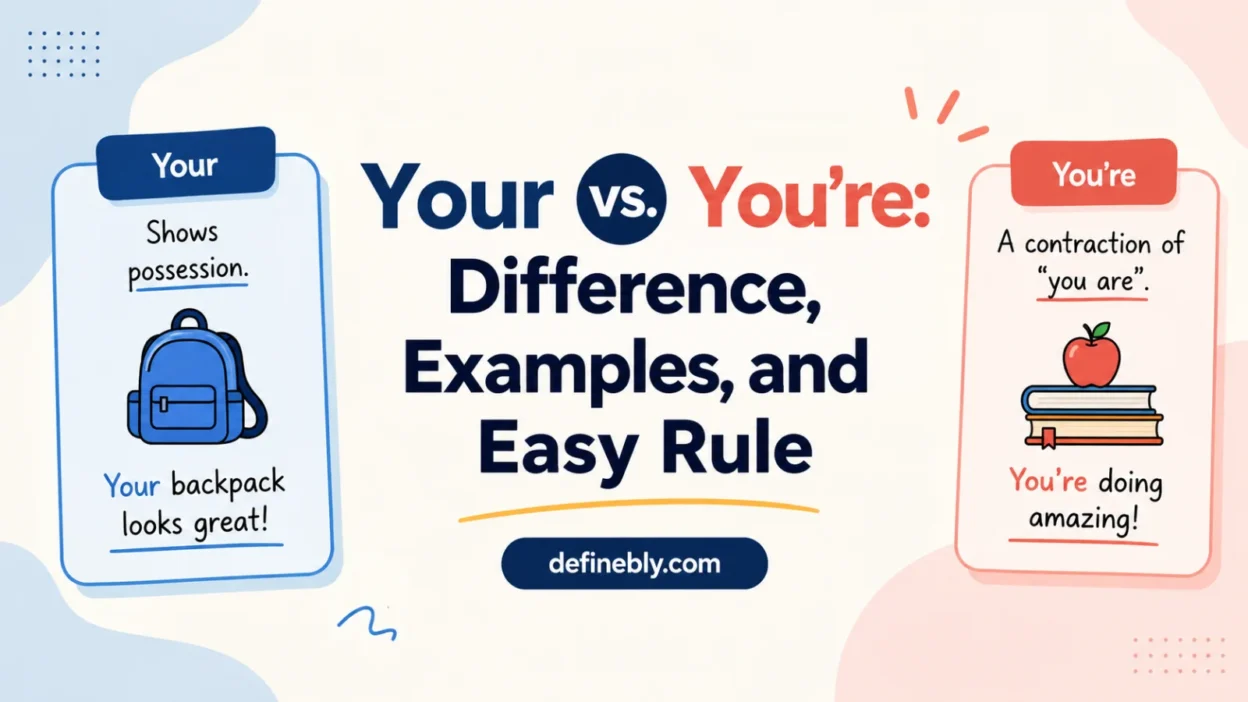
Your and you’re sound the same, but they do not mean the same thing.
Use your to show possession. Use you’re when you mean you are.
Correct:
- Is this your backpack?
- You’re going to love this movie.
The easiest rule is simple: your owns, and you’re means you are.
Quick Answer
Use your when something belongs to or relates to the person you are speaking to.
Correct:
- Your phone is ringing.
- I like your idea.
- Please bring your ID.
Use you’re when the sentence means you are.
Correct:
- You’re doing great.
- You’re invited to the meeting.
- You’re right about the deadline.
Try the you are test.
If you are fits, use you’re.
- You’re ready.
- You are ready.
If you are does not fit, use your.
- Your backpack is on the chair.
- You are backpack is on the chair.
That does not work, so your is correct.
Why People Confuse Them
Your and you’re are homophones.
Homophones sound the same but have different spellings and meanings.
When you say them out loud, your and you’re often sound identical. In writing, the spelling changes the meaning.
Compare:
- Your phone is ringing.
- You’re phone is ringing.
The first sentence is correct. The phone belongs to you.
The second sentence is wrong because it means:
- You are phone is ringing.
That does not make sense.
This mistake is common because both forms are real English words. A quick scan may miss the error, especially in texts, comments, captions, and emails.
Key Differences At A Glance
| Context | Best Choice | Why |
|---|---|---|
| Something belongs to you | your | It shows possession. |
| A noun comes right after the word | your | It often points to something you own or are connected to. |
| You mean you are | you’re | It is a contraction. |
| The sentence works with you are | you’re | The contraction expands correctly. |
| Before an adjective like ready or right | you’re | It usually means you are. |
| Before a noun like phone or idea | your | It usually shows whose noun it is. |
Meaning And Usage Difference
Your is used before a noun to show ownership, connection, or relationship.
Examples:
- Your jacket is on the chair.
- Your name is on the list.
- Your answer makes sense.
- Your appointment is at 3.
- Your dog is adorable.
In each sentence, your connects the noun to the person being addressed.
You’re is a contraction of you are.
Examples:
- You’re late for the meeting.
- You’re doing well.
- You’re the next speaker.
- You’re welcome to join us.
- You’re not on the schedule today.
In each sentence, you’re can be expanded to you are.
Example:
- You’re late for the meeting.
- You are late for the meeting.
The meaning stays the same.
Tone, Context, And Grammar
Your is a possessive determiner. That means it usually comes before a noun and tells whose thing, idea, role, or relationship it is.
Common patterns:
- your phone
- your car
- your email
- your homework
- your schedule
- your favorite song
- your next step
You’re is a contraction. It joins you and are into one word.
Common patterns:
- you’re ready
- you’re right
- you’re welcome
- you’re invited
- you’re going
- you’re doing well
The apostrophe in you’re does not show ownership. It replaces the missing a in are.
- you + are = you’re
In everyday writing, you’re is normal and natural.
In very formal writing, you are can sound more polished or more direct.
Casual:
- You’re required to check in by noon.
More formal:
- You are required to check in by noon.
Both are correct. The difference is tone.
Which One Should You Use?
Use your if the next word is something someone owns, has, uses, feels, does, or is connected to.
Correct:
- Please bring your ID.
- I read your message.
- What is your opinion?
- Your lunch is in the fridge.
- Your meeting starts soon.
Use you’re if the sentence means you are.
Correct:
- You’re on the list.
- You’re making progress.
- You’re the best person for the job.
- You’re going to need a password.
- You’re welcome to stay.
The best test is simple:
Replace the word with you are.
If the sentence still makes sense, use you’re.
Example:
- You’re ready.
- You are ready.
If the sentence does not make sense, use your.
Example:
- Your ready is on the table.
That is wrong because ready is not a thing you own in this sentence.
Correct:
- Your lunch is on the table.
When One Choice Sounds Wrong
Use you’re, not your, when the sentence means you are.
Incorrect:
- Your going to be late.
Correct:
- You’re going to be late.
Use your, not you’re, before a noun that belongs to or relates to someone.
Incorrect:
- I like you’re new haircut.
Correct:
- I like your new haircut.
Use you’re, not your, before adjectives that describe the person.
Incorrect:
- Your amazing.
Correct:
- You’re amazing.
Use you’re, not your, in the phrase you’re welcome.
Incorrect:
- Your welcome.
Correct:
- You’re welcome.
This means:
- You are welcome.
Use your, not you’re, in phrases like your turn, your choice, and your problem.
Incorrect:
- It is you’re turn.
Correct:
- It is your turn.
Common Mistakes And Quick Fixes
Using Your Instead Of You’re
Incorrect:
- Your going to love this.
- Your right about the price.
- Your not on the list.
- Your doing great.
Correct:
- You’re going to love this.
- You’re right about the price.
- You’re not on the list.
- You’re doing great.
Quick fix:
Replace the word with you are. If it works, use you’re.
Using You’re Instead Of Your
Incorrect:
- I found you’re keys.
- Is this you’re jacket?
- I like you’re idea.
- Please check you’re email.
Correct:
- I found your keys.
- Is this your jacket?
- I like your idea.
- Please check your email.
Quick fix:
Look at the next word. If it is a noun that belongs to or relates to someone, use your.
Forgetting The Apostrophe In You’re
Incorrect:
- Youre invited.
- Youre almost done.
- Youre welcome.
Correct:
- You’re invited.
- You’re almost done.
- You’re welcome.
The apostrophe matters because you’re is short for you are.
Using Your Welcome Instead Of You’re Welcome
Incorrect:
- Your welcome.
Correct:
- You’re welcome.
The phrase means:
- You are welcome.
It does not mean the welcome belongs to someone.
Trusting Sound Instead Of Meaning
These words sound alike, so reading aloud is not enough.
Wrong:
- Your doing a great job.
Right:
- You’re doing a great job.
The sentence means you are doing, so you’re is correct.
Everyday Examples
Your In Sentences
- Your email was helpful.
- Your order is ready.
- Your idea makes sense.
- Your dog is friendly.
- Your password expires today.
- Your appointment is tomorrow.
- Your camera is still on.
- Your answer was clear.
You’re In Sentences
- You’re helpful.
- You’re ready to order.
- You’re making sense now.
- You’re a friendly person.
- You’re doing better than you think.
- You’re invited to the event.
- You’re almost finished.
- You’re not required to attend.
Your And You’re In The Same Sentence
- Your email was clear, and you’re getting a response today.
- Your order is ready, but you’re missing one item.
- Your dog is friendly, and you’re clearly a patient owner.
- Your answer was correct, so you’re moving to the next round.
- Your phone is ringing because you’re getting a call.
Synonyms Or Closest Alternatives
Closest alternatives for your include:
- belonging to you
- owned by you
- connected to you
Example:
- Your car is outside.
- The car belonging to you is outside.
This replacement is not always smooth, but it helps test the meaning.
The closest alternative for you’re is:
- you are
Example:
- You’re right.
- You are right.
If you are works, you’re is correct.
Quick Proofreading Checklist
Before you publish, send, or submit a sentence with your or you’re, ask these questions:
- Does the word mean you are?
- Can I replace it with you are?
- Is the next word a noun?
- Does the sentence show possession?
- Is there an apostrophe if I mean you are?
Use you’re only when you are works.
Use your when the word shows possession or connection.
Quick Memory Fix Or Rule Of Thumb
Use this simple rule:
Your = belongs to you.
You’re = you are.
Memory examples:
- Your phone = the phone belongs to you.
- You’re late = you are late.
Another quick trick:
If you can replace the word with you are, choose you’re.
If you cannot, choose your.
FAQs
What is the difference between your and you’re?
Your shows possession or connection.
You’re means you are.
Examples:
- Is this your bag?
- You’re doing great.
When should I use your?
Use your when something belongs to or relates to the person you are speaking to.
Example:
- Your jacket is on the chair.
The jacket belongs to or is connected to that person.
When should I use you’re?
Use you’re when you mean you are.
Example:
- You’re going to love this song.
Expanded:
- You are going to love this song.
Is it your welcome or you’re welcome?
The correct phrase is you’re welcome.
It means:
- You are welcome.
Your welcome is usually incorrect unless you are talking about a welcome that belongs to someone, which is rare.
Is it your right or you’re right?
Usually, the correct phrase is you’re right.
Example:
- You’re right about the deadline.
This means:
- You are right about the deadline.
Use your right only when talking about a right that belongs to someone.
Example:
- Know your right to remain silent.
Is it your invited or you’re invited?
The correct phrase is you’re invited.
Example:
- You’re invited to the party.
This means:
- You are invited to the party.
Is it your going or you’re going?
The correct phrase is you’re going.
Example:
- You’re going to be late.
This means:
- You are going to be late.
Is your a contraction?
No. Your is not a contraction.
Your shows possession.
Example:
- Your shoes are by the door.
You’re is the contraction of you are.
Why does you’re have an apostrophe?
You’re has an apostrophe because it is short for you are.
The apostrophe replaces the missing letter in are.
- you + are = you’re
Do your and you’re sound the same?
Yes. In normal speech, your and you’re often sound the same.
That is why the mistake is common in writing. The best test is meaning, not sound.
Conclusion
Use your when something belongs to or relates to the person you are speaking to.
Use you’re when you mean you are.
The easiest memory rule is this: your owns; you’re means you are.