Which and that both introduce information about a noun.
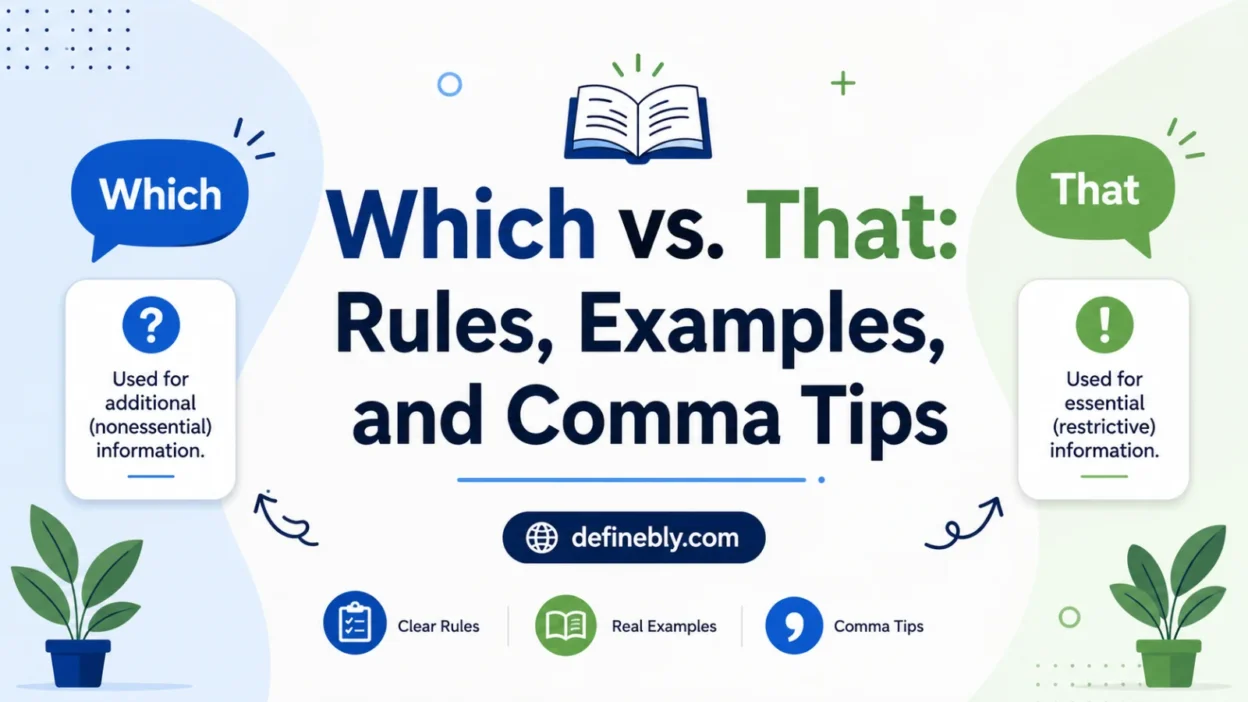
In edited American English, use that for essential information and which for extra information, usually with commas.
Correct:
- The laptop that I bought last year still works well.
- My laptop, which I bought last year, still works well.
The first sentence identifies the laptop. The second sentence adds extra detail about a laptop already identified.
Quick Answer
Use that when the information is necessary to identify the noun.
Example:
- The file that contains the invoice is on my desktop.
The clause that contains the invoice tells us which file.
Use which when the information is extra.
Example:
- The file, which contains the invoice, is on my desktop.
The clause which contains the invoice adds extra detail. The sentence still works without it:
- The file is on my desktop.
Simple rule:
- That defines.
- Which adds.
The Rule Explained
The difference depends on whether the clause is essential or extra.
An essential clause identifies, limits, or defines the noun. It tells readers exactly which person, place, thing, or idea you mean.
Use that for this kind of clause in edited American English.
Correct:
- The report that you sent yesterday needs one more chart.
The clause that you sent yesterday identifies which report.
An extra clause adds information that is helpful but not needed to identify the noun.
Use which with commas for this kind of clause.
Correct:
- The report, which you sent yesterday, needs one more chart.
The report is already clear. The which clause adds a side detail.
Here is the basic pattern:
| Type Of Information | Usual Word | Commas? | Example |
|---|---|---|---|
| Essential | that | No | The phone that rang was mine. |
| Extra | which | Yes | My phone, which rang twice, was on silent. |
In careful US writing, this distinction makes sentences clearer and prevents meaning problems.
When To Use It
Use That For Essential Information
Use that when the clause identifies the noun.
Correct:
- The shoes that are on sale are in the front row.
- The emails that arrived after midnight were marked urgent.
- The password that you sent me does not work.
- The restaurant that opened last month is already popular.
In each sentence, the that clause tells readers which noun you mean.
Without the clause, the meaning becomes too broad.
Example:
- The emails were marked urgent.
Which emails? The sentence no longer gives enough information.
Use That When The Clause Limits A Group
Use that when only part of a group is being described.
Correct:
- The students that submitted the form received a confirmation email.
- The books that are on the top shelf belong to my sister.
- The snacks that were gluten-free were placed on the side table.
These sentences do not refer to all students, all books, or all snacks. The that clause narrows the group.
Use Which For Extra Information
Use which when the noun is already clear and the clause adds a side detail.
Correct:
- My car, which needs new tires, is parked outside.
- Our office, which opened in 2021, is downtown.
- The report, which took three weeks to finish, was approved today.
- My phone, which rang twice, was on silent.
The sentence still makes sense if you remove the which clause.
Example:
- My car is parked outside.
- Our office is downtown.
- The report was approved today.
The extra detail may be useful, but it is not needed to identify the noun.
Use Commas Around Extra Which Clauses
A nonessential which clause should be set off with commas.
Correct:
- The presentation, which starts at 10, will be recorded.
- The jacket, which I left in the car, is still damp.
- The app, which I downloaded yesterday, already needs an update.
If the which clause appears in the middle of the sentence, use commas on both sides.
Correct:
- The project, which started in January, is almost finished.
If it appears at the end, use one comma before which.
Correct:
- We updated the policy, which caused some confusion.
Use Which Carefully When It Refers To A Whole Idea
Sometimes which can refer to the whole idea before it, not just one noun.
Correct:
- The deadline moved up, which surprised the team.
- She accepted the offer, which made her parents proud.
- The server went down, which delayed the launch.
In these sentences, which refers to the entire previous idea.
Do not use that in this structure.
Incorrect:
- The deadline moved up, that surprised the team.
Correct:
- The deadline moved up, which surprised the team.
When Not To Use It
Do Not Use Commas With Essential That Clauses
Do not place commas around a that clause when it identifies the noun.
Incorrect:
- The app, that tracks expenses, is free.
Correct:
- The app that tracks expenses is free.
The clause tells us which app.
Incorrect:
- The students, that submitted the form, received a confirmation email.
Correct:
- The students that submitted the form received a confirmation email.
The sentence refers only to students who submitted the form.
Do Not Use That For Extra Information Set Off By Commas
In edited American English, do not use that for nonessential information between commas.
Incorrect:
- My phone, that I bought yesterday, already needs charging.
Correct:
- My phone, which I bought yesterday, already needs charging.
The detail is extra, so which is the better choice.
Do Not Put Commas Around Which If The Clause Is Essential
A comma can change the meaning.
Incorrect if only some keys are meant:
- The keys, which are on the counter, are mine.
This suggests all the keys are on the counter.
Correct if only those keys are meant:
- The keys that are on the counter are mine.
The that clause identifies which keys.
Do Not Treat The Rule As The Same Everywhere
In strict edited American English, that is usually the safest choice for essential clauses.
However, you may see which used for essential information in other styles or varieties of English.
Example:
- The book which you recommended is on my desk.
This is understandable, and some writers accept it. For clear American writing, that is usually cleaner:
- The book that you recommended is on my desk.
Common Mistakes
Using Which Without Commas For Extra Information
Incorrect:
- My laptop which I use for work is almost five years old.
Correct:
- My laptop, which I use for work, is almost five years old.
The which clause adds extra detail about the laptop.
Using Commas With An Essential That Clause
Incorrect:
- The files, that were missing, have been restored.
Correct:
- The files that were missing have been restored.
The clause identifies which files.
Missing The Meaning Change
Compare these sentences:
- The snacks that were gluten-free were placed on the side table.
- The snacks, which were gluten-free, were placed on the side table.
The first sentence means only the gluten-free snacks were placed there.
The second sentence means all the snacks were gluten-free.
Another example:
- The cars that had expired permits were towed.
- The cars, which had expired permits, were towed.
The first sentence means only some cars were towed. The second suggests all the cars had expired permits.
Using Which When That Would Be Clearer In US Writing
Acceptable in some styles:
- The policy which changed last week affects new employees.
Cleaner in edited American English:
- The policy that changed last week affects new employees.
Use that when the clause is essential and you want the most standard US choice.
Using That Or Which For People When Who Is Better
For people, who is often the better choice.
Less natural:
- The employee that helped me was kind.
Better:
- The employee who helped me was kind.
Use that or which mainly for things, animals, groups, and ideas. Use who for people in most polished writing.
Correct Examples
| Sentence | Correct Word | Why |
|---|---|---|
| The files that were missing have been restored. | that | Identifies which files. |
| The files, which were missing yesterday, have been restored. | which | Adds extra detail. |
| The dog that barked all night lives next door. | that | Identifies which dog. |
| My dog, which rarely barks, woke me up. | which | Adds extra detail. |
| The movie that won the award is streaming now. | that | Identifies which movie. |
| The movie, which won the award, is streaming now. | which | Adds extra detail. |
| The laptop that has the sticker is mine. | that | Identifies the laptop. |
| My laptop, which has a sticker, is mine. | which | Adds extra detail. |
More examples:
- The jacket that I left in the car is still damp.
- My jacket, which I left in the car, is still damp.
- The restaurant that opened last month is already popular.
- The restaurant, which opened last month, is already popular.
- The password that you sent me does not work.
- The password, which you sent yesterday, does not work.
- The form that requires a signature is on top.
- The form, which requires a signature, is on top.
Quick Memory Fix Or Rule Of Thumb
Use this test:
Remove the clause and read the sentence again.
If the noun becomes unclear, the clause is essential. Use that.
Example:
- The car that needs gas is in the driveway.
Which car? The one that needs gas.
If the noun is still clear, the clause is extra. Use which with commas.
Example:
- My car, which needs gas, is in the driveway.
The noun my car is already clear.
Short memory trick:
That defines. Which adds.
FAQs
What is the difference between which and that?
That usually introduces essential information.
Which usually introduces extra information with commas.
Examples:
- The shirt that has a stain is in the laundry.
- My shirt, which has a stain, is in the laundry.
The first sentence identifies the shirt. The second adds extra detail.
When should I use that?
Use that when the information identifies or limits the noun.
Example:
- The house that has a red door is ours.
The clause tells us which house.
When should I use which?
Use which when the information is extra and not needed to identify the noun.
Example:
- Our house, which has a red door, is on the corner.
The clause adds extra detail.
Do I need a comma before which?
Use a comma before which when the which clause adds extra information.
Correct:
- My bike, which has a flat tire, is in the garage.
Do not use commas if the information is essential.
Do I need a comma before that?
Usually, no. Do not use a comma before that when it introduces essential information.
Correct:
- The bike that has a flat tire is in the garage.
A comma before that is rare and usually belongs to another sentence structure, not to an essential relative clause.
Can which be used instead of that?
Sometimes, yes. Which can appear in essential clauses in some styles.
Example:
- The book which you recommended is on my desk.
For clear edited American English, that is usually the safer choice:
- The book that you recommended is on my desk.
Can that be used instead of which?
Not when the clause is nonessential and set off by commas.
Incorrect:
- My car, that is parked outside, needs gas.
Correct:
- My car, which is parked outside, needs gas.
Use which for extra information with commas.
How can I tell if the clause is essential?
Remove the clause and read the sentence.
If the noun becomes unclear, the clause is essential. Use that.
If the noun is still clear, the clause is extra. Use which with commas.
Which is correct: “the one that” or “the one which”?
In edited American English, the one that is usually cleaner when the clause identifies the noun.
Correct:
- Choose the one that fits best.
You may see the one which in some contexts, but the one that sounds more natural in most US writing.
Should I use which or that for people?
Use who for people in most polished writing.
Better:
- The teacher who helped me was patient.
Use that mainly for things, animals, groups, and ideas. Use which for extra information about things, animals, groups, or ideas.
Conclusion
Use that for essential information. Use which for extra information, usually with commas.
The key question is whether the clause identifies the noun or simply adds detail.
If the information defines the noun, use that. If the information adds a side note, use which with commas.
Remember the simple rule: that defines, which adds.