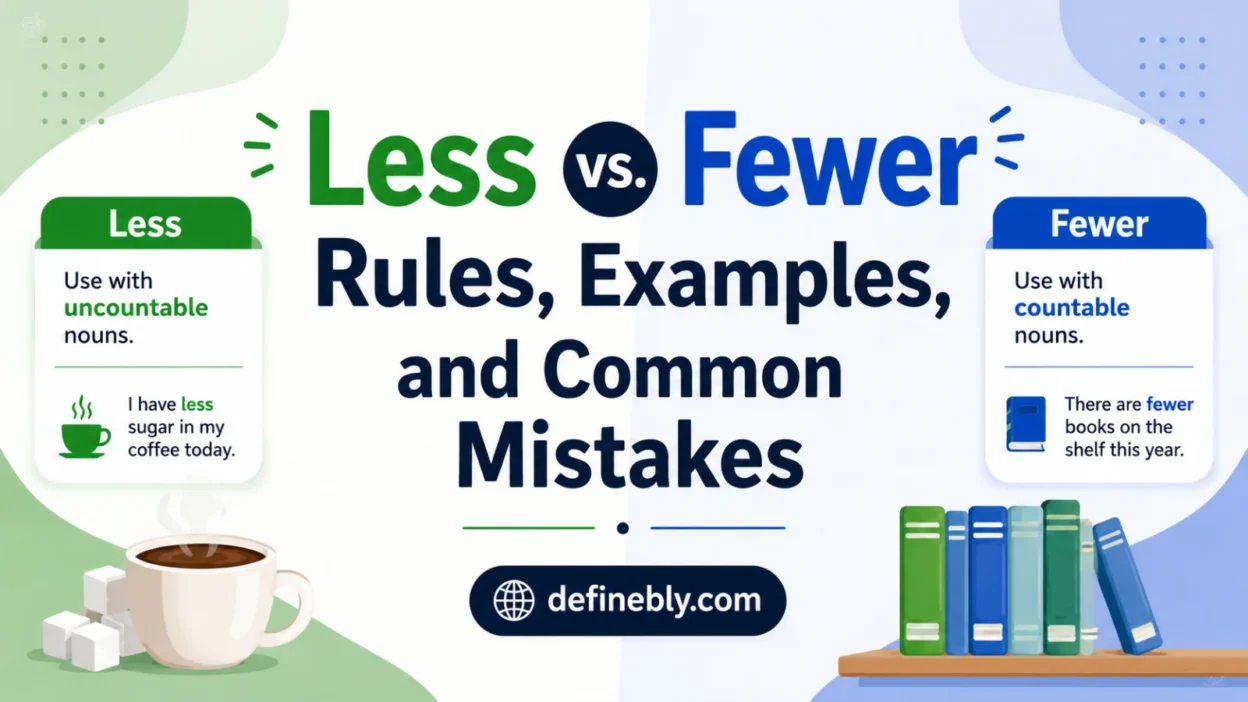
Less and fewer both point to a smaller amount, but they are not used the same way.
Use fewer when you mean a smaller number of separate things you can count.
Use less when you mean a smaller amount, degree, or measured total.
Correct:
- We had fewer meetings this week.
- We had less work this week.
The short rule is simple: fewer for countable things, less for amounts.
Quick Answer
Use fewer with countable plural nouns.
Examples:
- fewer books
- fewer emails
- fewer cars
- fewer mistakes
- fewer students
Use less with uncountable nouns, amounts, measurements, and degree.
Examples:
- less water
- less money
- less time
- less traffic
- less stress
Quick comparison:
| Use | Correct Word | Example |
|---|---|---|
| Countable Plural Noun | fewer | fewer problems |
| Uncountable Noun | less | less noise |
| Amount Or Degree | less | less expensive |
| Individual Items | fewer | fewer tickets |
| Measured Total | less | less than two hours |
The most practical rule is this: use fewer when you count the items one by one; use less when you measure the amount as a whole.
The Rule Explained
Fewer goes with plural countable nouns. These are things you can count separately.
Correct:
- fewer chairs
- fewer calls
- fewer applicants
- fewer errors
- fewer assignments
You can count them:
- one chair
- two chairs
- three chairs
Less goes with uncountable nouns. These are usually measured as an amount, not counted one by one.
Correct:
- less coffee
- less patience
- less information
- less traffic
- less homework
You do not normally say:
- one traffic
- two traffics
- three traffics
That is why less traffic is correct.
Compare:
- There were fewer cars on the road.
- There was less traffic on the road.
You can count cars. You measure traffic as an amount.
When To Use It
Use Fewer With Countable Plural Nouns
Use fewer when the noun names separate people, places, things, or ideas.
Correct:
- Fewer students signed up this year.
- The store sold fewer laptops in April.
- We made fewer mistakes this time.
- The team received fewer complaints.
- There are fewer cars in the parking lot.
Each noun is countable:
- students
- laptops
- mistakes
- complaints
- cars
If you can place a number directly before the noun, fewer is usually the right choice.
Examples:
- five students → fewer students
- ten laptops → fewer laptops
- three mistakes → fewer mistakes
Use Less With Uncountable Nouns
Use less when the noun names something treated as a mass, amount, or general quantity.
Correct:
- I need less sugar in my coffee.
- She has less patience today.
- We had less homework over the weekend.
- The room needs less noise.
- The project created less stress than expected.
These nouns are not usually counted as separate units in this context.
You may count packets of sugar, assignments, or noise complaints, but not sugar, homework, or noise as general amounts.
Use Less For Degree Or Intensity
Use less when comparing how strong, intense, expensive, stressful, or difficult something is.
Correct:
- This route is less stressful.
- The second option is less expensive.
- The instructions are less confusing now.
- Today feels less busy than yesterday.
- The new process is less complicated.
Here, you are not counting separate things. You are comparing degree.
Use Less With Money, Time, Distance, And Weight As Measured Totals
Use less when the sentence treats money, time, distance, or weight as one total amount.
Correct:
- The repair cost less than $100.
- The meeting lasted less than an hour.
- The trail is less than three miles long.
- The package weighs less than five pounds.
- The movie is less than two hours long.
Dollars, hours, miles, and pounds can be counted, but these sentences treat the amount as a single measurement.
That is why less sounds natural and standard.
Use Fewer When Counting Separate Units Of Time, Money, Or Measurement
Use fewer when you clearly mean separate countable units.
Correct:
- This month has fewer workdays than last month.
- I have fewer one-dollar bills in my wallet now.
- The recipe uses fewer cups of flour than the old one.
- The schedule has fewer ten-minute breaks.
Here, the sentence counts individual units.
Compare:
- The meeting took less than 30 minutes.
- This week had fewer meeting minutes than last week.
The first sentence refers to one duration. The second refers to countable recorded minutes.
When Not To Use It
Do Not Use Less With Clearly Countable Plural Nouns In Careful Writing
Incorrect:
- There were less people at the meeting.
Correct:
- There were fewer people at the meeting.
People can be counted, so fewer is the careful choice.
More examples:
Incorrect:
- We had less customers today.
Correct:
- We had fewer customers today.
Incorrect:
- The report had less errors.
Correct:
- The report had fewer errors.
Do Not Use Fewer With Uncountable Nouns
Incorrect:
- I have fewer patience today.
Correct:
- I have less patience today.
Incorrect:
- She wants fewer homework.
Correct:
- She wants less homework.
Incorrect:
- The room has fewer light.
Correct:
- The room has less light.
These nouns are treated as amounts, not separate items.
Do Not Overcorrect Measurement Phrases
Some writers use fewer anytime a number appears. That can sound awkward or wrong.
Awkward:
- The movie is fewer than two hours long.
Correct:
- The movie is less than two hours long.
Awkward:
- The repair cost fewer than $50.
Correct:
- The repair cost less than $50.
Awkward:
- The trail is fewer than four miles.
Correct:
- The trail is less than four miles.
These are measured totals, so less is the natural choice.
Common Mistakes
Using Less With Countable People Or Things
Incorrect:
- We had less guests than expected.
Correct:
- We had fewer guests than expected.
Guests can be counted.
Incorrect:
- There are less seats available.
Correct:
- There are fewer seats available.
Seats can be counted.
Using Fewer With Amounts
Incorrect:
- I need fewer coffee today.
Correct:
- I need less coffee today.
Coffee is treated as an amount.
Incorrect:
- There was fewer traffic this morning.
Correct:
- There was less traffic this morning.
Traffic is treated as an amount.
Misusing Less Than And Fewer Than
Use fewer than with countable plural nouns.
Correct:
- Fewer than ten students were absent.
- Fewer than five tickets remain.
- Fewer than three employees joined the call.
Use less than with amounts, measurements, and degree.
Correct:
- The repair took less than an hour.
- The jacket costs less than $50.
- The package weighs less than two pounds.
Overcorrecting 10 Items Or Less
Strictly, 10 items or fewer follows the countable-noun rule because items can be counted.
Careful writing:
- 10 items or fewer
Everyday sign:
- 10 items or less
The second version is common on store signs and in casual speech. In formal writing, fewer is the safer choice.
Forgetting That Some Nouns Change By Context
Some nouns can be countable or uncountable depending on meaning.
Coffee as an amount:
- I drank less coffee this week.
Coffee as separate cups or types:
- We ordered fewer coffees than usual.
Chicken as food:
- I ate less chicken this month.
Chickens as animals:
- The farm has fewer chickens now.
Experience as general knowledge:
- She has less experience than the other candidate.
Experiences as separate events:
- The trip gave us fewer memorable experiences than expected.
Correct Examples
| Sentence | Correct Word | Why |
|---|---|---|
| We need fewer chairs. | fewer | Chairs can be counted. |
| I need less coffee. | less | Coffee is an amount. |
| Fewer people attended this year. | fewer | People can be counted. |
| She has less free time now. | less | Time is an amount. |
| The test had fewer questions. | fewer | Questions can be counted. |
| The room had less light. | less | Light is an amount. |
| The trip took less than a week. | less | A week is treated as one span of time. |
| This month has fewer workdays. | fewer | Workdays are countable units. |
More examples:
- There are fewer cars in the parking lot.
- There is less space in the closet.
- We made fewer mistakes this time.
- I feel less pressure now.
- The project took less than a week.
- The store received fewer online orders.
- The new plan uses less energy.
- We had fewer delays after the update.
- She spent less money this month.
- The team handled fewer support tickets today.
Quick Memory Fix Or Rule Of Thumb
Use this simple test:
Can you count the noun one by one? Use fewer.
Examples:
- fewer books
- fewer calls
- fewer students
- fewer tasks
Do you measure it as an amount? Use less.
Examples:
- less water
- less money
- less time
- less work
Shortest memory trick:
Fewer = number. Less = amount.
Also remember:
- Fewer cars
- Less traffic
- Fewer tasks
- Less work
- Fewer dollars in my wallet
- Less than $20 total
FAQs
What is the difference between less and fewer?
Fewer is used with countable plural nouns.
Example:
- fewer emails
Less is used with uncountable nouns, amounts, measurements, or degree.
Example:
- less work
When should I use fewer?
Use fewer when you are talking about things you can count one by one.
Example:
- We had fewer guests than expected.
Guests can be counted.
When should I use less?
Use less when you are talking about an amount, quantity, degree, or measured total.
Example:
- I need less noise while I study.
Noise is treated as an amount.
Is it less people or fewer people?
The standard choice is fewer people.
Correct:
- Fewer people came to the event this year.
People can be counted, so fewer is the careful choice.
Is it less money or fewer money?
The correct phrase is less money.
Correct:
- I spent less money this month.
Money is treated as an amount in this sentence.
Is it less time or fewer time?
The correct phrase is less time.
Correct:
- We have less time than we expected.
Use fewer only when counting separate time units.
Correct:
- This month has fewer workdays.
Is it less calories or fewer calories?
The careful choice is fewer calories because calories can be counted.
Correct:
- This snack has fewer calories.
In casual speech, people sometimes say less calories, but fewer calories is better in edited writing.
Is it less than or fewer than?
Use fewer than with countable plural nouns.
Example:
- Fewer than ten students were absent.
Use less than with amounts, measurements, and degree.
Example:
- The repair took less than an hour.
Is “10 items or less” wrong?
In strict grammar, 10 items or fewer is more precise because items are countable.
Still, 10 items or less is common on store signs and in everyday speech.
For formal writing, use fewer.
Do I use less or fewer with percentages?
Use the word that matches what the percentage refers to.
Correct:
- Less than 50% of the water was used.
Water is an amount.
Correct:
- Fewer than 50% of the students passed.
Students are countable people.
Conclusion
Use fewer for separate things you can count. Use less for amounts, measurements, and degree.
The basic rule is easy:
- fewer cars
- less traffic
- fewer tasks
- less work
When in doubt, ask whether you are counting separate items or measuring one amount. If you are counting, choose fewer. If you are measuring, choose less.