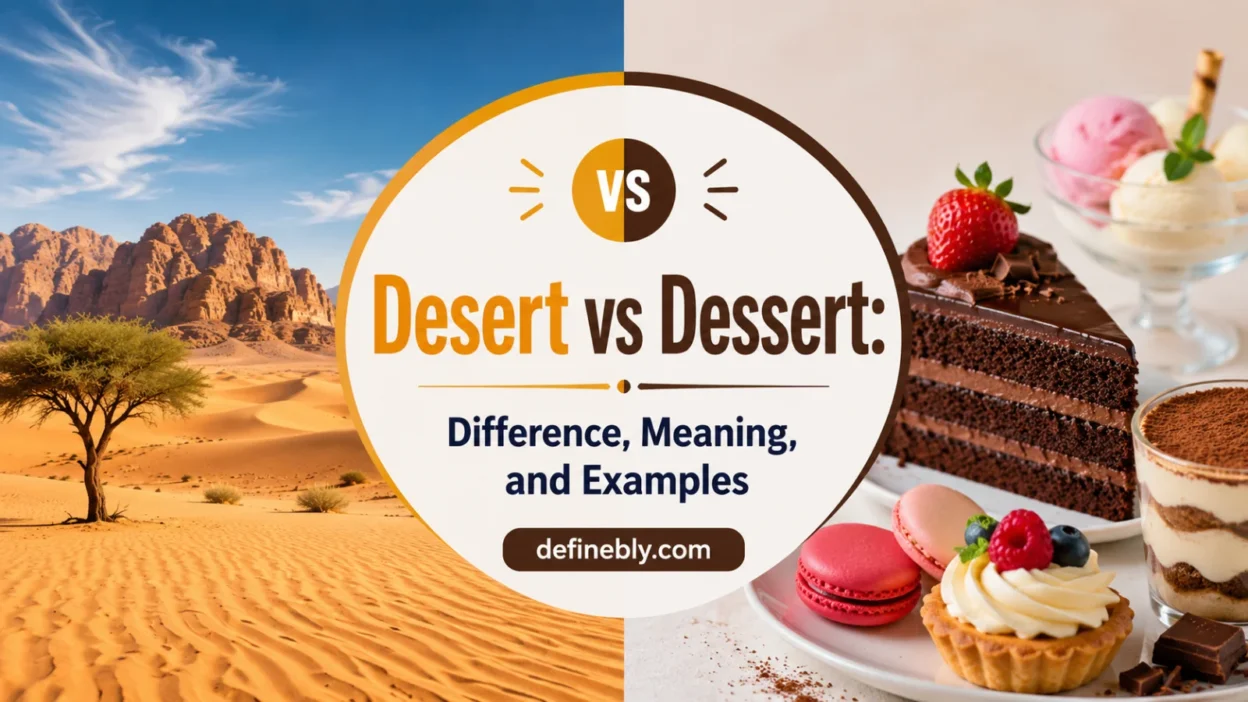
Desert vs. Dessert: What’s the Difference?
Desert and dessert have different meanings, even though they look and sound similar. Desert can mean a dry region with little rainfall or the act of abandoning someone or something. Dessert means a sweet dish usually served at the end of a meal.
Use desert when talking about dry land or leaving someone behind. Use dessert when talking about cake, ice cream, pie, or another sweet treat.
Examples:
- The travelers crossed the desert in the afternoon.
- A loyal friend would never desert you.
- We had chocolate cake for dessert.
- She ordered ice cream for dessert.
The easiest way to remember the difference is that dessert has two S’s because you might want seconds.
Desert vs. Dessert: Quick Answer
| Word | Meaning | Part of Speech | Pronunciation | Example |
|---|---|---|---|---|
| Desert | A dry region with little rainfall | Noun | DEH-zert | The desert gets very little rain. |
| Desert | To abandon or leave behind | Verb | dih-ZURT | He would never desert his friends. |
| Desert | Related to a desert | Adjective | DEH-zert | Desert plants need little water. |
| Dessert | A sweet dish served after a meal | Noun | dih-ZURT | We ordered dessert after dinner. |
The main spelling difference is one letter: desert has one s, while dessert has two. Their pronunciation also changes depending on the meaning of desert.
What Does Desert Mean?
The word desert has several meanings. It can refer to a dry geographical region, the act of abandoning someone or something, or something associated with a desert.
Desert as a Noun
As a noun, desert refers to a region that receives very little precipitation and generally has sparse vegetation. Deserts are not always hot or covered in sand; some are cold and rocky.
Examples of desert as a noun:
- The Sahara is one of the world’s best-known deserts.
- The hikers carried extra water across the desert.
- Cacti and other specially adapted plants can survive in the desert.
- The Mojave Desert is located in the southwestern United States.
- Some desert regions experience cold temperatures at night.
In this meaning, desert is pronounced DEH-zert, with the stress on the first syllable.
Desert as a Verb
As a verb, desert means to abandon, leave, or withdraw from someone, a place, or a responsibility. It can suggest leaving when support or loyalty is expected.
Examples of desert as a verb:
- He refused to desert his teammates during the difficult match.
- The soldier was accused of deserting his post.
- She felt that her friends had deserted her.
- The captain would not desert the ship in an emergency.
- They promised not to desert the project when problems arose.
When desert means to abandon, it is pronounced dih-ZURT, with the stress on the second syllable.
Desert as an Adjective
Desert can also function as an adjective meaning related to a desert.
Examples:
- Desert plants often have adaptations that help them conserve water.
- The researchers studied desert wildlife.
- They traveled along a desert road.
The adjective is pronounced like the noun referring to dry land: DEH-zert.
The expression desert island is also common. It generally means an uninhabited island, not necessarily an island covered in dry sand.
What Does Dessert Mean?
Dessert is a noun that usually refers to a sweet dish served at the end of a meal. Common desserts include cake, pie, cookies, pudding, ice cream, and other sweet treats.
In everyday American English, dessert is the standard word for the sweet course after lunch or dinner.
Examples of dessert in sentences:
- We saved room for dessert.
- Apple pie is my favorite dessert.
- The restaurant offers several homemade desserts.
- She ordered chocolate cake for dessert.
- They served coffee with dessert.
- The children chose ice cream for dessert.
Dessert is pronounced dih-ZURT, with the stress on the second syllable. It sounds like the verb desert, meaning to abandon someone, but it does not sound like the noun desert, meaning dry land.
Desert vs. Dessert: Pronunciation Differences
Pronunciation is one of the most useful ways to distinguish these words when speaking.
| Word | Meaning | Pronunciation | Stressed Syllable |
|---|---|---|---|
| Desert | Dry land | DEH-zert | First |
| Desert | To abandon | dih-ZURT | Second |
| Dessert | Sweet food | dih-ZURT | Second |
Notice that dessert and the verb desert have the same usual pronunciation. The noun desert, meaning a dry region, has a different stress pattern.
Examples:
- DEH-zert: The desert was hot and dry.
- dih-ZURT: Never desert your friends.
- dih-ZURT: We ate dessert after dinner.
Understanding the context is important because pronunciation alone cannot distinguish dessert from desert when desert is used as a verb.
How to Remember Desert vs. Dessert
If you often confuse desert and dessert, these simple spelling tricks can help.
1. Dessert Has Two S’s for Seconds
The word dessert has two S’s because you might want seconds after tasting something sweet.
Think of cake, cookies, or ice cream when you see the double S.
2. Desert Has One S for Sand
The noun desert has one S. You can associate it with sand, dry land, and a lack of rainfall.
This is a memory trick, not a formal spelling rule, but it makes the distinction easier to remember.
3. Remember the Meaning Before You Write
Ask yourself what you want to say:
- Talking about dry land? Use desert.
- Talking about abandoning someone? Use desert.
- Talking about a sweet dish? Use dessert.
Quick memory rule: One S for the dry desert; two S’s for sweet dessert.
Desert vs. Dessert in Sentences
Seeing both words in context makes the difference easier to understand.
Examples Using Desert for Dry Land
- The cactus grows in the desert.
- We drove through the desert at sunrise.
- The desert air was hot and dry.
- Several animals have adapted to desert conditions.
- The researchers studied plants native to the desert.
Examples Using Desert to Mean Abandon
- Please do not desert your friends when they need help.
- The soldier was punished for deserting his post.
- He felt that his coworkers had deserted him.
- The captain refused to desert the crew.
- She would never desert her responsibilities.
Examples Using Dessert for Sweet Food
- We ordered cheesecake for dessert.
- The children wanted ice cream for dessert.
- She baked cookies for dessert.
- The restaurant serves chocolate cake and other desserts.
- They shared a slice of pie after dinner.
These examples show that the correct spelling depends on meaning, not simply on how the word sounds.
Common Mistakes With Desert and Dessert
Mistake 1: Using Dessert for a Dry Region
Incorrect: We traveled across the hot dessert.
Correct: We traveled across the hot desert.
Use desert when referring to a dry geographical region.
Mistake 2: Using Desert for Sweet Food
Incorrect: I saved room for desert.
Correct: I saved room for dessert.
Remember the double S in dessert when referring to a sweet dish.
Mistake 3: Writing Dessert When You Mean to Abandon Someone
Incorrect: He would never dessert his teammates.
Correct: He would never desert his teammates.
The verb desert means to abandon or leave behind. Dessert refers to sweet food.
Mistake 4: Confusing Desert With Its Verb Pronunciation
The noun desert is pronounced DEH-zert, while the verb desert is pronounced dih-ZURT.
For example:
- The desert was vast and dry.
- He refused to desert his friends.
The spelling stays the same, but the pronunciation and meaning change.
Just Deserts or Just Desserts?
The correct traditional expression is just deserts, not just desserts.
Just deserts means the outcome or treatment someone deserves, often a punishment or negative consequence resulting from their actions.
Examples:
- The dishonest salesman finally got his just deserts.
- After repeatedly cheating, he received his just deserts.
- The villain got her just deserts at the end of the story.
This phrase is confusing because deserts in this expression is pronounced like desserts. It comes from an older use of desert meaning what someone deserves, rather than from the word for sweet food.
Although just desserts sometimes appears as a playful spelling or pun, just deserts is the established expression when you mean a deserved outcome.
Desert, Dessert, Deserts, and Desserts: What Is the Difference?
Adding an ending can change a word’s meaning or grammatical function.
| Word | Meaning | Example |
|---|---|---|
| Desert | A dry region or to abandon | The desert is dry. |
| Deserts | More than one dry region | The world has hot and cold deserts. |
| Dessert | A sweet dish served after a meal | We ordered dessert. |
| Desserts | More than one sweet dish | The bakery sells several desserts. |
| Deserted | Abandoned or empty | The streets looked deserted. |
| Deserter | Someone who abandons a duty or post | The deserter left his assigned position. |
| Just deserts | The outcome someone deserves | The fraudster got his just deserts. |
The plural deserts can also appear in the expression just deserts. Its meaning depends on context.
Desert vs. Dessert: Practice Quiz
Choose the correct word to complete each sentence.
- We had chocolate cake for ______.
- The travelers crossed the ______ in the afternoon.
- A loyal friend would never ______ you.
- The restaurant serves several homemade ______.
- The dishonest man finally got his just ______.
- The old town looked ______ after everyone moved away.
Answers and Explanations
- Dessert — Chocolate cake is a sweet dish.
- Desert — The sentence refers to a dry region.
- Desert — Here, the verb means to abandon someone.
- Desserts — This is the plural of dessert.
- Deserts — The established expression is just deserts.
- Deserted — This means empty or abandoned.
Frequently Asked Questions
Is It Desert or Dessert After Dinner?
Use dessert after dinner. It refers to a sweet dish, such as cake, pie, cookies, or ice cream.
Example: We had brownies for dessert.
Does Dessert Have One S or Two?
Dessert has two S’s. A helpful memory trick is that you might want seconds of dessert.
Does Desert Have One S or Two?
Desert has one S when it refers to dry land or means to abandon someone. The word deserted also has one S.
Why Do Desert and Dessert Sound Similar?
The words are pronounced differently depending on their meaning. The noun desert, meaning dry land, is usually pronounced DEH-zert. Dessert and the verb desert are usually pronounced dih-ZURT.
Is It “Just Deserts” or “Just Desserts”?
The established expression is just deserts. It means receiving the outcome or treatment one deserves. The word is pronounced like desserts, but its spelling and origin are different.
What Is the Plural of Dessert?
The plural of dessert is desserts.
Example: The bakery sells cakes, pies, and other desserts.
What Is the Plural of Desert?
The plural of the noun desert, meaning a dry region, is deserts.
Example: Some deserts are hot, while others are cold.
What Does Desert Island Mean?
A desert island generally means an uninhabited island. The phrase does not necessarily mean the island is dry, sandy, or covered in desert terrain.
Can Desert Be a Verb?
Yes. Desert means to abandon or leave someone or something behind.
Example: He refused to desert his team during a difficult time.
Key Takeaways
- Desert means a dry region, or it can mean to abandon someone or something.
- Dessert means a sweet dish usually served after a meal.
- The noun desert is pronounced DEH-zert; dessert and the verb desert are pronounced dih-ZURT.
- Remember that dessert has two S’s because you might want seconds.
- The correct expression is just deserts, meaning the outcome someone deserves.
Conclusion
The difference between desert and dessert comes down to spelling, pronunciation, and meaning. Use desert for dry land or the act of abandoning someone. Use dessert for sweet food served after a meal.
When you are unsure, remember the simple rule: desert has one S, while dessert has two S’s for seconds. This small spelling trick can help you choose the correct word in everyday American English.
Desert means a dry region with little rain, or it can mean to leave someone or something behind. Dessert means a sweet course usually served after a meal.
Use desert for land or abandonment:
- The camel crossed the desert.
- Do not desert your team.
Use dessert for sweet food:
- We had brownies for dessert.
- She ordered ice cream for dessert.
The easiest spelling trick is this: dessert has two s’s because many people want seconds.
Quick Answer: Desert Vs. Dessert
| Word | Meaning | Part Of Speech | Pronunciation | Example |
|---|---|---|---|---|
| Desert | A dry region with little rain | Noun | DEH-zert | The Sahara is a famous desert. |
| Desert | To abandon or leave behind | Verb | dih-ZURT | He would never desert his friends. |
| Dessert | A sweet course after a meal | Noun | dih-ZURT | We shared cake for dessert. |
What Does Desert Mean?
Desert has more than one meaning, which is why it causes confusion.
Desert As A Noun
As a noun, desert means a dry, barren area with little rainfall and sparse vegetation. Merriam-Webster lists related meanings such as barren land, wasteland, and wilderness.
Examples:
- The hikers carried extra water through the desert.
- Many plants cannot survive in the desert.
- The Mojave Desert covers parts of the southwestern United States.
Desert As A Verb
As a verb, desert means to abandon, leave, or withdraw from someone or something, often when loyalty or responsibility is expected. Merriam-Webster notes that desert is close to abandon and forsake, but it often implies leaving something weakened by your absence.
Examples:
- Do not desert your family during a crisis.
- The soldier was accused of deserting his post.
- She felt deserted after everyone left.
Desert As An Adjective
Desert can also describe something related to a desert or something uninhabited.
Examples:
- Desert plants need little water.
- They filmed the scene on a desert road.
- A desert island is not always sandy; it means an uninhabited island.
What Does Dessert Mean?
Dessert is a noun. It usually means a sweet course or dish served at the end of a meal, such as cake, pie, cookies, pudding, ice cream, or fruit. Merriam-Webster defines dessert as a usually sweet course or dish served at the end of a meal.
Examples:
- We saved room for dessert.
- The restaurant has a separate dessert menu.
- Apple pie is my favorite dessert.
- They served coffee with dessert.
In everyday US English, dessert almost always refers to sweet food.
Pronunciation Difference Between Desert And Dessert
The pronunciation depends on meaning.
| Word | Meaning | Pronunciation | Stress |
|---|---|---|---|
| desert | dry land | DEH-zert | First syllable |
| desert | to abandon | dih-ZURT | Second syllable |
| dessert | sweet food | dih-ZURT | Second syllable |
This is why the words are easy to mix up. Dessert sounds like the verb desert, not like the noun desert. Grammar Monster and LanguageTool both highlight this pronunciation difference.
Examples:
- DEH-zert: The desert was dry and hot.
- dih-ZURT: Do not desert your post.
- dih-ZURT: We ate dessert after dinner.
How To Remember Desert Vs. Dessert
Use these memory tricks:
- Dessert has two s’s because you may want seconds.
- Dessert has two s’s for sweet stuff.
- Desert has one s because it is dry and empty.
- Desert has one s like sand.
The best quick rule is simple:
If you mean sweet food, use dessert.
If you mean dry land or abandon, use desert.
Desert Vs. Dessert In Sentences
Use Desert For Dry Land
- The cactus grows in the desert.
- We drove through the desert at sunrise.
- The desert air felt hot and dry.
- Camels can survive harsh desert conditions.
Use Desert For Abandoning
- Please do not desert your friends.
- The captain refused to desert the ship.
- He deserted the group when the work became difficult.
- No one wanted to feel deserted.
Use Dessert For Sweet Food
- We ordered cheesecake for dessert.
- The kids wanted ice cream for dessert.
- She brought cookies for dessert.
- The dessert table had brownies, cupcakes, and pie.
Common Mistakes With Desert And Dessert
Mistake 1: Using Dessert For A Dry Place
Incorrect: We crossed the hot dessert.
Correct: We crossed the hot desert.
Mistake 2: Using Desert For Sweet Food
Incorrect: I saved room for desert.
Correct: I saved room for dessert.
Mistake 3: Misspelling Just Deserts
Incorrect: The cheater got his just desserts.
Correct: The cheater got his just deserts.
Mistake 4: Forgetting Desert Can Be A Verb
Incorrect: He did not want to dessert his team.
Correct: He did not want to desert his team.
Just Deserts Or Just Desserts?
The correct phrase is just deserts, not just desserts.
Just deserts means the punishment or outcome someone deserves. It is usually used when someone receives a fair negative consequence.
Examples:
- The scammer finally got his just deserts.
- After lying to everyone, he received his just deserts.
- The villain got her just deserts at the end of the story.
This phrase is confusing because deserts is spelled like desert but pronounced like desserts. Merriam-Webster explains that this phrase uses an older noun form related to what someone deserves, not the sweet food word.
Deserts, Desserts, Deserted, And Deserter
These related forms are also easy to confuse.
| Word | Meaning | Example |
|---|---|---|
| deserts | plural of desert; dry regions | Many deserts are cold at night. |
| deserts | what someone deserves, mostly in “just deserts” | The thief got his just deserts. |
| desserts | plural of dessert | The bakery sells many desserts. |
| deserted | abandoned or empty | The street looked deserted. |
| deserter | someone who abandons a duty, group, or military post | The army searched for the deserter. |
Fast Decision Test
Ask yourself what the sentence is about.
| Sentence Meaning | Correct Word |
|---|---|
| Dry land, sand, heat, little rain | desert |
| Leaving someone behind | desert |
| Abandoning a duty or post | desert |
| Cake, pie, ice cream, cookies, pudding | dessert |
| Sweet food after a meal | dessert |
| Deserved punishment | just deserts |
Practice Quiz: Desert Or Dessert?
Choose the correct word.
- We had chocolate cake for ______.
- The travelers got lost in the ______.
- A loyal friend would not ______ you.
- The restaurant is known for its homemade ______.
- The villain finally got his just ______.
- The old town looked ______ after the storm.
Answers:
- dessert
- desert
- desert
- desserts
- deserts
- deserted
FAQ
Is it desert or dessert after dinner?
Use dessert after dinner. Dessert means a sweet course or treat, such as cake, pie, cookies, pudding, or ice cream.
Does dessert have one s or two?
Dessert has two s’s. Remember: you might want seconds of dessert.
Does desert have one s or two?
Desert has one s when it means a dry place or the act of abandoning someone.
Why do desert and dessert sound alike?
They can sound alike because dessert and the verb desert are both stressed on the second syllable: dih-ZURT. The noun desert, meaning dry land, is usually pronounced DEH-zert.
Is just deserts spelled like the food dessert?
No. The correct phrase is just deserts. It means someone received what they deserved, usually a fair punishment.
What is the plural of dessert?
The plural of dessert is desserts.
Example: The bakery sells cakes, pies, and other desserts.
What is the plural of desert?
The plural of desert is deserts.
Example: Some deserts are extremely hot, while others are cold.
Is desert island related to desert sand?
Not always. A desert island means an uninhabited island. It does not have to be a sandy desert. Merriam-Webster explains that the desert in desert island comes from the idea of being deserted or uninhabited.
Conclusion
The difference between desert and dessert comes down to spelling, pronunciation, and meaning. Use desert for dry land or the act of abandoning someone. Use dessert for sweet food served after a meal.
When you are unsure, remember the simple rule: desert has one S, while dessert has two S’s for seconds. This small spelling trick can help you choose the correct word in everyday American English.