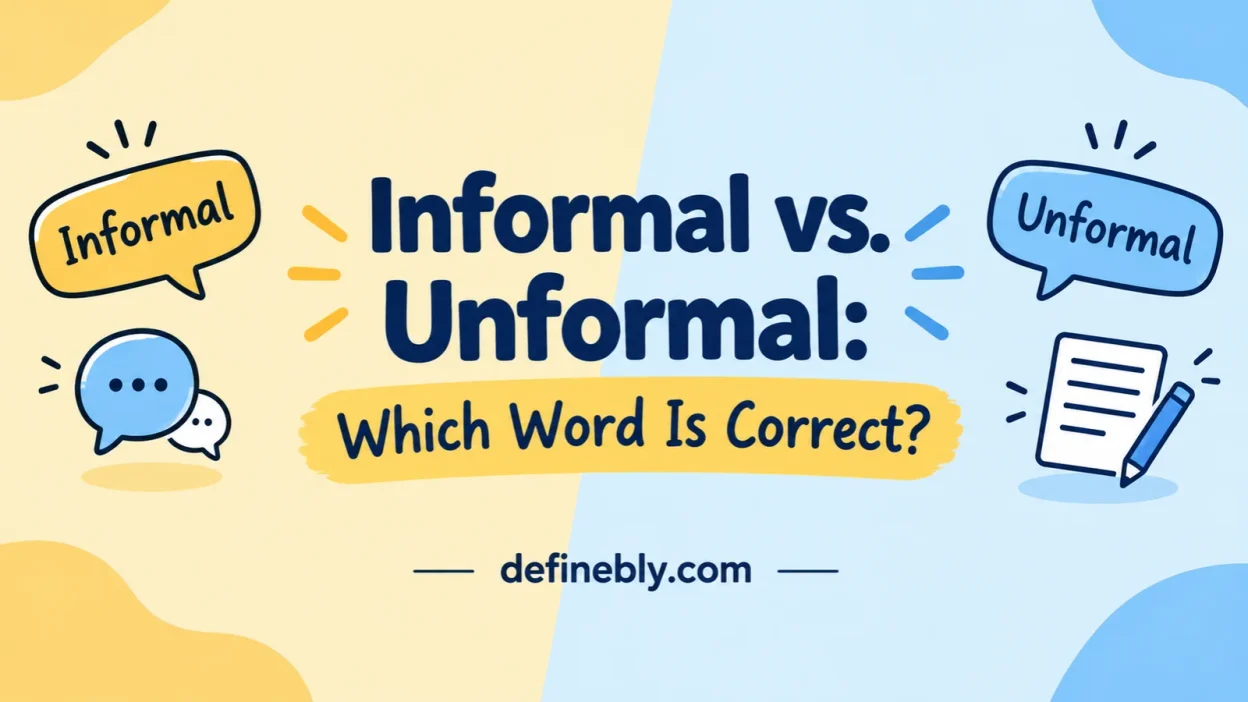
Informal is the standard word in modern English when you mean casual, relaxed, or not formal. Unformal is rare and is not the usual choice in standard American English. If you are writing an email, describing a meeting, or talking about clothing, use informal.
For example:
- Correct: We had an informal meeting after lunch.
- Not standard in ordinary usage: We had an unformal meeting after lunch.
The confusion is understandable because un- often means “not.” However, English does not form every opposite by adding the same prefix. In this case, informal is the established word.
Informal vs. Unformal: Quick Answer
| Word | Meaning and usage |
|---|---|
| Informal | The standard adjective for something casual, relaxed, or not following formal conventions. |
| Unformal | A rare form that is generally avoided in standard contemporary English. |
Remember: Use informal in everyday conversation, school assignments, business writing, and published content when you mean “casual” or “not formal.”
What Does Informal Mean?
Informal is an adjective that describes something relaxed or less formal in style, behavior, language, or organization. Its precise meaning depends on the context.
Here are common examples:
- Informal conversation: A relaxed discussion.
- Informal writing: Writing that sounds natural and conversational.
- Informal clothing: Casual clothes rather than formal attire.
- Informal meeting: A discussion with a relaxed or less structured format.
- Informal invitation: A casual invitation to an event or activity.
Informal in Example Sentences
- We had an informal conversation about the project.
- She sent an informal email to her coworker.
- The company allows informal clothing on Fridays.
- Let’s arrange an informal meeting to discuss our ideas.
- His informal writing style makes the article easy to understand.
- They met in an informal setting outside the office.
- The invitation was informal, so I wore casual clothes.
- The teacher encouraged an informal discussion among students.
In each example, informal describes a style or situation that does not require the conventions of a formal setting.
What Does Unformal Mean?
Unformal is a rare word formation, but it is not the normal choice in contemporary standard English when describing something casual or not formal. Most readers will expect informal instead.
Consider these examples:
- Unnatural in standard usage: We organized an unformal dinner.
- Natural: We organized an informal dinner.
- Unnatural in standard usage: Please use an unformal tone.
- Natural: Please use an informal tone.
The point is not that every word beginning with un- is incorrect. English uses the prefix in many established words, including unfair, unhappy, and unclear. However, prefixes are not freely interchangeable. The standard form for this meaning is informal.
Why Is It Informal Instead of Unformal?
English vocabulary develops through established usage, so a word’s correct form cannot always be predicted by applying a prefix.
The adjective informal is the established opposite of formal in contexts involving style, language, behavior, and social conventions.
Compare these examples:
- Formal language → informal language
- Formal meeting → informal meeting
- Formal clothing → informal clothing
- Formal invitation → informal invitation
Although unformal may seem logical, it is not the usual modern form in these expressions.
A similar pattern appears in other English words:
- Impossible, not unpossible, in standard usage.
- Inaccurate, not usually unaccurate.
- Informal, not usually unformal.
These comparisons are examples of established vocabulary, not a rule that in- must always replace un-.
Informal vs. Unformal: Examples at a Glance
| Intended meaning | Recommended wording |
|---|---|
| A relaxed meeting | an informal meeting |
| A friendly email | an informal email |
| Casual language | informal language |
| A relaxed event | an informal event |
| A conversational tone | an informal tone |
| A casual dress code | an informal dress code |
| A relaxed discussion | an informal discussion |
| A friendly invitation | an informal invitation |
If you are unsure which spelling to use, choose informal for these situations.
Informal vs. Formal: What Is the Difference?
The most useful comparison is often informal vs. formal, because these are the established words for contrasting levels of formality.
Formal describes language or behavior that follows more official, conventional, or structured expectations. Informal describes something more relaxed or conversational.
| Formal | Informal |
|---|---|
| I would appreciate your response. | I’d appreciate your reply. |
| We cordially invite you to attend. | We’d love you to come. |
| Please provide additional information. | Could you send me more details? |
| We will commence the meeting at noon. | We’ll start the meeting at noon. |
The informal versions sound more conversational. That does not automatically make them less respectful or professional.
When Should You Use Informal?
Use informal when the tone, setting, or style is casual rather than formal.
Informal Writing
Informal writing often uses familiar words, contractions, and a conversational tone.
Example: Hi Sam, just checking whether you’re free tomorrow.
This style may suit a friendly email or personal message.
Informal Conversations
An informal conversation is relaxed and does not usually follow a strict script.
Example: We had an informal chat about our weekend plans.
Informal Clothing
An informal dress code generally permits casual clothing, although expectations vary by workplace and event.
Example: The invitation says the dress code is informal.
Informal Meetings
An informal meeting may involve a flexible discussion rather than a strict agenda.
Example: Let’s have an informal meeting before we finalize the proposal.
Informal does not mean careless, rude, or automatically unprofessional. A message can be informal and still be clear, polite, and appropriate.
Informal vs. Unofficial: Are They the Same?
No. Informal and unofficial have related but different meanings.
- Informal means casual or not following formal conventions.
- Unofficial means not formally authorized, approved, or recognized.
Examples:
- We had an informal discussion about the proposal.
- The announcement was unofficial because management had not approved it.
The discussion was relaxed, while the announcement lacked official approval.
Choose unofficial when authorization or official status matters. Choose informal when you mean a relaxed style or setting.
Common Mistakes to Avoid
1. Writing Unformal Instead of Informal
Incorrect: We had an unformal discussion.
Correct: We had an informal discussion.
Use the established word informal for a casual discussion.
2. Assuming Un- Works With Every Word
The prefix un- appears in words such as unhappy and unfair, but that does not mean it can replace every other negative prefix.
Incorrect: Please send an unformal email.
Correct: Please send an informal email.
Learn the established form instead of relying on a prefix pattern.
3. Treating Informal as a Synonym for Unprofessional
Informal communication can still be appropriate in a professional environment.
Example: Hi Alex, could you send me the updated file when you have a chance?
The message is conversational but remains polite.
4. Confusing Informal With Unofficial
Incorrect for the intended meaning: The decision was informal because it had not been approved.
Clearer: The decision was unofficial because it had not been approved.
Use the word that matches the intended meaning.
Frequently Asked Questions
Is Informal or Unformal Correct?
Informal is the standard choice in contemporary English when you mean casual or not formal. Unformal is rare and generally avoided in standard American English.
Is Unformal a Real Word?
Unformal can be encountered as a rare formation, but it is not the usual word in contemporary standard English. In ordinary writing, use informal.
Why Do People Confuse Informal and Unformal?
The confusion comes from the prefix un-, which often means “not.” However, English does not use the same negative prefix with every word. Informal is the established form.
What Is the Opposite of Informal?
The usual opposite is formal.
Example: The ceremony is formal, but the dinner afterward is informal.
Does Informal Mean Unprofessional?
No. Informal describes a casual style or setting. An informal email can still be polite, clear, and professional.
Can I Use Unformal in Academic Writing?
It is best to use informal when describing a casual style or a lack of formality. If you mean that something lacks official approval, unofficial may be more accurate.
Is Informal Suitable for Business Emails?
Yes, when the audience and situation allow a conversational tone. A friendly message to a familiar colleague may be informal, while an official request to an unfamiliar client may call for more formal wording.
Final Verdict: Informal vs. Unformal
When choosing between informal and unformal, use informal in standard contemporary English. It is the established word for casual conversations, relaxed writing, everyday clothing, and situations that do not follow formal conventions.
Unformal may look logical, but it is not the normal choice in these contexts. If you mean something casual, write informal meeting, informal email, or informal conversation.
The simple rule: Informal is the standard word; unformal is generally best avoided.