
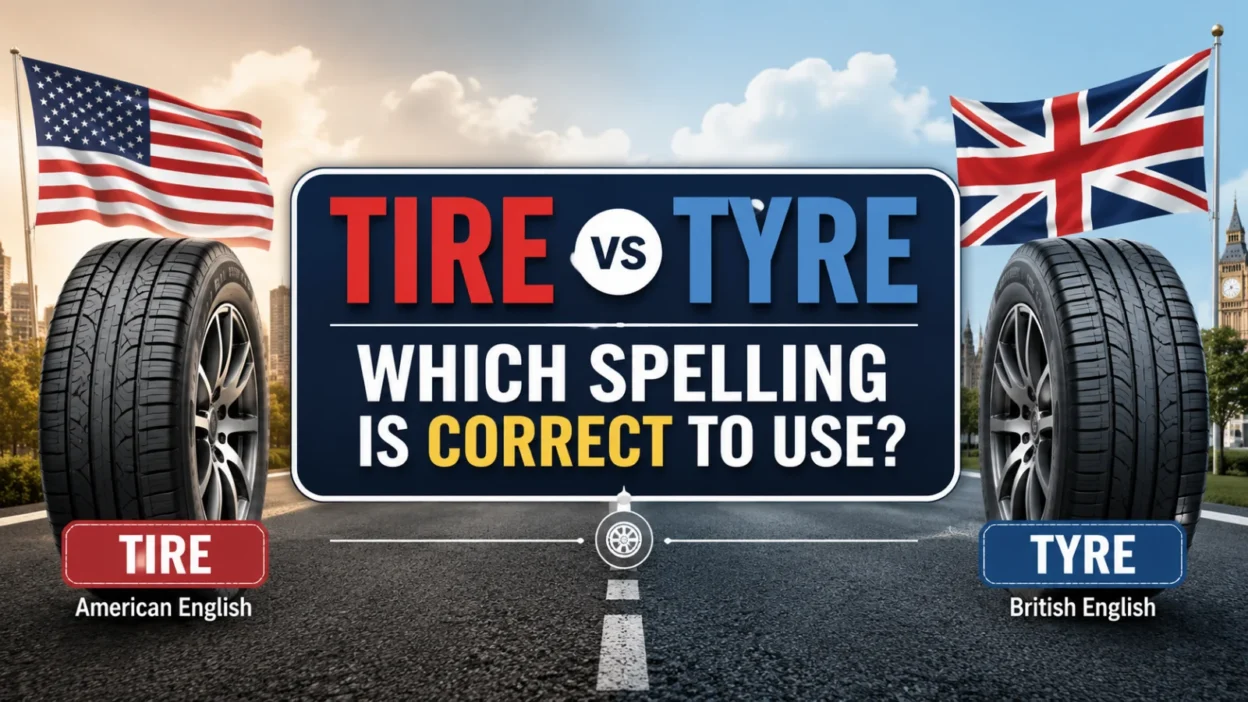
Tire is the standard spelling in American and Canadian English. Tyre is the standard spelling in British English and most other Commonwealth countries, including Australia and New Zealand. Both refer to the exact same object — the rubber covering fitted around a wheel — and both are pronounced identically. The difference is purely regional, not a matter of one spelling being wrong.
Here’s exactly where each spelling belongs, plus the real history behind the split — which runs in the opposite direction most people assume.
Quick Reference Table
| Region | Correct Spelling | Example |
|---|---|---|
| United States | Tire | “I need a new front tire.” |
| Canada | Tire | “The shop replaced all four tires.” |
| United Kingdom, Ireland | Tyre | “I need a new front tyre.” |
| Australia, New Zealand | Tyre | “The garage checked the tyre pressure.” |
| Verb meaning “to grow weary” (any region) | Tire | “Long meetings tend to tire me out.” |
Where Each Spelling Comes From
The word didn’t start with cars at all — it started with clothing. “Tire” traces back to “attire,” meaning equipment, dress, or covering. Early on, a “tire” was literally the iron plates or bands that formed the rim of a wooden carriage wheel, holding it together and protecting it from wear — centuries before rubber wheels existed.
The spelling history is more surprising than most guides suggest: tyre, not tire, was actually the dominant spelling first, prevailing through the 16th century. It shifted to tire during the 17th and 18th centuries, and it was British English — not American English — that revived the “tyre” spelling in the 19th century, eventually making it the UK standard. American English simply kept the older “tire” form that had been in use before the British revival.
The spelling split hardened further once rubber tires for bicycles, and later automobiles, came into widespread use starting in 1877 — by then, American and British English were already on separate spelling paths, and the automotive boom locked each region into its version.
They’re Pronounced The Same
Unlike many US/UK spelling pairs, tire and tyre are pronounced identically. The difference exists only on the page, which is part of why the two spellings get mixed up so often in global writing — nothing about how the word sounds gives away which spelling is “correct” for a given audience.
The Verb Sense Is Always “Tire”
Separate from the wheel-covering noun, “tire” also functions as a verb meaning to become weary or to wear someone out — as in “climbing all those stairs will tire you quickly.” This sense is spelled “tire” in every variety of English, everywhere, including the UK and Australia. “Tyre” is never used as a verb.
How To Choose The Right Spelling
- Writing for a US or Canadian audience? Use tire.
- Writing for a UK, Australian, or New Zealand audience? Use tyre.
- Writing about the verb “to grow weary”? Always use tire, regardless of your audience’s region.
- Referring to a specific brand or company name? Follow that company’s actual spelling — some tire manufacturers use “tyre” in their branding even when based outside the UK, since it can read as more premium or international.
- Unsure of your audience? Default to tire. It has the larger global reach in written content and won’t confuse most readers.
A Note On Canadian English
Canada isn’t a simple case of “follows American spelling.” Canadian English is a genuine blend: it uses British spelling for many words (like “colour” and “centre”) while following American spelling for others, including “tire.” So while Canadian writers do use “tire,” it’s not because Canadian English defaults to the US convention across the board — this particular word just happens to land on the American side of a mixed system.
Common Mistakes And Fixes
Mistake: Using “tyre” in US-facing content.
Fix: Switch to “tire” for American and Canadian audiences.
Mistake: Spelling the verb sense as “tyre” (“I tyre of this quickly”).
Fix: The verb is always “tire,” in every English variety — this sense never takes the “y” spelling.
Mistake: Mixing both spellings within the same document.
Fix: Pick one based on your audience and stay consistent throughout.
Mistake: Assuming “tyre” is a typo.
Fix: It’s the correct, standard spelling in the UK, Australia, New Zealand, and most other Commonwealth countries.
Examples In Context
- “I need to replace the front tire on my car.” (US)
- “I need to replace the front tyre on my car.” (UK)
- “Long meetings tend to tire me out.” (verb, same in every region)
- “The mechanic checked the tire pressure before the trip.” (US)
- “The mechanic checked the tyre pressure before the trip.” (UK)
- “The spare tire is in the trunk.” (US)
- “The garage replaced all four tyres on the vehicle.” (UK/Australia)
Plurals
Both spellings pluralize by simply adding an “s” — no spelling shift required:
- Tire → tires
- Tyre → tyres
Frequently Asked Questions
What is the difference between tire and tyre?
There’s no difference in meaning or pronunciation — only in regional spelling. Tire is standard American and Canadian English; tyre is standard in the UK, Australia, New Zealand, and most other Commonwealth countries.
Which spelling came first, tire or tyre?
Tyre was actually the earlier dominant spelling, common through the 16th century. It gave way to “tire” in the 17th and 18th centuries, and British English later revived “tyre” in the 19th century as its standard form.
Is tire or tyre used in Canada?
Canada uses “tire,” even though Canadian English follows British spelling for many other words. It’s a mixed system rather than a strict US or UK default.
Are tire and tyre pronounced differently?
No. They’re pronounced exactly the same. Only the spelling differs by region.
Is “tyre” ever used as a verb?
No. The verb meaning “to grow weary” is always spelled “tire,” in every variety of English, including British and Australian English.
Can a US-based company use “tyre” in its branding?
Yes. Some tire manufacturers and brands use “tyre” in their name regardless of home region, often for stylistic or international-market reasons. Brand names follow the company’s own choice, not the regional default.
Conclusion
Tire is your go-to spelling for American and Canadian writing, while tyre belongs in UK, Australian, and New Zealand content. Just remember that the verb meaning “to become weary” is always spelled tire, no matter where you’re writing for. Match your spelling to your audience, and you’ll never second-guess it again.