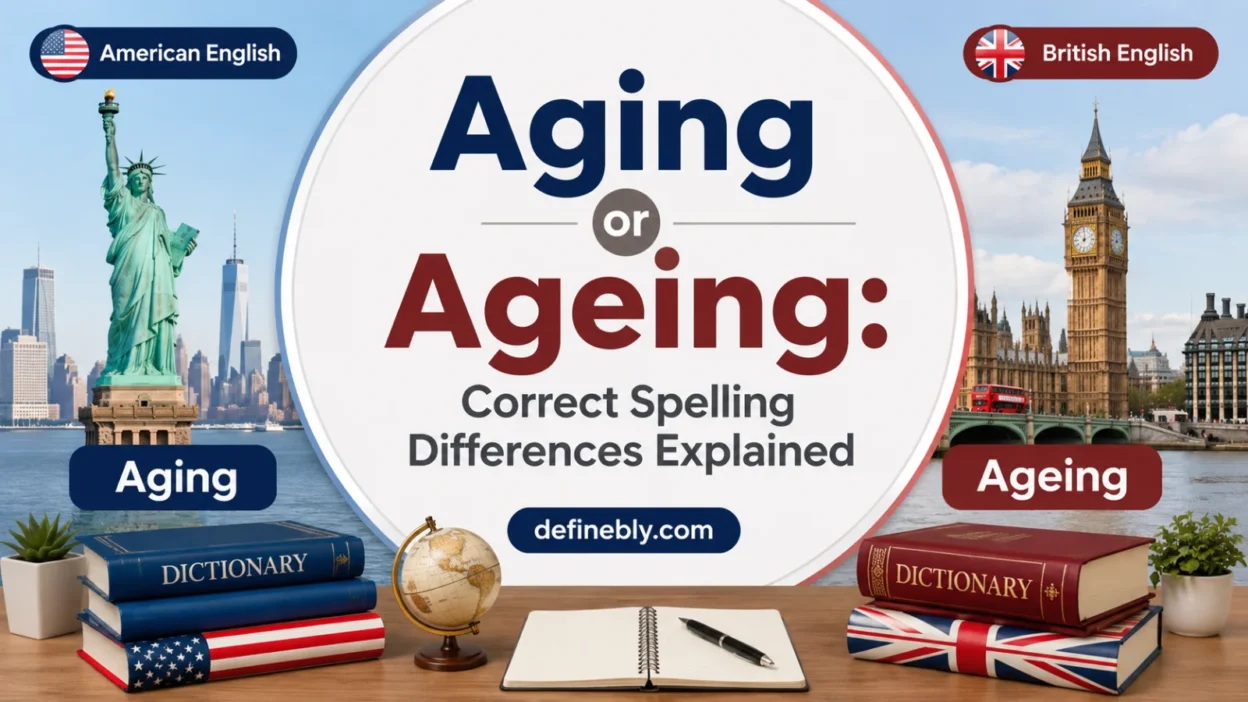
“Aging” and “ageing” are two accepted spellings of the same word that describe the process of growing older or becoming older over time. The meaning is identical, but spelling differs based on regional English conventions. American English prefers “aging,” while British English and many Commonwealth regions prefer “ageing.”
Which Spelling Is Correct?
Both spellings are correct:
- Aging → American English standard and dominant in scientific writing
- Ageing → British English and Commonwealth standard
The difference is stylistic, not grammatical or semantic.
Why Are There Two Spellings?
The word developed from Old French aage, which influenced Middle English forms related to “age.” Over time:
- American English simplified spelling conventions and dropped the “e,” forming aging
- British English retained the traditional spelling ageing
Both forms remain correct due to independent regional standardization.
Aging Vs Ageing In Style Guides
Authoritative sources show clear regional patterns:
- AP Style (US): aging
- Chicago Manual of Style: aging
- Oxford Dictionaries (UK): ageing
- Cambridge Dictionary: ageing
- British Council English: ageing
However, in scientific and medical writing worldwide, “aging” is the dominant standardized form, even outside the US.
How The Word Is Used In Real Life
Healthcare And Science:
- Aging is associated with cognitive and physical changes.
- Studies on healthy aging focus on long-term wellness.
- Ageing research in the UK examines lifespan development.
Demographics:
- The aging population is increasing globally.
- Ageing populations place pressure on healthcare systems.
Skin And Beauty Industry:
- Anti-aging skincare products are widely marketed.
- Ageing signs include wrinkles and reduced elasticity.
Infrastructure And Systems:
- Aging infrastructure requires modernization.
- Ageing bridges and roads need maintenance.
Global Usage Trend
In modern writing, “aging” has become the dominant form in:
- Medical journals
- Scientific research papers
- Global health organizations
- SEO and marketing content (especially “anti-aging”)
“Ageing” remains standard in:
- UK government documents
- British academic writing
- Commonwealth publications
Related Word Family
Understanding related terms improves clarity:
- aging process
- aging population
- healthy aging
- anti-aging
- cognitive aging
- age-related conditions
These terms almost always follow regional spelling rules, though scientific writing strongly favors “aging.”
How To Choose The Correct Spelling
Use this decision framework:
- Writing for US audience → use aging
- Writing for UK/Commonwealth audience → use ageing
- Writing for science, medicine, or global research → prefer aging
- Writing for marketing (especially skincare/health products) → “anti-aging” is dominant globally
- Always → maintain consistency within your content
Common Mistakes
- Mixing “aging” and “ageing” in the same document
- Assuming “ageing” is incorrect (it is valid in British English)
- Ignoring scientific convention where “aging” is standard globally
- Overgeneralizing rules without considering domain-specific usage
- Using inconsistent spelling in professional writing or SEO content
Quick Decision Rule
- US English → aging
- UK English → ageing
- Science/medical/global research → aging
- Marketing/SEO (global) → aging
- Always → stay consistent across the document
FAQs
Is aging or ageing correct in American English?
“Aging” is the correct and standard spelling in American English.
Is ageing incorrect?
No, “ageing” is standard in British English and widely used in Commonwealth countries.
Do aging and ageing mean the same thing?
Yes, both words refer to the process of growing older.
Which spelling is used in medical research?
“Aging” is the dominant spelling in global scientific and medical literature.
Why does British English use ageing?
British English retained traditional spelling conventions that include the “e.”
Is anti-aging or anti-ageing correct?
Both are correct, but “anti-aging” is more widely used globally in marketing and US English.
Can I mix aging and ageing in writing?
No, mixing spellings is inconsistent and should be avoided in professional content.
Which spelling is better for SEO?
“Aging” generally performs better in global search and US-based SEO traffic.
Are there other words like aging vs ageing?
Yes, similar variations include “color/colour” and “organize/organise.”
What is the safest spelling choice overall?
For most modern digital content, “aging” is the safest and most widely recognized form globally.
Conclusion
“Aging” and “ageing” are two correct spellings of the same word. The choice depends on regional English style.
Use “aging” for American English and “ageing” for British English. Consistency is the most important rule.