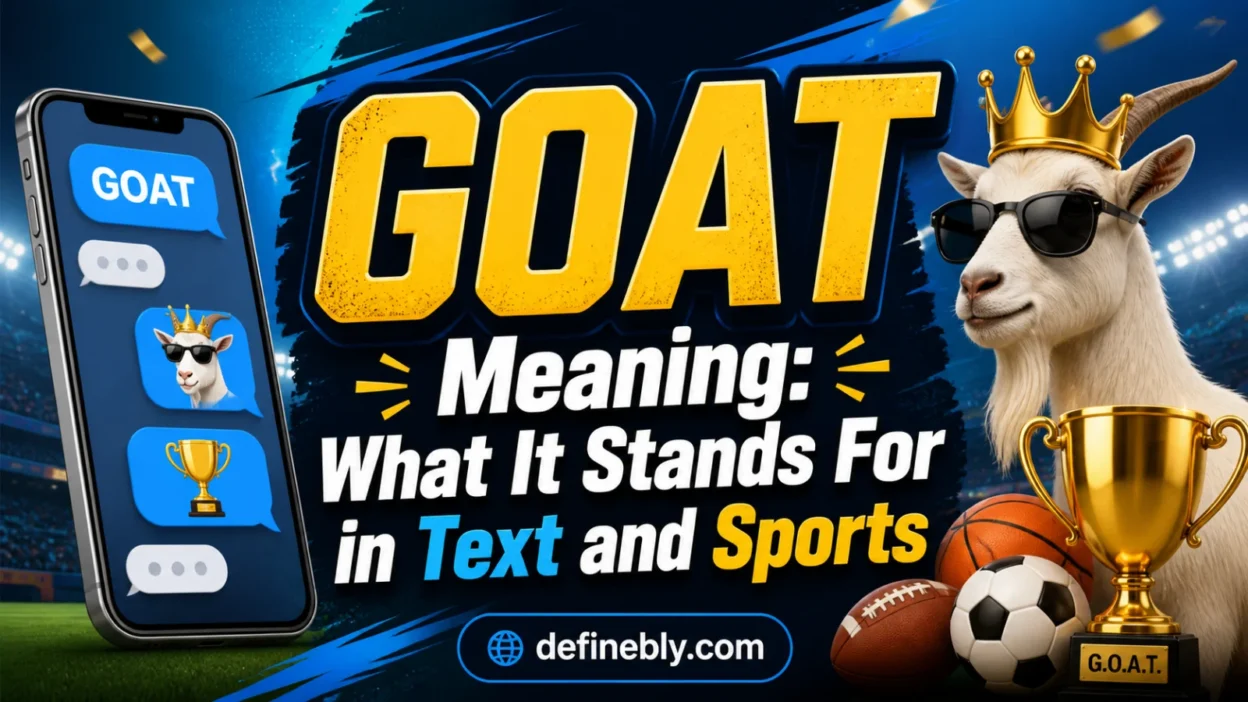
GOAT Meaning: What Does This Acronym Really Mean?
Have you ever seen someone call a famous athlete, singer, or even a friend the “GOAT”? In modern slang, GOAT stands for “Greatest of All Time.” It is used to describe someone considered the best in a particular sport, profession, activity, or category.
The term is especially popular in sports discussions, where fans use it to compare legendary players and celebrate extraordinary achievements. However, its meaning has expanded beyond sports into music, movies, gaming, and everyday conversations.
For example, someone might say, “Messi is the GOAT,” to express their belief that Lionel Messi is the greatest football player ever. In a casual conversation, a friend who helps you solve a difficult problem might also earn the same compliment.
In this guide, you’ll learn what GOAT means, how people use it in different situations, where the acronym originated, and how it differs from related slang terms such as GOATed and MVP.
What Does GOAT Stand For?
GOAT stands for “Greatest of All Time.” It describes a person widely regarded as the best ever in a particular field or activity.
Unlike ordinary compliments such as “great” or “excellent,” calling someone the GOAT usually suggests that their achievements, talent, or influence place them above other competitors.
People commonly use GOAT to recognize:
- Exceptional talent and skill
- Outstanding achievements and records
- Consistent success over many years
- A lasting influence on a particular field
- Dominance over other competitors
For example, a basketball fan might call Michael Jordan the GOAT because of his achievements and influence on the sport.
Similarly, a music fan might use the term for an artist whose songs, performances, and cultural impact have made them stand out across generations.
The exact person considered the GOAT depends on the category and the opinions of the people having the conversation.
What Does GOAT Mean in Texting?
In texting, GOAT is a way to give someone an enthusiastic compliment. It can express admiration, gratitude, or the belief that someone is exceptionally good at something.
For example:
Friend 1: “I finished the assignment you were struggling with.”
Friend 2: “You’re the GOAT!”
Here, the sender means that their friend is amazing or deserves special appreciation.
Other common examples include:
- “You remembered my birthday? GOAT behavior.”
- “She’s the GOAT when it comes to cooking.”
- “Thanks for helping me move. You’re the GOAT.”
- “That was the best advice ever. Absolute GOAT.”
In casual messages, the term does not always require a serious comparison with everyone who has ever done something. People often use it playfully to show strong appreciation.
What Does GOAT Mean on Social Media?
On social media, GOAT is commonly used in captions, comments, memes, and discussions about celebrities, athletes, musicians, and internet personalities.
People often add the acronym to posts celebrating impressive performances or memorable achievements.
For example:
- “That final performance proved why she’s the GOAT.”
- “The GOAT of football, no debate.”
- “This artist has been delivering hits for decades. Absolute GOAT.”
- “My dad fixing everything around the house is the real GOAT moment.”
The term can also appear alongside the goat emoji 🐐, which has become a popular visual symbol for “Greatest of All Time.”
For instance, a fan might comment “🐐🐐🐐” under a video of an athlete breaking a record.
The meaning is generally positive, although discussions about who truly deserves the title can lead to plenty of friendly arguments.
What Does GOAT Mean in Sports?
Sports is one of the most common settings for GOAT. Fans use it when discussing athletes whose accomplishments, abilities, and influence place them among the greatest competitors in history.
The debate often involves comparing athletes from different eras, teams, or playing styles.
Examples include:
- Calling Lionel Messi the GOAT of football.
- Describing Serena Williams as one of the GOATs of tennis.
- Debating whether Michael Jordan or LeBron James deserves the GOAT title in basketball.
- Praising Simone Biles for her extraordinary achievements in gymnastics.
These discussions are rarely based on a single statistic. Fans may consider championships, individual awards, records, consistency, influence, and overall performance.
Because different people value different achievements, the GOAT title is often subjective. One fan might prioritize championships, while another might focus on individual talent or long-term impact.
That is why sports debates about the greatest athlete of all time continue even when the competitors have already established remarkable careers.
Can GOAT Be Used Outside Sports?
Yes. Although GOAT has strong connections to sports culture, people now use it in many other areas.
GOAT in Music
Music fans use GOAT to describe artists they believe have made an exceptional contribution to music.
Example: “For me, Beyoncé is the GOAT when it comes to live performances.”
GOAT in Movies and Entertainment
The term can describe actors, directors, comedians, or entertainers whose work has had a lasting impact.
Example: “He’s the GOAT of comedy. Every performance makes me laugh.”
GOAT in Gaming
Gamers may use GOAT when talking about an outstanding esports competitor, a legendary player, or someone who consistently performs at an exceptional level.
Example: “She carried the entire team. She’s the GOAT.”
GOAT in Everyday Life
In everyday conversation, GOAT can be a humorous or affectionate compliment.
Example: “You brought snacks for everyone? You’re the GOAT!”
In this situation, the speaker is not making a serious historical ranking. They are simply expressing appreciation.
GOAT vs. Great: What’s the Difference?
GOAT and great are both positive descriptions, but they communicate different levels of praise.
Great means someone or something is very good, impressive, or successful.
GOAT suggests that someone is the best ever in a particular category.
Consider these examples:
- “She’s a great tennis player.” This means she performs very well.
- “She’s the GOAT of tennis.” This means the speaker considers her the greatest tennis player of all time.
Someone can be great without being considered the GOAT. The second expression makes a much stronger claim because it compares a person’s achievements with those of others across history.
In casual conversation, however, people sometimes use GOAT as an exaggerated way of saying that someone is exceptionally good.
What Is the Origin of GOAT?
The modern popularity of GOAT is closely associated with sports culture and the phrase “the greatest.”
Boxing legend Muhammad Ali famously promoted himself as “The Greatest,” helping establish the expression as part of sports culture.
A notable milestone came in 1992, when Ali’s wife, Lonnie Ali, incorporated G.O.A.T. Inc., a company established to manage aspects of Ali’s intellectual property and commercial interests.
The acronym gained further mainstream attention when rapper LL Cool J released his album G.O.A.T. (Greatest of All Time) in 2000.
Over time, sports media, celebrity culture, music, and internet communities helped spread the term into everyday language.
Today, GOAT is widely understood as a slang expression for someone considered the best ever, whether the discussion concerns professional sports or an ordinary personal achievement.
What Does GOATed Mean?
GOATed is a related slang term derived from GOAT. It is used as an adjective to describe someone or something considered exceptionally good or worthy of greatest-of-all-time status.
The difference is mainly grammatical.
- GOAT: “She’s the GOAT of tennis.”
- GOATed: “That was a GOATed performance.”
In the first example, GOAT identifies the person being praised. In the second, GOATed describes the performance.
People also use GOATed for songs, movies, video games, food, and memorable experiences.
For example:
- “That album is GOATed.”
- “His performance in the final was absolutely GOATed.”
- “This pizza place is GOATed.”
Like GOAT itself, GOATed is informal and especially common in online discussions and social media.
GOAT vs. MVP vs. Legend
These terms are related, but each has a slightly different meaning.
| Term | Meaning | Typical use |
|---|---|---|
| GOAT | Greatest of All Time | Someone considered the best ever |
| MVP | Most Valuable Player | A player who provides exceptional value in a particular competition or period |
| Legend | Someone widely admired for lasting achievements | A person with an important reputation or legacy |
| Icon | Someone with major cultural influence or recognition | An influential person in a field or community |
| GOATed | Considered exceptionally great or GOAT-level | A performance, person, or thing receiving strong praise |
For example, a player might win the MVP award for a particular season without necessarily being considered the GOAT of the sport.
Likewise, someone can be a legend because of their lasting contributions, even if fans disagree about whether they are the single greatest ever.
The main distinction is that GOAT makes an all-time comparison, while MVP usually refers to value within a particular competition or period.
Examples of GOAT in Everyday Sentences
Here are some natural examples showing how GOAT appears in different conversations.
- “Many basketball fans consider Michael Jordan the GOAT.”
- “She’s the GOAT when it comes to solving difficult problems.”
- “That singer’s live performances are legendary. She’s the GOAT.”
- “You helped me finish everything before the deadline. You’re the GOAT!”
- “This is easily the GOAT of all video games for me.”
- “He scored the winning goal again. The GOAT strikes back!”
- “My mother makes the best food. She’s the real GOAT.”
- “That comeback was incredible. Absolutely GOATed.”
These examples demonstrate how GOAT can express a serious opinion about historical greatness or serve as a fun, enthusiastic compliment.
Is GOAT Always a Compliment?
Usually, yes. When someone calls a person the GOAT, they are generally expressing admiration for that person’s talent, achievements, or abilities.
However, the tone depends on context.
In a sports debate, the term can be used seriously to argue that one athlete is better than all others. Among friends, it might simply be a playful way to say thank you.
It can also be used sarcastically, depending on the wording and situation. For example, someone might jokingly call a friend the GOAT after they make an amusing mistake.
Therefore, the acronym itself is usually positive, but the surrounding conversation determines whether it is sincere, playful, or sarcastic.
Frequently Asked Questions About GOAT
What is the simplest meaning of GOAT?
GOAT stands for “Greatest of All Time.” It describes someone considered the best ever in a particular field, sport, or activity.
Does GOAT always refer to an athlete?
No. GOAT is commonly associated with sports, but it is also used for musicians, actors, entertainers, gamers, creators, and people who excel at everyday activities.
What does 🐐 mean in texting?
The goat emoji often represents “Greatest of All Time.” People use it to praise an athlete, celebrity, friend, or impressive achievement.
For example, commenting “🐐” under a footballer’s photograph usually means that the person considers the player one of the greatest.
Is GOAT slang?
Yes. GOAT is an informal acronym widely used in sports conversations, social media, text messages, and popular culture. It is also recognized in major dictionaries.
What does GOATed mean in slang?
GOATed means that someone or something is considered exceptionally good or worthy of greatest-of-all-time status. For example, “That song is GOATed” means the speaker thinks the song is outstanding.
Is GOAT the same as a legend?
Not exactly. A legend is someone admired for their achievements or lasting influence. GOAT specifically suggests that someone is the greatest ever in a particular category.
A person can be a legend without everyone agreeing that they are the GOAT.
Can I call my friend the GOAT?
Absolutely. In casual conversation, calling a friend the GOAT is a way to show appreciation or praise them for doing something helpful, thoughtful, or impressive.
For example, “You saved me a seat. You’re the GOAT!” is a friendly and natural use of the term.
Final Thoughts
GOAT means “Greatest of All Time.” It is commonly used to describe someone considered the best in a sport, profession, or other category, but it can also be a playful compliment in everyday conversations.
From debates about legendary athletes to comments praising a friend’s helpful gesture, GOAT communicates strong admiration. Its exact meaning depends on the situation, but the central idea remains the same: someone or something stands out as exceptionally great.
When you see GOAT in a text, social media post, or sports discussion, it usually means the person being described is considered one of the very best—or, in the speaker’s opinion, the best of all time.
GOAT stands for “greatest of all time.” People use it to describe someone they believe is the best ever in a sport, field, or category of performance. Merriam-Webster defines it as the most accomplished and successful individual in the history of a particular sport or category of performance or activity, while Cambridge says it refers to the person who has performed better than anyone else ever, especially in sport.
Quick Answer
GOAT means “greatest of all time.” In real use, it is usually a serious or emphatic claim that someone stands above everyone else in a category, not just that they are very good.
What GOAT Stands For
The letters stand for greatest of all time. Merriam-Webster lists GOAT and the less common punctuated form G.O.A.T., and Cambridge treats it as an abbreviation used to describe the best performer ever, especially in sports.
That is why the word can look like the animal goat, but in modern slang and sports talk it often means something very different: top-tier, all-time greatness.
What GOAT Means In Context
In actual use, GOAT is stronger than ordinary praise. It usually means the speaker thinks someone is not just excellent, but historically unmatched or nearly unmatched.
For example:
- “Serena Williams is the GOAT.”
- “He might be the GOAT of that franchise.”
- “She’s the GOAT in women’s gymnastics.”
In each case, the phrase implies comparison across an entire history, not just a good season or a strong performance. That stronger all-time comparison is what separates GOAT from words like great, legend, or icon.
What The Phrase Usually Implies
When people call someone the GOAT, they usually mean one or more of these things:
- unmatched skill
- sustained excellence
- major achievements or titles
- historical impact
- dominance over peers
Merriam-Webster’s definition is especially useful here because it ties the term not just to “best,” but to being the most accomplished and successful in a category. That makes GOAT less casual than many weaker explanations suggest.
Where People Use GOAT
The term is still most strongly associated with sports. Cambridge says it is used especially in sport, and Collins labels it informal, mainly US sport usage. That is where the phrase is most rooted and where it still feels most natural in serious debate.
But modern use has broadened. Merriam-Webster’s wording allows for any sport or category of performance or activity, which helps explain why people now use GOAT in music, entertainment, gaming, business, and even playful everyday situations.
So these all sound possible, though not equally formal:
- “Tom Brady is the GOAT.”
- “Beyoncé is the GOAT.”
- “My grandma’s lasagna is the GOAT.”
The first two sound more serious. The third is clearly playful exaggeration.
Tone And Context
The tone of GOAT is usually highly positive and admiring, but context matters.
In serious sports or career discussions, it can sound weighty and debatable. In casual texts, it often becomes a playful super-compliment. That is why “Michael Jordan is the GOAT” sounds like a legacy argument, while “You fixed my laptop in five minutes—you’re the GOAT” sounds like casual praise.
So the same word can sound:
- serious
- admiring
- argumentative
- playful
- exaggerated
The difference comes from the context, not the acronym itself.
Origin And History
The modern rise of GOAT is commonly tied to Muhammad Ali’s long-running claim to be “the greatest.” How-To Geek says that in 1992, Ali’s wife Lonnie incorporated G.O.A.T. Inc., which is widely cited as an early notable use of the acronym in this positive sense. Sports Illustrated also ties the term’s roots to Ali’s self-branding as “the greatest.”
The phrase became much more mainstream in pop culture after LL Cool J released the album G.O.A.T. in 2000, a milestone that How-To Geek and Sports Illustrated both identify as important to the term’s wider spread.
That does not mean every single use comes directly from those moments. But they are central to how the acronym gained cultural force.
GOAT Vs. GOATed
These terms are related, but not identical.
GOAT is usually a noun or title:
- “She’s the GOAT.”
GOATed is a newer adjective or predicate form:
- “That performance was GOATed.”
- “He’s absolutely GOATed.”
Merriam-Webster defines GOATED as “considered to be the greatest of all time.” That makes it a current derivative readers now expect to see alongside the base acronym.
Example Sentences
- “Michael Jordan is still the GOAT to a lot of basketball fans.”
- “Many people call Simone Biles the GOAT of gymnastics.”
- “That singer is the GOAT in live performance.”
- “You brought coffee for everyone? You’re the GOAT.”
- “That playoff run was GOATed.”
These examples work because they show the two main real-world uses: serious all-time ranking and playful everyday praise.
Similar Short Forms
A few nearby terms overlap with GOAT, but they are not the same:
- MVP usually means the best or most valuable in a specific season, game, or event.
- Legend suggests lasting respect or status.
- Icon suggests major cultural importance.
- GOATed means considered GOAT-level.
Among these, MVP is the closest in sports language, but GOAT is usually a much bigger claim because it reaches across all time, not just one moment.
FAQ
Is GOAT always about sports?
No. It is still most strongly rooted in sports, and Cambridge and Collins both highlight that, but Merriam-Webster’s definition allows for any sport or category of performance or activity. That is why people now use it for musicians, entertainers, creators, and even playful everyday praise.
Does GOAT always mean the absolute best ever?
Usually yes, at least in serious use. The point of GOAT is that it is an all-time comparison, not just a compliment. In casual conversation, though, people often use it more loosely as strong praise.
What does GOATed mean?
GOATed means considered to be the greatest of all time. Merriam-Webster has a separate entry for it, which shows it has become a recognized derivative rather than just a random internet spelling.
Is GOAT formal?
Not really. It is informal, especially in sports talk, social media, and casual conversation. Collins explicitly labels it informal and mainly US sport usage. In more formal writing, the full phrase greatest of all time is usually clearer.
What is the simplest meaning of GOAT?
The simplest meaning is greatest of all time. Merriam-Webster and Cambridge both define it that way directly.
Conclusion
GOAT means “greatest of all time.” It is one of the strongest praise terms in modern English because it does more than say someone is excellent—it places them at the top of a whole history. That is why the word works so well in sports and pop culture, and why it still carries extra weight even when people use it casually in texts and social posts.