
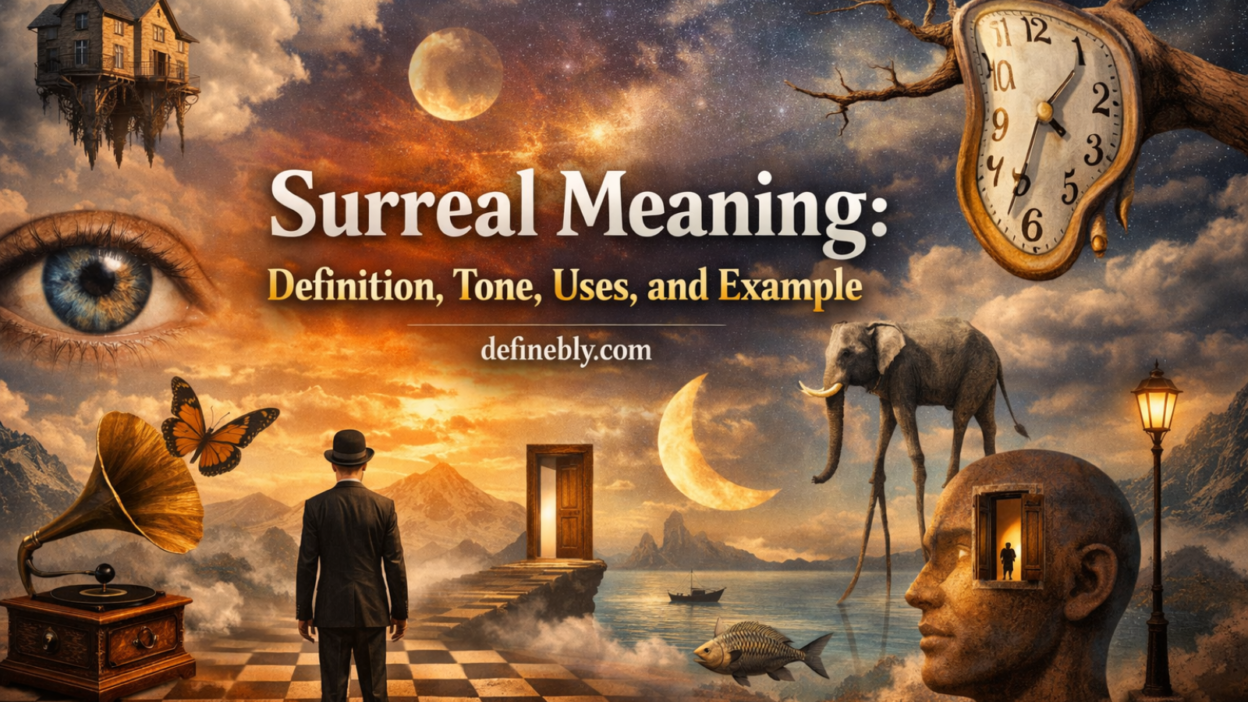
Some moments feel so strange or dreamlike that they don’t seem real. That’s exactly where the word “surreal” comes in. It’s commonly used in everyday English to describe experiences that feel unusual, almost like a dream.
Quick Answer
Surreal means something feels strange, dreamlike, or unreal—even if it is actually happening.
What Does Surreal Mean?
Surreal means so strange, dreamlike, or hard to believe that it does not feel fully real. In everyday English, people use it for moments, scenes, feelings, and experiences that seem unreal even when they are actually happening. Major dictionaries consistently define it with that mix of dreamlike quality and unusualness.
In simple words, surreal describes something your mind knows is real, but your emotions experience as unreal, eerie, magical, shocking, or strangely vivid. That is why people say things like, “Winning felt surreal,” or “The empty street looked surreal in the fog.”
Core Meaning In Plain English
A good plain-English definition is this: surreal means more like a dream than normal reality. It often suggests a strange mix of familiarity and unreality. Something surreal may be beautiful, unsettling, emotional, absurd, or unforgettable, but it usually feels outside the normal flow of life.
For example, seeing your hometown covered in orange wildfire smoke, hearing your name announced as a winner, or walking through a silent airport during a crisis can all feel surreal. The events are real, but the experience feels dreamlike or hard to process. This matches how reference and example pages use the word.
The Two Main Meanings Of Surreal
The first and most common meaning is the everyday one: strange, dreamlike, or not seeming real. That is the meaning most searchers want. Cambridge, Oxford, Britannica, Merriam-Webster, Collins, and Dictionary.com all reflect that sense.
The second meaning is art-related. Surreal can also mean “related to Surrealism,” the 20th-century artistic and literary movement associated with dreams, irrational images, and the unconscious mind. That sense matters, but it is usually secondary in everyday searches.
How Surreal Is Used In Everyday English
People often use surreal for experiences, scenes, emotions, and creative work.
A surreal experience feels unbelievable or emotionally overwhelming.
A surreal scene looks dreamlike, distorted, or strangely beautiful.
A surreal feeling happens when reality seems hard to absorb.
A surreal movie, painting, or sequence uses imagery that feels irrational, symbolic, or dream-based.
This is why the word works in both ordinary speech and artistic discussion. You can describe a sunset as surreal, a hospital hallway as surreal, or a film opening as surreal, and all of those uses sound natural.
Is Surreal Positive, Negative, Or Neutral?
On its own, surreal is usually neutral. It tells the listener that something feels outside ordinary reality, but it does not automatically say whether that feeling is good or bad. The emotional direction comes from context.
That means surreal can sound positive in a sentence like, “The concert was surreal,” negative in a sentence like, “The accident scene felt surreal,” or mixed in a sentence like, “Graduation was surreal because I was happy and exhausted at the same time.” That flexibility is one reason the word is so common in modern speech.
Surreal Vs. Unreal
These words overlap, but they are not identical. Unreal is broader. It can mean fake, impossible, unbelievable, or amazing in slang. Surreal is more specific. It usually points to a dreamlike, disorienting, or emotionally strange quality.
So a basketball shot might be called unreal because it was incredible. A foggy stadium after the crowd leaves might feel surreal because it seems dreamlike and oddly detached from normal reality.
Surreal Vs. Bizarre Or Weird
Bizarre and weird can describe anything odd. Surreal usually adds something more atmospheric: a sense of dream, distortion, emotional unreality, or impossible-seeming reality. Not every weird thing is surreal. A typo is weird. A city skyline glowing green before a storm may feel surreal.
That is why surreal often sounds more vivid and expressive than simply saying strange. It carries mood, not just oddness.
Surreal Vs. Surrealism
This is one of the most important distinctions. Surreal is an adjective. Surrealism is the name of an art and literary movement. Britannica and Tate describe Surrealism as a movement rooted in dream imagery, the unconscious, and irrational or unexpected combinations.
In everyday speech, people often use surreal without making any direct reference to the art movement. Saying “The night felt surreal” does not mean the night belonged to Surrealism as an artistic style. It simply means it felt dreamlike or unreal.
Example Sentences With Surreal
“It felt surreal to hear my name called after months of waiting.”
“The desert looked surreal at sunrise, with pink light and no sound at all.”
“Walking back into the office after the announcement felt surreal.”
“The movie opens with a surreal sequence of floating furniture and silent streets.”
“After the storm, the sky was such a strange color that the whole evening felt surreal.”
“Meeting someone I had watched on screen for years was completely surreal.”
Common Mistakes To Avoid
Do not treat surreal as just another word for random. The word usually suggests dreamlike unreality, not mere disorder.
Do not assume surreal means impossible. Something surreal can be completely real; it just does not feel fully real in the moment.
Do not confuse surreal with Surrealism in every sentence. They are related, but one is a general adjective and the other is a specific cultural movement.
Do not assume the word is always negative. It can describe beauty, awe, shock, grief, confusion, or excitement. Context decides the mood.
How To Remember The Meaning Of Surreal
An easy memory trick is this: surreal means reality that feels like a dream. If something seems so strange, vivid, emotional, or unbelievable that normal words feel too flat, surreal is often the right choice.
FAQ
What does surreal mean in simple words?
In simple words, surreal means very strange, dreamlike, or not seeming fully real.
Can surreal describe real life?
Yes. People often use surreal for real events that feel unbelievable, emotional, or dreamlike while they are happening.
Is surreal a positive word?
Usually it is neutral, but it can sound positive, negative, or mixed depending on the situation.
What is the difference between surreal and unreal?
Unreal is broader and can mean fake, impossible, or amazing. Surreal usually means dreamlike, emotionally strange, or oddly unreal in a vivid way.
How do you pronounce surreal?
Common dictionary pronunciations include /səˈriːəl/ and the American English form shown by Oxford as /səˈriəl/.
What is the connection between surreal and Surrealism?
The everyday adjective and the art movement are related. Surrealism is the formal movement; surreal is the broader adjective people now use for dreamlike or unreal things in everyday life.
Final Takeaway
Surreal means dreamlike, strangely unreal, or so unusual that reality feels slightly disconnected. It is one of the best words for moments that are hard to believe, hard to process, or too vivid to feel ordinary. In modern English, it usually describes real experiences that feel like a dream, while its secondary meaning connects it to Surrealism in art and literature.
Conclusion
Surreal means dreamlike, unreal, or strangely hard to believe. It is a flexible word for moments, scenes, and experiences that feel outside ordinary reality, whether they are beautiful, shocking, eerie, or unforgettable.