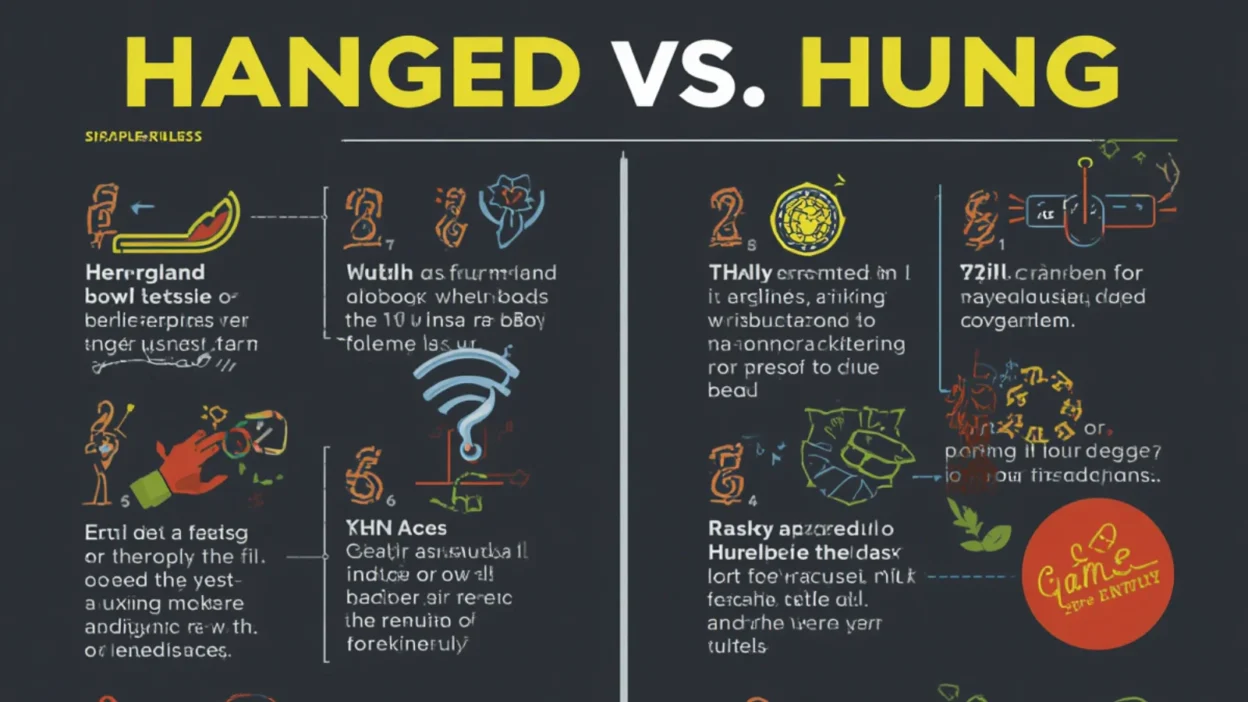
Hanged applies to one situation only: a person who died by hanging — execution or suicide. Hung applies to everything else: pictures, curtains, fog, phone calls, clothes, idioms, and even a living person dangling from a ledge.
The quick test: did a person die specifically as a result of hanging? If yes, use hanged. If no — regardless of what or who is involved — use hung.
She hung the painting over the fireplace. ✔
The prisoner was hanged at dawn. ✔
The prisoner was hung at dawn. — imprecise; avoid in formal writing
Why Two Forms Exist — The Etymology
Hang is unusual in English because it descends from two separate Old English verbs that merged into a single modern verb but left behind two distinct past tenses.
The first verb, Old English hōn, was a strong irregular verb meaning “to hang” in the sense of suspension. Its past tense changed through internal vowel alternation — the same pattern as sing/sang, ring/rang, drink/drank — which eventually produced the modern hung.
The second verb, Old English hangian, was a weak regular verb also meaning “to hang.” Regular weak verbs form their past tenses by adding a dental suffix (-d or -t), which is how hangian produced hanged — the regular, predictable past tense.
Over centuries, hung (from the strong verb hōn) gradually took over nearly every everyday use of hang. But hanged (from the weak verb hangian) was preserved in legal, historical, and journalistic writing for the specific sense of death by hanging — a specialization that hardened into convention and that style guides eventually codified as the standard. It is hung that is the newer dominant form; hanged retained a specific lane rather than vanishing.
What the Style Guides Say
The major American authorities all agree on this distinction.
The AP Stylebook specifies hanged as the past tense of hang when referring to a person killed by hanging — including both executions and suicides. This applies to news writing about historical executions as well as current events.
Garner’s Modern American Usage is emphatic: using hung for a person’s execution or suicide is considered an error in careful prose. Garner places the hung/hanged distinction in the category of genuine, established distinctions that educated writers are expected to observe.
Merriam-Webster documents both forms but includes a usage note explicitly stating that hanged is standard when referring to death by hanging and that hung is “widely considered an error” in that specific sense in formal contexts.
The Complete Rule With Examples
“Hung” — The Default for Almost Everything
Use hung as the standard past tense and past participle of hang in all but the one narrow exception.
Objects: She hung the mirror above the desk. The flag was hung at half-mast.
Weather and atmospherics: A thick fog hung over the harbor. Smoke hung in the air for hours.
Phrasal verbs — no exceptions: He hung up without saying goodbye. They hung out by the pool all afternoon. The deal hung in the balance. We made a left and hung a right.
Living people in suspension: She hung from the monkey bars for thirty seconds. He hung from the cliff edge until the rescue team arrived. (Person is alive — hung is correct.)
Animals: The butcher hung the carcasses overnight. (Treat animals as objects for this distinction.)
Idioms: Hung out to dry. Left hanging. Hung over. All use hung — no exceptions.
“Hanged” — Reserved for Death by Hanging
Hanged applies when a person died by hanging, whether by execution, judicial sentence, or suicide.
The Nazi war criminals sentenced at Nuremberg were hanged in October 1946.
John Wilkes Booth escaped capture and was never hanged; he was shot.
The report stated that the victim had hanged herself.
He was hanged for murder in the county’s last public execution.
The word hanged does not apply to objects, animals, or living people in suspension — only to human death by this specific means.
The Hung Jury Clarification
Legal writing uses hung in one prominent phrase that has nothing to do with death: a hung jury. This describes a jury that cannot reach a unanimous verdict, leaving the case unresolved. It uses hung — not hanged — because the reference is to the jury being stuck or suspended in indecision, not to any person dying.
The trial ended with a hung jury after three days of deliberation.
This is a useful reminder that not every legal use of hang involves execution. The death-by-hanging rule applies specifically to human death, not to any legal context broadly.
The Overcorrection Error: “Hung Over”
Some writers who learn the hanged rule overcorrect and begin writing hanged over when they mean hung over. This is wrong. The idiomatic use — feeling the effects of too much alcohol — always uses hung (as in the noun hangover).
I was hung over after the party. ✔
I was hanged over after the party. ✗
The hanged rule applies exclusively to death by hanging. It never transfers to idioms, phrasal verbs, or unrelated uses of the word.
Why “Hung” for Executions Feels Natural — But Isn’t Formal
In casual speech and some informal writing, hung for executions and suicides is common and widely understood. You’ll hear it frequently and encounter it in some news reports, particularly outside the United States. It is not a nonsense error — it is a natural extension of the dominant past-tense form.
But in formal, journalistic, legal, historical, and academic writing, hanged is the expected form. Using hung in those contexts signals to careful readers — editors, lawyers, historians — that the writer either doesn’t know the convention or is not following it. The meaning does not change, but the precision does.
How the Wrong Choice Changes Meaning
In one specific scenario, choosing the wrong word genuinely changes what a sentence says.
He was hung by his friends on his birthday. — reads as a prank or celebratory suspension; the reader pictures a harmless ritual.
He was hanged by his friends on his birthday. — reads as a killing; the reader understands something fatal occurred.
The word choice is doing real semantic work here. This is the most concrete reason the distinction matters beyond convention.
Common Mistakes and Quick Fixes
Mistake: The picture was hanged above the fireplace.
Fix: The picture was hung above the fireplace. — objects are always hung.
Mistake: He was hung for treason in 1865.
Fix: He was hanged for treason in 1865. — formal writing about execution requires hanged.
Mistake: I hanged up the phone.
Fix: I hung up the phone. — phrasal verbs always use hung.
Mistake: She was hanged from the monkey bars at recess.
Fix: She was hung from the monkey bars at recess. — she’s alive; hung is correct.
Mistake: The jury came back hanged.
Fix: The jury came back hung. — a hung jury is a deadlocked jury, not a death.
Quick Practice
Choose the correct form.
- The suspect was [hanged / hung] after a three-week trial.
- They [hanged / hung] the new banner in the gymnasium yesterday.
- Smoke [hanged / hung] in the air long after the fire was out.
- The case ended with a [hanged / hung] jury.
- She [hanged / hung] herself according to the official report.
- He [hanged / hung] from the pull-up bar for a full minute.
Answers: 1. hanged — 2. hung — 3. hung — 4. hung — 5. hanged — 6. hung
FAQs
Is it “hanged” or “hung” for a picture?
Always hung. Objects, furniture, signs, mirrors, and any inanimate thing that is suspended or displayed takes hung, never hanged. There is no context in which an object takes hanged.
Was Guy Fawkes hanged or hung?
Hanged. Guy Fawkes was executed in 1606. Formal reference to an execution uses hanged — the AP Stylebook, Garner’s Modern American Usage, and Merriam-Webster all specify this form for death by hanging.
Is “hung” for executions completely wrong?
Not grammatically invented, but considered imprecise in formal writing. Garner’s Modern American Usage calls it an error in careful prose. Merriam-Webster notes it is “widely considered an error” in formal contexts. In casual speech it is common; in journalistic, legal, and historical writing, hanged is expected.
Why does English have two past tenses for one verb?
Because hang evolved from two distinct Old English verbs: the strong verb hōn (giving us hung) and the weak verb hangian (giving us hanged). As they merged into the modern single verb, both past tenses survived. Hung became dominant in everyday use; hanged was preserved specifically for the death-by-hanging sense through legal and journalistic convention.
Is “hung jury” ever “hanged jury”?
Never. A hung jury describes a deadlocked jury that cannot reach a verdict. The word hung here means stuck or suspended in indecision — it has nothing to do with death. It always uses hung.
Can a living person who is suspended be “hanged”?
No. Hanged is reserved for death by hanging. A living person dangling from a rope, bar, ledge, or any other object uses hung: “She hung from the trapeze,” “He hung from the edge of the roof.” The death must be the result of the hanging for hanged to apply.
The Bottom Line
The rule for hanged and hung reduces to a single question: did a person die by hanging? If yes, use hanged. For everything else — every object, every idiom, every phrasal verb, every living person in suspension, every atmospheric sense of the word — use hung. Both forms are standard in their respective domains. The AP Stylebook, Garner’s Modern American Usage, and Merriam-Webster all agree on the boundary. The etymology explains why the split exists; the style guides confirm which side everything falls on.
Conclusion
The rule comes down to one question: did a person die? If so, use “hanged.” For everything else — objects, animals, idioms, casual suspension — use “hung.” Keep that test in mind and this pair stops being confusing.