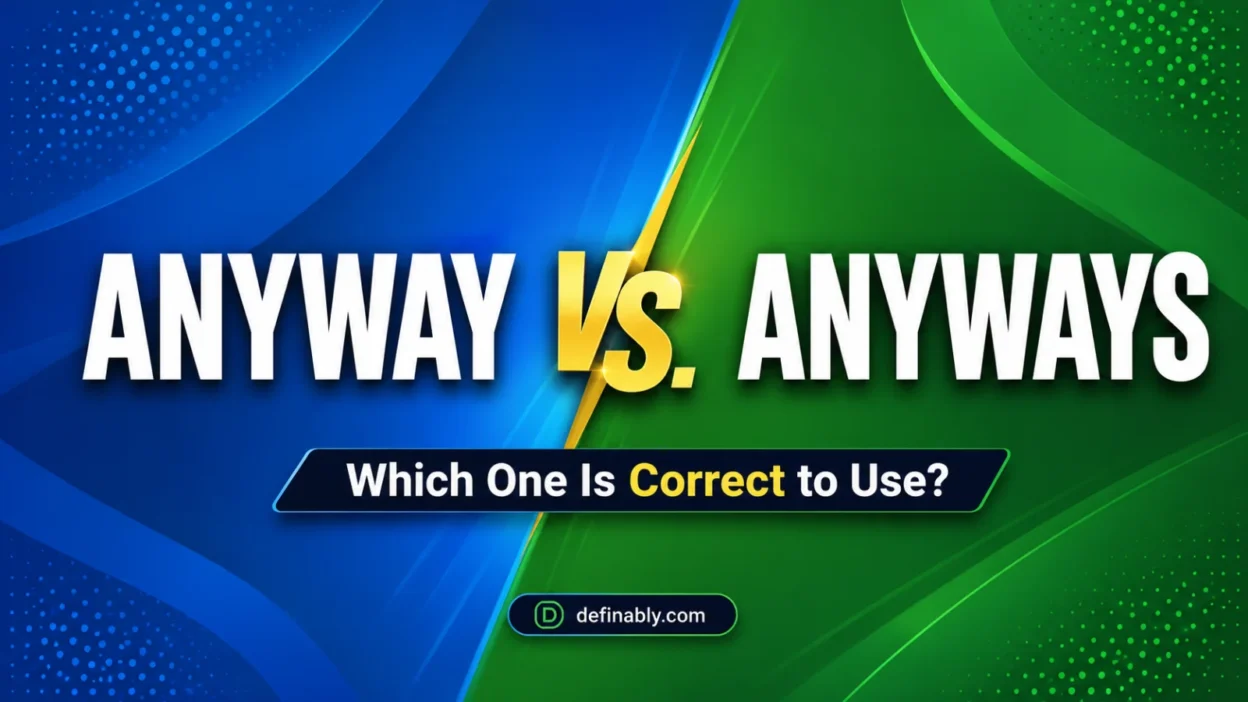
Anyway is the standard form in American English. It belongs in formal writing, professional communication, academic prose, and everyday writing at any register. Anyways — with the s — is labeled “chiefly dialectal” by Merriam-Webster and occupies Stage 3 on Garner’s Language Change Index, meaning it is “commonplace even among educated speakers but avoided in careful usage.” It carries a recognizable regional flavor in American English and reads as informal or dialectal in edited writing.
The quick rule: in any sentence where you would stop to wonder which form to use, reach for anyway. You will never be wrong.
The History — And a Surprising Fact
The common assumption is that anyway came first and anyways developed later as a casual corruption. The actual history is more complicated.
The -s in anyways is an adverbial genitive — an Old English and Middle English suffix added to nouns and adjectives to form adverbs. The same suffix is responsible for towards (as opposed to toward), afterwards, besides, needs (as in “I must needs”), and unawares. These are not corruptions; they are legitimate formations from a productive grammatical pattern.
The Online Etymology Dictionary documents anyways in Middle English, and several medieval sources use the form before the modern anyway consolidated as the dominant form. In other words, anyways is not simply a degraded version of anyway — both forms have long, parallel histories. What changed over time is that written edited English standardized around anyway, while anyways continued in spoken dialects, particularly in parts of the American South and Upper Midwest.
Knowing this history doesn’t change the practical rule — anyway is the standard form for edited writing — but it does correct the misimpression that anyways is a modern invention.
The Three Functions of “Anyway”
Anyway is an adverb, but it performs three distinct roles in a sentence, and the examples differ enough to be worth distinguishing.
1. Regardless, in any case — signals “despite what was said before”:
It was raining, but we went for a walk anyway.
She hadn’t slept well, but she came to the meeting anyway.
The road was closed; we found a way through anyway.
2. Return to topic — signals a return after a digression:
Anyway, where were we?
But anyway, the point I was trying to make is this.
Anyway, let’s get back to the main question.
3. Summation — signals a conclusion or wrap-up:
Anyway, that’s the whole story.
Anyway, I should let you go.
All three uses take anyway, no s, in any register of edited writing.
When “Anyways” Appears
Anyways is not a made-up word. Merriam-Webster includes it with the characterization “chiefly dialectal,” meaning it is associated with specific regional American speech patterns rather than simply being a casual alternative. It appears most frequently in the American South, Upper Midwest, and parts of Canada, and it carries the voice of those regions when used in speech or written dialogue.
Garner’s Modern American Usage places it at Stage 3 on the Language Change Index — a form that is “commonplace even among many educated speakers” but that careful writers consistently avoid in edited prose. This is a more precise characterization than “informal”: it is not merely casual, it is dialectal, and in edited writing outside its native dialect contexts, it signals a register mismatch rather than simply a relaxed tone.
Anyways is acceptable — and even editorially appropriate — in:
- Authentic dialogue written to represent a character’s regional speech
- First-person informal narration where the narrator’s voice is deliberately colloquial
- Text messages and casual digital communication
- Transcriptions of speech
It is not appropriate in professional emails, academic writing, news writing, business reports, or any formal context.
“Anyways” in Fiction and Dialogue
For writers of fiction, anyways is a legitimate and useful characterization tool. A character who says anyways signals something specific about their region, background, generation, or class. Writers using it deliberately in dialogue or first-person narration are doing something accurate, not making an error.
“Anyways,” she said, pushing back from the table, “I should probably get going.”
He’d talked himself out of the job, he knew. Anyways, he’d never really wanted it.
In these contexts, anyways is doing exactly what dialect words should do: conveying voice. Editing it out would flatten the character.
The Three-Way Distinction: “Anyway,” “Anyways,” and “Any Way”
All three forms are real and all three are different. The most consequential distinction for careful writers is the two-word form.
Anyway (one word, adverb): “regardless, in any case”
We didn’t have much time, but we finished anyway.
Anyways (one word, dialectal adverb): same meaning as anyway
We didn’t have much time, but we finished anyways. (dialectal/nonstandard in edited prose)
Any way (two words, adjective + noun): “any method, path, or means”
Is there any way to fix this before the deadline?
She couldn’t find any way to explain what she’d seen.
We’ll support you any way we can.
The two-word form any way has an entirely different grammatical function. It is a noun phrase built from the adjective any and the noun way, meaning “a method, path, or means.” You can replace it with “any method” or “any means” and the sentence holds. You cannot do this with the adverb anyway.
Is there anyway to fix this? ✗ — incorrect; anyway is an adverb, not a noun phrase
Is there any way to fix this? ✔ — correct; any way = any method
Common Mistakes and Quick Fixes
Mistake: Using anyways in a professional email, cover letter, or business report.
Fix: Replace with anyway. The s reads as dialectal or careless in formal contexts.
Mistake: Writing “Is there anyway I can help?” as one word.
Fix: Write “Is there any way I can help?” — two words. Anyway (one word) is the adverb; any way (two words) is the noun phrase meaning “any method or means.”
Mistake: Assuming anyways is simply wrong in all contexts.
Fix: In fiction dialogue and character voice, anyways is appropriate and purposeful. In edited prose outside of direct speech, it belongs only if a deliberate dialectal voice is intended.
Mistake: Using anyways in any position where anyway signals a topic return or summation.
Fix: Anyway, let’s move on — always one word in this transitional function.
Examples Side by Side
We were running late, but we made it anyway. ✔ (adverb — regardless)
We were running late, but we made it anyways. — dialectal; avoid in edited prose
Is there any way to reschedule the meeting? ✔ (two words — any method)
Is there anyway to reschedule the meeting? ✗ (one word — grammatically wrong here)
Anyway, I should let you know by Thursday. ✔ (summation)
“Anyways,” she said, dragging out the word, “I gotta run.” ✔ (dialogue — dialectal, intentional)
Anyway, where were we? ✔ (digression return)
Anyways, where were we? — nonstandard in edited prose; acceptable in dialogue
Quick Practice
Choose the correct form.
- She wasn’t sure it was worth the effort, but she applied [anyway / anyways].
- Is there [anyway / any way] to get there before noon?
- [Anyway / Anyways], let’s focus on what we can actually control.
- He spoke in a slow drawl. “[Anyway / Anyways],” he said, “that’s all I got.”
- There’s [anyway / any way] I can help — just say the word.
Answers: 1. anyway — 2. any way (two words) — 3. Anyway — 4. Anyways (intentional dialect in dialogue) — 5. any way (two words)
FAQs
Is “anyways” a real word?
Yes. It appears in Merriam-Webster labeled “chiefly dialectal” — meaning it is recognized as part of American dialect vocabulary, particularly in the South and Upper Midwest. It is not a made-up word, but it is not standard in edited writing.
What does Garner’s Modern American Usage say about “anyways”?
Garner classifies it at Stage 3 on the Language Change Index — “commonplace even among many educated speakers but avoided in careful usage.” This places it in the category of forms that are widely spoken but consistently edited out of polished prose.
Is “anyways” more informal, or more regional?
Both. Merriam-Webster’s characterization of “chiefly dialectal” is the more accurate one. It is associated with specific American regional speech patterns, particularly the South and Upper Midwest, giving it a regional flavor on top of its informal register.
When is it correct to write “any way” as two words?
When way is functioning as a noun meaning “method, path, or means,” and any is modifying it as an adjective. “Is there any way to fix this?” means “Is there any method to fix this?” — two words. Whenever you could substitute “any method,” use two words.
Can I use “anyways” in fiction or dialogue?
Yes — and it can be an effective characterization tool. A character who says anyways signals regional background, generational voice, or class. In dialogue or first-person narration written to capture a specific voice, anyways is purposeful, not an error.
Is “anyway” always correct?
Yes, in every context and register. Anyway will never be flagged as wrong in formal, informal, journalistic, academic, or creative writing. When in doubt, use anyway.
The Bottom Line
Anyway is the standard adverb, correct in every context. Anyways is chiefly dialectal in American English — common in spoken regional dialects and useful in fiction dialogue, but avoided in edited writing. Garner places it at Stage 3: widespread but consistently excluded from careful prose. The sharpest practical distinction to keep straight is anyway (adverb) versus any way (two-word noun phrase meaning “method or means”) — those are different words with different grammar, and confusing them is a different error entirely.
Conclusion
“Anyway” is the standard, correct choice for any kind of writing. “Anyways” isn’t a grammar crime, but it’s a casual variant that doesn’t belong in formal or professional contexts. When in doubt, drop the “s.”