
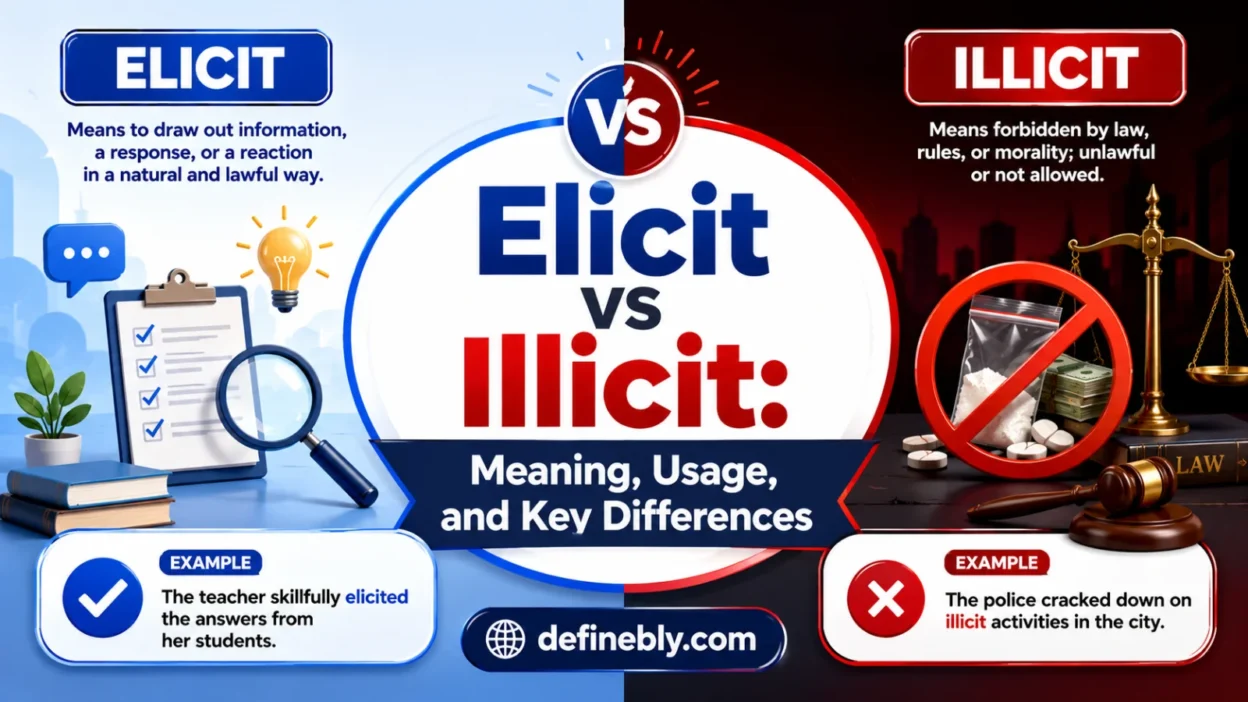
“Elicit” and “illicit” are among the most frequently confused words in English. They look similar, sound somewhat alike, and often appear in formal writing, but their meanings are completely unrelated.
The easiest way to remember the difference is this:
- Elicit means to draw out or bring forth a response, reaction, or information.
- Illicit means illegal, forbidden, or unauthorized.
One is a verb describing an action. The other is usually an adjective describing something improper or unlawful.
Quick Answer
Use elicit when you want to obtain, encourage, or draw out a response, feeling, or information.
Use illicit when describing something prohibited, unlawful, or socially unacceptable.
Examples
- The teacher asked a question to elicit discussion.
- Authorities investigated an illicit gambling operation.
The Main Difference At A Glance
| Feature | Elicit | Illicit |
|---|---|---|
| Part Of Speech | Verb | Adjective |
| Meaning | Draw out or obtain | Illegal or forbidden |
| Common Context | Communication, psychology, education | Law, regulation, crime |
| Example | Elicit a response | Illicit activity |
Why People Confuse Elicit And Illicit
Several factors contribute to the confusion:
- The words differ by only one letter.
- Their pronunciations are somewhat similar.
- Both often appear in formal writing.
- Many people encounter them infrequently compared to everyday vocabulary.
Despite these similarities, they serve entirely different grammatical and semantic functions.
What Does Elicit Mean?
Elicit is a verb that means:
- to draw out
- to bring forth
- to obtain
- to provoke a response
It is commonly used when discussing information, emotions, reactions, opinions, or behavior.
Common Collocations With Elicit
- elicit a response
- elicit feedback
- elicit information
- elicit sympathy
- elicit laughter
- elicit an emotional reaction
Examples
- The survey was designed to elicit honest feedback.
- Her speech elicited applause from the audience.
- Detectives used careful questioning to elicit information.
- The movie elicited strong emotions from viewers.
What Does Illicit Mean?
Illicit is usually an adjective that means:
- illegal
- prohibited
- unauthorized
- forbidden
It commonly describes activities, substances, relationships, transactions, or behavior that violate laws, rules, or accepted standards.
Common Collocations With Illicit
- illicit drugs
- illicit trade
- illicit activity
- illicit relationship
- illicit transaction
- illicit profits
Examples
- Officials uncovered an illicit smuggling network.
- The company faced penalties for illicit business practices.
- Law enforcement agencies work to stop illicit drug trafficking.
- Investigators traced illicit financial transfers.
Pronunciation Differences
Although the words look similar, their pronunciations are slightly different.
Elicit
Pronounced approximately:
ih-LISS-it
The stress falls on the second syllable.
Illicit
Pronounced approximately:
ih-LISS-it
In modern American English, they are often pronounced nearly identically.
Because pronunciation provides little help, spelling and meaning become especially important.
Part Of Speech: The Fastest Way To Choose The Right Word
One of the easiest ways to avoid mistakes is to identify the word’s role in the sentence.
Elicit Is A Verb
It performs an action.
Examples:
- The question elicited debate.
- The article elicited strong reactions.
Illicit Is An Adjective
It describes a noun.
Examples:
- illicit activity
- illicit trade
- illicit profits
If the word needs to perform an action, choose elicit.
If the word describes something forbidden, choose illicit.
Elicit Vs Evoke Vs Solicit
These words are related but not identical.
Elicit
Draws out a response.
- The interviewer elicited useful information.
Evoke
Causes a feeling or memory.
- The song evoked childhood memories.
Solicit
Actively request something.
- The company solicited customer feedback.
While all three can involve responses, their meanings are distinct.
Illicit Vs Illegal
These words overlap but are not always identical.
Illegal
Directly violates the law.
Illicit
May be illegal, forbidden, or socially unacceptable.
Examples:
- Illegal drug trafficking
- Illicit relationship
An illicit relationship may not break a law, but it can still be considered improper or prohibited in a particular context.
Common Mistakes And Quick Fixes
Mistake: Using Illicit As A Verb
Incorrect:
- The survey illicit valuable feedback.
Correct:
- The survey elicited valuable feedback.
Mistake: Using Elicit For Criminal Activity
Incorrect:
- Authorities investigated an elicit operation.
Correct:
- Authorities investigated an illicit operation.
Mistake: Forgetting The Part Of Speech
Incorrect:
- The manager gave an elicit warning.
Correct:
- The manager gave an illicit warning. (if forbidden)
- The manager elicited feedback. (if drawing out responses)
Sentence Correction Practice
- ❌ The advertisement illicit curiosity among consumers.
✔ The advertisement elicited curiosity among consumers. - ❌ Police shut down an elicit gambling ring.
✔ Police shut down an illicit gambling ring. - ❌ The interview helped illicit important details.
✔ The interview helped elicit important details. - ❌ Authorities investigated elicit financial transactions.
✔ Authorities investigated illicit financial transactions.
Memory Tricks To Remember The Difference
Elicit = Extract
Both words start with a similar sound and involve drawing something out.
Think:
Elicit = Extract Information
Illicit = Illegal
Both words begin with “il-“.
Think:
Illicit = Illegal Activity
This memory trick works in most situations.
Word Origins
Although the words look similar today, they come from different Latin roots.
Elicit
Derived from a Latin word meaning “to draw out.”
Illicit
Derived from a Latin word meaning “not permitted.”
Their origins perfectly reflect their modern meanings.
FAQ
What is the difference between elicit and illicit?
Elicit means to draw out a response, reaction, or information. Illicit means illegal, forbidden, or unauthorized.
Is elicit a verb or an adjective?
Elicit is a verb.
Example:
- The speaker elicited applause.
Is illicit always illegal?
Not always. Illicit can describe something socially unacceptable or prohibited even when it is not strictly against the law.
How do you use elicit in a sentence?
Example:
- The teacher asked questions to elicit discussion.
What are common examples of illicit activities?
Examples include illicit drug trafficking, illicit trade, illicit financial operations, and other unauthorized activities.
How can I remember elicit vs illicit?
Think:
- Elicit = Extract a response
- Illicit = Illegal or forbidden
Conclusion
“Elicit” and “illicit” may look similar, but they belong to completely different categories of meaning.
- Use elicit when drawing out information, reactions, feelings, or responses.
- Use illicit when describing something illegal, unauthorized, or forbidden.
Remember the simplest rule:
Elicit gets something out. Illicit breaks the rules.
Once you connect that distinction to the part of speech—verb versus adjective—the confusion becomes much easier to avoid.