
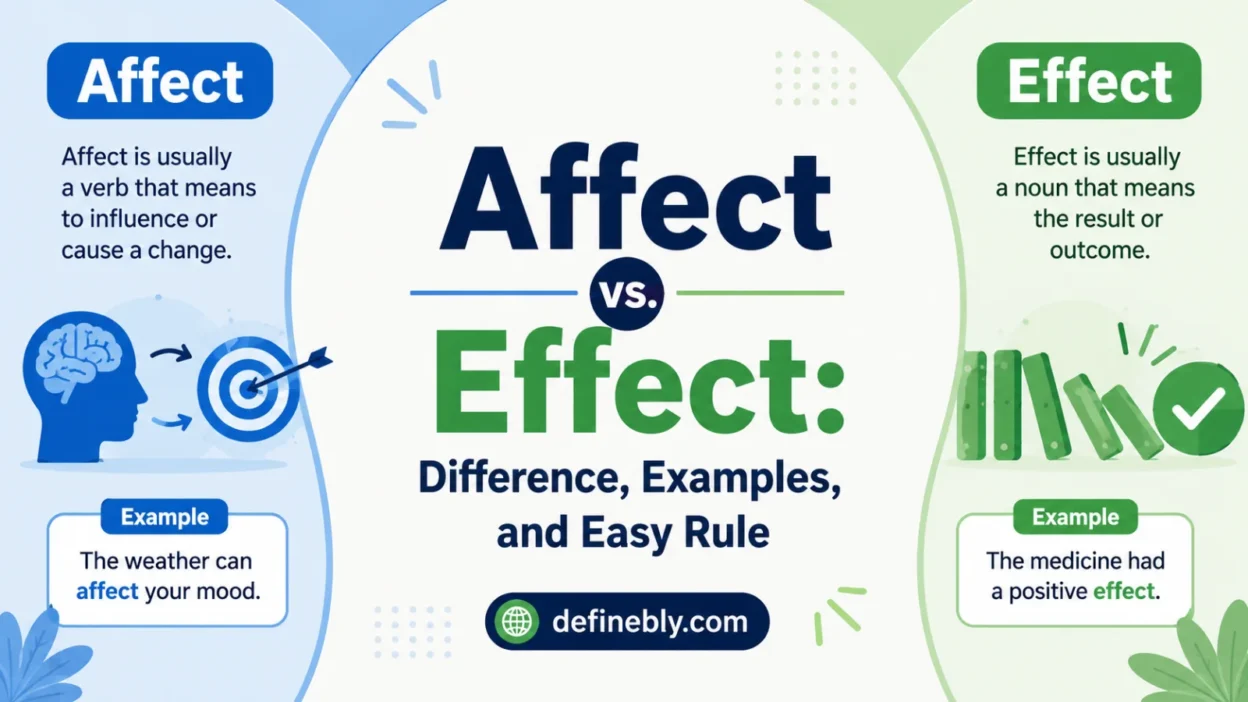
Affect usually means to influence. It is usually a verb.
Effect usually means a result. It is usually a noun.
Correct:
- Lack of sleep can affect your mood.
- Lack of sleep can have a bad effect on your mood.
The easiest rule is this: affect is the action; effect is the result.
Quick Answer
Use affect when the sentence needs an action word meaning influence or change.
Example:
- The weather can affect travel plans.
Use effect when the sentence needs a noun meaning result, outcome, or consequence.
Example:
- The weather had a major effect on travel plans.
Quick test:
- If you mean influence, use affect.
- If you mean result, use effect.
A sentence using both:
- The storm affected traffic, and the main effect was a two-hour delay.
Why People Confuse Them
Affect and effect are easy to mix up because they look similar, sound similar, and both relate to change.
Compare:
- The new policy affected employees.
- The new policy had an effect on employees.
The meaning is connected, but the grammar is different.
In the first sentence, affected shows what the policy did.
In the second sentence, effect names the result of the policy.
Key Difference At A Glance
| Context | Best Choice | Why |
|---|---|---|
| You mean “to influence” | affect | It is usually a verb. |
| You mean “a result” | effect | It is usually a noun. |
| The word follows can, will, or may | affect | A verb often follows these words. |
| The word follows a, an, or the | effect | A noun often follows an article. |
| You mean “bring about change” | effect | This is a less common verb use. |
| You mean emotional expression | affect | This is a specialized noun use. |
Meaning And Usage Difference
Affect means to influence, change, or have an impact on something.
Examples:
- Stress can affect your sleep.
- The update may affect your account.
- The teacher’s feedback affected my confidence.
- Rain could affect tomorrow’s game.
In each sentence, something influences or changes something else.
Effect means the result or outcome of a change.
Examples:
- Stress can have a negative effect on sleep.
- The update had no effect on my account.
- The teacher’s feedback had a positive effect on my confidence.
- Rain had a serious effect on the game.
In each sentence, effect names the result.
Tone, Context, And Grammar
In everyday writing, affect is usually a verb.
Examples:
- Noise affects my focus.
- The decision affected everyone.
- The new schedule may affect attendance.
- Screen time can affect sleep quality.
In everyday writing, effect is usually a noun.
Examples:
- The noise had an effect on my focus.
- The decision had a major effect.
- The new schedule had little effect on attendance.
- One effect of too much screen time is poor sleep.
The grammar matters because the words fit different sentence patterns.
Verb pattern:
- Something affects something.
Noun pattern:
- Something has an effect on something.
Which One Should You Use?
Use affect if the sentence needs a verb.
Ask:
- Can I replace it with influence?
Correct:
- The outage may affect thousands of customers.
- The outage may influence thousands of customers.
Use effect if the sentence needs a noun.
Ask:
- Can I replace it with result or outcome?
Correct:
- The outage had a serious effect on local businesses.
- The outage had a serious result for local businesses.
Look for clue words.
Use effect after words like:
- a
- an
- the
- no
- little
- major
- positive
- negative
Examples:
- a positive effect
- the main effect
- no effect
- little effect
- a major effect
Use affect after helping verbs such as:
- can
- will
- may
- might
- did
Examples:
- can affect
- will affect
- may affect
- might affect
- did affect
These clues are not perfect, but they work in most everyday sentences.
When One Choice Sounds Wrong
Use affect when the word is doing an action.
Incorrect:
- The cold weather can effect your skin.
Correct:
- The cold weather can affect your skin.
The weather can influence your skin.
Use effect when the sentence names a result.
Incorrect:
- The cold weather had an affect on my skin.
Correct:
- The cold weather had an effect on my skin.
The sentence refers to a result.
Use effect in common noun phrases.
Correct:
- side effect
- sound effect
- special effect
- ripple effect
- long-term effect
Use affect in common verb phrases.
Correct:
- affect your health
- affect the outcome
- affect the team
- affect performance
- affect the results
Common Mistakes And Quick Fixes
Using Effect When The Sentence Needs A Verb
Incorrect:
- The new rule will effect small businesses.
Correct:
- The new rule will affect small businesses.
The rule will influence the businesses.
Using Affect When The Sentence Needs A Noun
Incorrect:
- The new rule had a strong affect on small businesses.
Correct:
- The new rule had a strong effect on small businesses.
The sentence names the result of the rule.
Confusing Affected And Effected
Affected means influenced.
Correct:
- The storm affected several neighborhoods.
Effected means brought about or caused to happen. This is less common.
Correct:
- The policy effected major reform.
Most everyday sentences need affected, not effected.
Avoiding Effect As A Verb In Formal Phrases
Effect can be a verb meaning to bring about.
Correct:
- The organization hopes to effect change.
- The new leader promised to effect reform.
This use is more formal. In everyday writing, bring about or create may sound clearer.
Using Affect For Emotional Result
Incorrect:
- The speech had a powerful affect on the audience.
Correct:
- The speech had a powerful effect on the audience.
The sentence means the speech produced a result.
Everyday Examples
Affect In Sentences
- The teacher’s feedback affected my confidence.
- The outage affected thousands of customers.
- Exercise can affect your energy level.
- The new law may affect small businesses.
- A slow internet connection can affect video calls.
- The price change could affect sales.
- Lack of sleep may affect your memory.
- The delay did not affect our plans.
Effect In Sentences
- The teacher’s feedback had a positive effect on my confidence.
- The outage had a serious effect on local businesses.
- One effect of exercise is better sleep.
- The new law may have a lasting effect.
- The medicine had a strong effect.
- The price change had little effect on sales.
- The delay had no effect on our plans.
- The movie used impressive sound effects.
Affect And Effect In The Same Sentence
- The storm affected traffic, and the main effect was a long delay.
- The update affected the app, but the effect was minor.
- The speech affected the audience, and its effect lasted for days.
- The new rule affected attendance, but the long-term effect is still unclear.
Special Cases: Effect As A Verb And Affect As A Noun
Most of the time, use affect as a verb and effect as a noun.
There are two exceptions worth knowing.
Effect can be a verb meaning to bring about.
Example:
- The mayor promised to effect change.
That means the mayor promised to bring change about.
Affect can be a noun in psychology. It refers to visible emotional expression.
Example:
- The patient showed a flat affect.
This meaning is specialized. Most everyday sentences do not use affect as a noun.
Synonyms And Closest Alternatives
Closest alternatives for affect include:
- influence
- change
- shape
- impact
- alter
Example:
- The decision affected the team.
- The decision influenced the team.
Closest alternatives for effect include:
- result
- outcome
- consequence
- impact
- change
Example:
- The decision had a major effect.
- The decision had a major impact.
These words are not always exact replacements. Choose the one that fits the sentence.
Quick Memory Fix Or Rule Of Thumb
Use this memory trick:
Affect = Action.
Effect = End Result.
Examples:
- The action affects something.
- The end result is the effect.
Another quick test:
- If you mean influence, choose affect.
- If you mean result, choose effect.
FAQs
What is the difference between affect and effect?
Affect usually means to influence. It is usually a verb.
Effect usually means a result. It is usually a noun.
Example:
- The weather can affect your mood.
- The weather can have an effect on your mood.
When should I use affect?
Use affect when you mean to influence or change something.
Example:
- Stress can affect your sleep.
The stress influences your sleep.
When should I use effect?
Use effect when you mean a result, outcome, or consequence.
Example:
- Stress can have a negative effect on sleep.
The effect is the result.
Is affect a verb or noun?
Affect is usually a verb in everyday writing.
Example:
- The change may affect everyone.
It can also be a noun in psychology, where it refers to emotional expression.
Example:
- The patient showed a flat affect.
Is effect a noun or verb?
Effect is usually a noun.
Example:
- The medicine had a strong effect.
It can also be a verb meaning to bring about.
Example:
- The policy helped effect change.
Is it “had an affect” or “had an effect”?
The correct phrase is usually had an effect.
Correct:
- The news had an effect on the market.
Effect is a noun, and it fits after an.
Is it “can affect” or “can effect”?
The correct phrase is usually can affect.
Correct:
- The decision can affect the whole team.
After can, you usually need a verb meaning influence.
What does “effect change” mean?
Effect change means to bring about change or make change happen.
Example:
- The policy was designed to effect change.
This use is more formal than create change or bring about change.
What is a side effect?
A side effect is an additional result, often an unwanted one.
Example:
- Drowsiness is a common side effect of the medicine.
Use effect, not affect, in this phrase.
What is the easiest way to remember affect vs. effect?
Remember this:
Affect is the action. Effect is the end result.
If the word means influence, use affect. If it means result, use effect.
Conclusion
Use affect when you mean to influence. Use effect when you mean a result.
Most of the time, affect is a verb and effect is a noun.
The easiest rule is simple: affect is the action; effect is the end result