NVM Meaning: What Does NVM Mean in Texting and Chat?
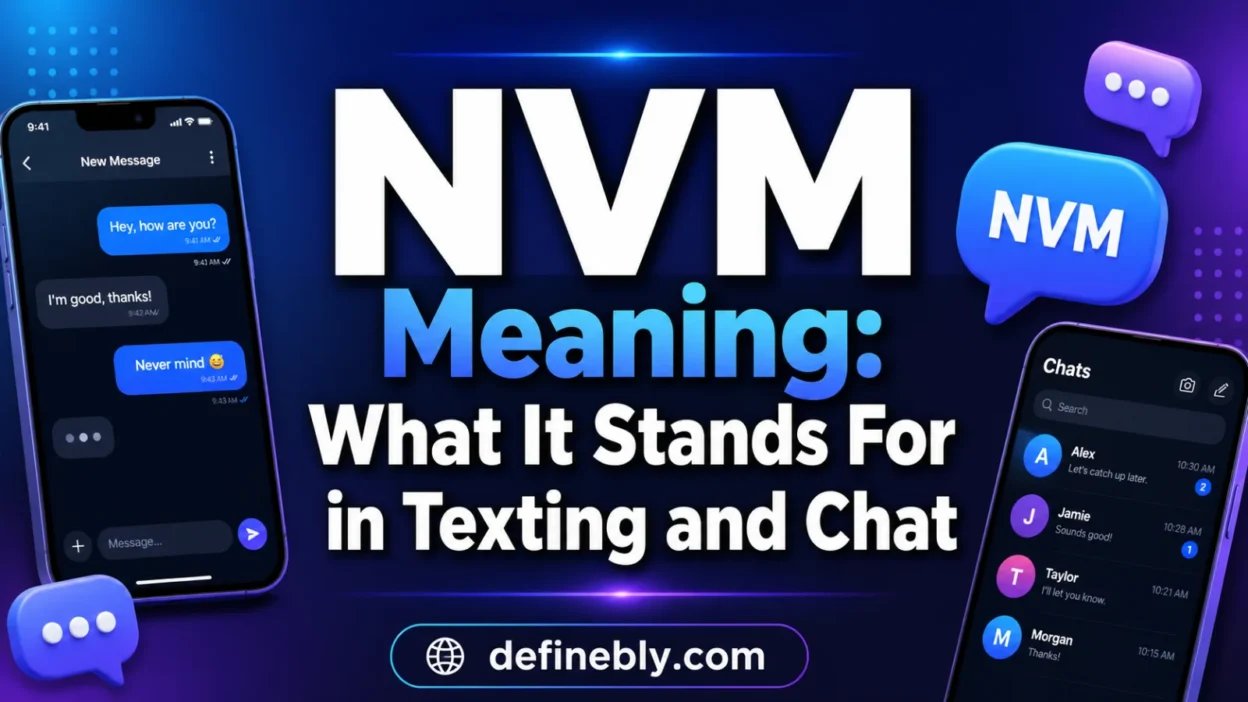
Have you ever received a text that simply says “NVM” and wondered what the sender meant? NVM is a common abbreviation used in texting, social media, and online conversations. It stands for “never mind” and is usually used when someone no longer needs an answer, wants to take back a question, or decides to move on from a topic.
Although NVM is short and simple, its meaning can change slightly depending on the conversation and the tone of the sender. Let’s explore what NVM means, how people use it, and when it might sound rude.
What Does NVM Stand For?
NVM stands for never mind. It is an informal shorthand that helps people communicate quickly without typing the full phrase.
People commonly use NVM when they have already found the information they need, no longer want to discuss something, or want the other person to ignore an earlier message.
For example:
- “Where did you put the keys? NVM, I found them.”
- “Can you explain this to me? nvm, I figured it out.”
- “I wanted to ask you something, but never mind.”
In each example, NVM indicates that the original question or request is no longer necessary.
What Does NVM Mean in Text Messages?
In text messages, NVM usually communicates one of three things:
- The question is no longer important: The sender has changed their mind or no longer needs an answer.
- The problem is solved: The sender has figured something out independently.
- The conversation should move on: The sender does not want to continue discussing the subject.
For instance, if someone texts, “Do you know when the store closes?” and follows up with “NVM, I checked online,” they are simply letting you know that they found the answer.
NVM can also be used when someone changes their mind about asking a question or sharing information.
How Is NVM Used on Social Media?
NVM appears across many forms of digital communication, including:
- Text messages and private chats
- Instagram and Facebook direct messages
- WhatsApp conversations
- Discord and gaming chats
- Online forums and social media comments
Because online conversations often move quickly, abbreviations such as NVM make it easier to send short replies.
However, NVM is generally better suited to casual communication than professional writing. In a formal email, using the full phrase “never mind” or explaining the situation clearly may sound more appropriate.
Does NVM Sound Rude?
NVM is not automatically rude. Its tone depends on the situation, the relationship between the people chatting, and how the message is written.
Here are a few examples that show the difference.
Neutral: “NVM, I found the information.”
This sounds practical because the sender has resolved the issue.
Friendly: “Wait, nvm! I misunderstood what you said.”
This sounds casual and shows that the sender is correcting a mistake.
Potentially dismissive: “nvm.”
A one-word reply can sometimes sound impatient, especially if the other person was trying to help or was waiting for an explanation.
If you want to avoid misunderstanding, add a little context. For example, “Never mind, I figured it out. Thanks for helping!” sounds warmer than simply sending “nvm.”
NVM vs. NM: What’s the Difference?
NVM and NM are similar abbreviations, but they can have different meanings.
| Abbreviation | Common meaning | Example |
|---|---|---|
| NVM | Never mind | “NVM, I got it.” |
| NM | Never mind | “NM, I found it.” |
| NM | Not much | “What’s up?” — “NM, you?” |
The main difference is that NM can mean either “never mind” or “not much,” depending on the conversation.
NVM is usually the clearer option when you want to tell someone to disregard an earlier message.
NVM vs. Never Mind
Both expressions communicate essentially the same idea, but they are used in different situations.
NVM is an informal abbreviation commonly found in texts, gaming chats, and social media messages.
Never mind is the complete phrase and works in both casual and more formal communication, depending on the sentence.
For example:
- Casual: “NVM, I already sent it.”
- More explicit: “Never mind, I’ve already sent it.”
- Professional: “Please disregard my previous question; I’ve found the information.”
If you’re communicating with a friend, NVM is usually fine. If you’re writing to a client, manager, or someone you don’t know well, a complete sentence is often a better choice.
Where Did NVM Come From?
NVM developed as part of the wider culture of internet abbreviations and electronic messaging. Online chat rooms, instant messaging services, and text messages encouraged people to shorten common phrases to save time and typing effort.
As digital communication became more widespread, abbreviations such as NVM, BRB, and IDK became familiar to internet users.
It is difficult to identify one exact moment when NVM first appeared, but its continued use reflects a broader habit of shortening everyday expressions in online conversations.
Examples of NVM in Everyday Conversations
Here are some natural examples of how people use NVM in different situations.
Example 1: Finding an answer
Person A: “What time does the movie start?”
Person B: “NVM, I just checked the ticket.”
Example 2: Changing your mind
Person A: “Can I ask you something?”
Person B: “Sure.”
Person A: “Nvm, it’s not important.”
Example 3: Solving a problem
Person A: “Can you send me the website link?”
Person B: “NVM, I found it in our previous chat.”
Example 4: Correcting a misunderstanding
Person A: “Did you mean Friday?”
Person B: “Wait, nvm. I read your message wrong.”
Example 5: Ending a topic
Person A: “Do you remember what I wanted to tell you?”
Person B: “No, what was it?”
Person A: “NVM, I’ll tell you later.”
These examples demonstrate that NVM can retract a question, acknowledge a solution, or signal that a topic can be dropped.
Other Texting Abbreviations Similar to NVM
NVM is just one of many shortened expressions used in digital communication. Here are a few other common examples.
- NM: Never mind or not much.
- BRB: Be right back.
- IDK: I don’t know.
- IDC: I don’t care.
- TTYL: Talk to you later.
- BTW: By the way.
- IMO: In my opinion.
- FYI: For your information.
These abbreviations can make conversations faster, but their meanings may not be obvious to everyone. When communicating with someone unfamiliar with texting slang, using complete phrases can help prevent confusion.
Frequently Asked Questions About NVM
What does NVM mean in texting?
NVM means “never mind.” People use it when they no longer need an answer, have solved a problem, or want someone to ignore a previous question or message.
What does NVM mean from a girl or a guy?
The abbreviation has the same basic meaning regardless of who sends it. It usually means “never mind,” although the tone can vary depending on the conversation. The word alone does not necessarily indicate anger, annoyance, or romantic interest.
Is NVM considered rude?
Not necessarily. It can be a quick and harmless way to say that something is no longer necessary. However, sending only “nvm” during an important conversation may come across as dismissive. Adding an explanation or a thank-you can make the message friendlier.
Does NVM mean never mind or not much?
NVM generally means “never mind.” The abbreviation more commonly associated with “not much” is NM, particularly in replies to questions such as “What’s up?”
Can I use NVM in a professional email?
It is better to avoid NVM in formal or professional emails. Use phrases such as “Please disregard my previous message,” “Never mind,” or “I’ve found the information I needed” instead.
What does lowercase nvm mean?
Lowercase “nvm” has the same meaning as uppercase “NVM.” The difference is simply a matter of typing style. Lowercase abbreviations are common in casual messaging.
What should I reply when someone texts NVM?
Your response depends on the context. If the person has solved the problem, you may not need to reply at all. If you think they might be upset, you can ask, “Are you sure?” or say, “Okay, let me know if you need anything.”
Final Thoughts
NVM is a widely used texting abbreviation that stands for “never mind.” It helps people quickly withdraw a question, explain that they have found an answer, or move on from a conversation.
Although the abbreviation is usually harmless, its tone can depend on the situation. A message such as “NVM, I figured it out” sounds clear and practical, while a short “nvm” may sometimes feel abrupt.
The simplest way to understand NVM is to read it in context. In most everyday conversations, it means that the previous question or topic no longer needs attention.
NVM stands for “never mind.” In texting and chat, people use it when they want someone to ignore a previous message, drop a question, or stop worrying about something because it no longer needs attention. That is the core meaning reflected across current usage pages and Merriam-Webster’s guidance on never mind / nvm.
Quick Answer
NVM means “never mind.” It usually signals that the sender no longer needs an answer, wants to retract what they just said, or is moving on from the topic.
What NVM Stands For
The basic expansion is simple: NVM = never mind. But one useful nuance matters here: several modern explainers treat NVM less as a classic acronym and more as a shorthand or shortened form of the full phrase never mind. How-To Geek says this directly and also notes related variants like NM and NVMD.
What NVM Means In Context
In real messages, NVM usually does one of three things:
- It retracts a previous question.
- It drops a topic.
- It tells the other person the issue is already solved.
That is why messages like these sound natural:
- “What time is the meeting? NVM, I found it.”
- “Can you send me the link? nvm, I got it.”
- “I was going to ask something, but nvm.”
The strongest usage pages describe nvm in exactly these kinds of situations: the sender changes direction, resolves the issue alone, or decides the topic is no longer worth continuing.
Where People Use NVM
NVM is most common in informal digital communication, especially:
- text messages
- group chats
- direct messages
- gaming chat
- casual online discussion
- social posts and comments
How-To Geek says it appears frequently in messaging apps, chat rooms, and texts, while newer usage pages place it across DMs, group chats, and quick online replies.
It is much less natural in formal writing. In a work email or polished message, spelling out never mind or rewriting the sentence usually sounds better.
Tone And Context
The tone of NVM depends heavily on context. Used in a full sentence, it often sounds neutral, efficient, and harmless. Used by itself, it can sound abrupt. Recent usage pages note that nvm can feel polite and practical in one setting, but annoyed or passive-aggressive in another.
For example:
- “NVM, I found the answer.” sounds neutral.
- “nvm.” after someone is trying to help can sound irritated or dismissive.
- “Wait, nvm, I misunderstood.” sounds light and self-correcting.
So the abbreviation is not automatically rude, but it can feel rude if it cuts off the conversation too sharply.
What NVM Usually Signals
One of the most useful ways to understand NVM is to think of it as a conversation reset. The sender is saying one of the following:
- Ignore that
- Don’t worry about it
- I figured it out
- Let’s drop this
- What I just asked no longer matters
That function is what makes NVM so common in fast digital conversation. It is less about “importance” in the abstract and more about telling the other person to stop acting on the previous message.
NVM Vs. NM
These abbreviations are related, but they are not always equally clear. NVM almost always means never mind in texting. NM can also mean never mind, but it can mean not much too, especially in replies like “nm, you?” A recent NM explainer emphasizes that this ambiguity depends heavily on context.
That is why NVM is often the safer choice when you specifically mean never mind.
NVM Vs. Never Mind
In meaning, they are the same. The difference is register. NVM fits casual digital writing, while never mind works everywhere from texts to more polished writing. Merriam-Webster’s guidance on never mind / nevermind / nvm also reinforces that the full phrase has much broader standard use than the chat shorthand.
Origin And History
NVM comes out of early internet and messaging culture. How-To Geek says it has been around since the earliest online chat rooms, and other explainers place its wider spread in the early 2000s alongside instant messaging and texting. The exact first use is unclear, but the overall history is consistent: it is part of long-running digital shorthand culture.
Example Sentences
- “NVM, I found the answer.”
- “Can you send me the address? NVM, I got it.”
- “I was going to ask something, but nvm.”
- “Wait, nvm, I misunderstood the message.”
- “nvm, we can talk about it later.”
These examples work because they show the main real uses of NVM: retracting a question, correcting yourself, or dropping a topic.
Similar Short Forms
A few related abbreviations often appear in the same kinds of messages:
- NM — never mind or not much
- BRB — be right back
- IDK — I don’t know
- IDC — I don’t care
- TTYL — talk to you later
The closest lookalike is NM, but it is also the most ambiguous. That is why many people prefer NVM when they want their meaning to be clearer.
FAQ
Is NVM rude?
Not usually. In many texts, it is just a quick way to say never mind. But if you send only nvm after someone is trying to help, it can sound abrupt, annoyed, or passive-aggressive. Tone and context make the difference.
Is NVM formal?
No. NVM is informal and works best in texts, chats, and other casual digital communication. In more formal writing, the full phrase never mind is usually better.
What is the difference between NVM and NM?
NVM means never mind. NM can also mean never mind, but it can mean not much too, depending on the context. That makes NVM the clearer form when you want to retract something.
What is the simplest meaning of NVM?
The simplest meaning is never mind. In practice, that usually means ignore that, forget that question, or I no longer need an answer.
Conclusion
NVM means “never mind.” In modern digital conversation, it usually tells someone to ignore a previous message, stop trying to answer a question, or move on from a topic that no longer matters. It is quick and useful, but tone matters: inside a full sentence it often sounds neutral, while by itself it can sound abrupt. That is the real key to using it naturally.