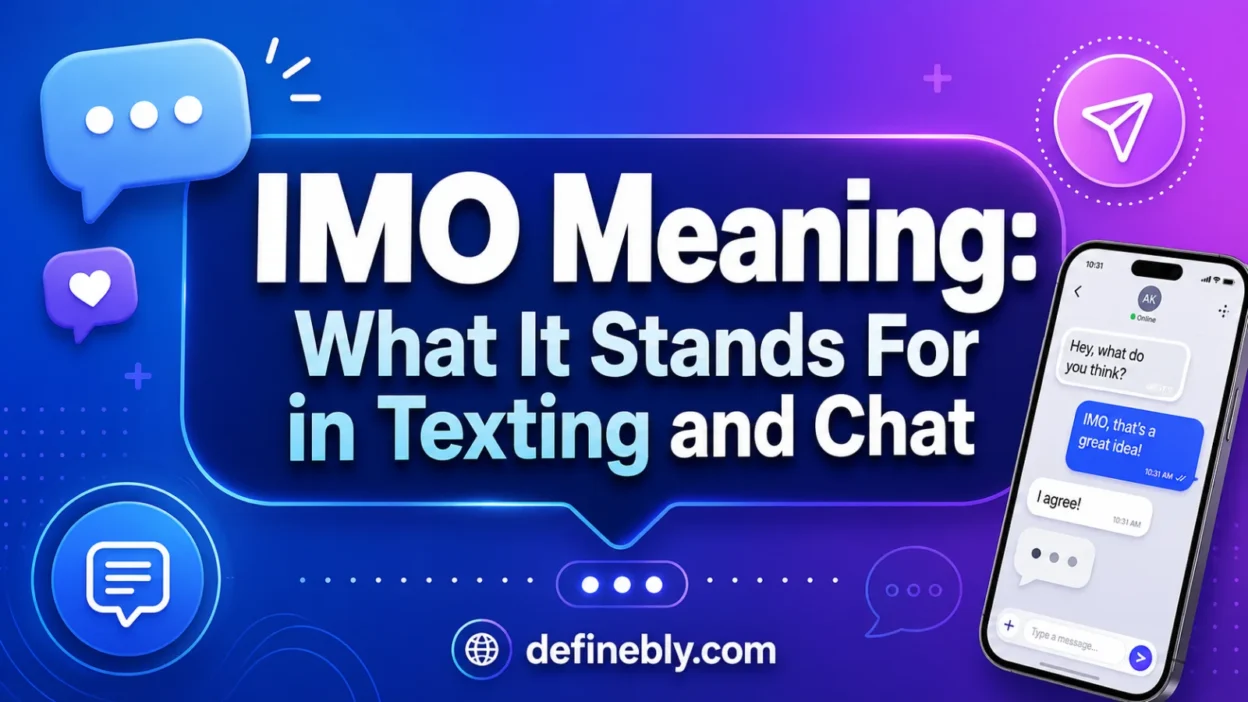
IMO stands for “in my opinion.” People use it in texts, chats, comments, and other informal digital writing to show that they are sharing a personal view rather than stating a fact. That is the standard meaning reflected in Merriam-Webster and Cambridge.
Quick Answer
IMO means “in my opinion.” It tells the reader that what follows is the writer’s personal take, not an objective fact. In real use, it can also make a message sound a little softer or less absolute.
What IMO Stands For
The basic expansion is simple: IMO = in my opinion. Merriam-Webster defines it that way directly, and Cambridge says it is a written abbreviation used when you tell someone your opinion, including in emails and other digital communication.
That core meaning has stayed stable even as internet language has changed.
What IMO Means In Context
In actual messages, IMO does more than announce an opinion. It often helps frame a statement as personal, subjective, and open to disagreement. That is why it can make a message feel less like a hard claim and more like a viewpoint. How-To Geek describes IMO and IMHO as disclaimers that signal a statement should not be taken as fact, and newer usage explainers say IMO can soften what might otherwise sound too definite.
For example:
- “IMO, the first season was better.”
- “That restaurant is overpriced, IMO.”
In both cases, the speaker is not claiming objective truth. They are marking the sentence as a personal judgment.
Where People Use IMO
IMO is most common in informal digital communication, especially in:
- text messages
- group chats
- social media comments
- forums
- direct messages
- casual emails
Cambridge explicitly mentions email use, while modern usage pages place it broadly in texting, chats, and online conversation. It is much less natural in formal writing, where spelling out in my opinion or using a fuller phrase is usually better.
Tone And Register
The tone of IMO is usually casual and direct. It can make a sentence feel more conversational because it signals that the speaker is offering a view, not laying down a rule. At the same time, it does not automatically make a sentence polite. If the opinion itself is blunt, IMO may still sound blunt.
For example:
- “IMO, we should leave earlier.” sounds practical.
- “IMO, that idea makes no sense.” still sounds sharp.
So IMO often softens tone, but it does not erase the content of what follows.
IMO Vs. IMHO
IMHO is closely related to IMO. It usually means “in my humble opinion,” though some users interpret it as “in my honest opinion.” How-To Geek and other explainers note both versions. In practice, the two abbreviations are often interchangeable, but IMHO can sound slightly softer, more self-effacing, or more old-internet in tone.
That means:
- IMO = neutral opinion marker
- IMHO = slightly softer or more self-conscious opinion marker
The difference is real, but usually small.
IMO Vs. Plain English
In many messages, IMO works naturally because it is short and familiar. But in settings where clarity or tone matters more, spelling it out can sound better.
- IMO, this update is worse feels casual and chat-like.
- In my opinion, this update is worse feels more polished.
That is why IMO fits well in digital conversation but not always in professional or formal writing.
Other Meanings Of IMO
In texting and chat, IMO most commonly means in my opinion. Outside that context, though, abbreviations can have other meanings. Abbreviations.com, for example, lists multiple expansions, including International Maritime Organization. That is another reason context matters.
For this topic, though, the texting meaning is by far the relevant one.
Origin And History
IMO belongs to early internet and email-style abbreviation culture. Modern explainers group it with older chat and message-board shorthand that became common long before current social media. How-To Geek treats it as part of long-running internet slang culture, and Cambridge’s email-based example shows how established it is in written digital English.
Even though the exact first use is not the main point, the term clearly comes from online shorthand designed to keep messages quick and conversational.
Example Sentences
- “IMO, the original version was better.”
- “That color looks better, imo.”
- “We should leave earlier, IMO, or we’ll hit traffic.”
- “IMO, the update made the app harder to use.”
- “The second option is stronger, imo.”
These examples sound natural because they show IMO in the kinds of low-friction opinion statements where people actually use it.
Similar Short Forms
A few close alternatives include:
- IMHO — in my humble opinion / in my honest opinion
- TBH — to be honest
- NGL — not gonna lie
- FYI — for your information
The closest match is IMHO, because it serves almost the same function while often sounding a little softer.
FAQ
Is IMO rude?
Not usually. It is mainly a neutral way to mark something as a personal view. But if the opinion itself is harsh, IMO will not automatically make it sound kind. It softens certainty more than it softens content.
Is IMO formal?
No. It is mostly used in casual digital communication such as texts, chats, social posts, forums, and casual emails. Cambridge explicitly frames it as a written abbreviation used in that kind of context.
What is the difference between IMO and IMHO?
IMO means in my opinion. IMHO usually means in my humble opinion, though some people also interpret it as in my honest opinion. In practice, both mark a statement as personal rather than factual, but IMHO can sound slightly softer.
What is the simplest meaning of IMO?
The simplest meaning is in my opinion. Merriam-Webster and Cambridge both define it that way directly.
Conclusion
IMO means “in my opinion.” In digital conversation, it helps mark a statement as personal rather than factual, and it often makes a message feel more conversational and less absolute. That is why it remains so common in texts, chats, comments, and casual email: it is short, familiar, and useful for sharing a view without sounding overly formal.