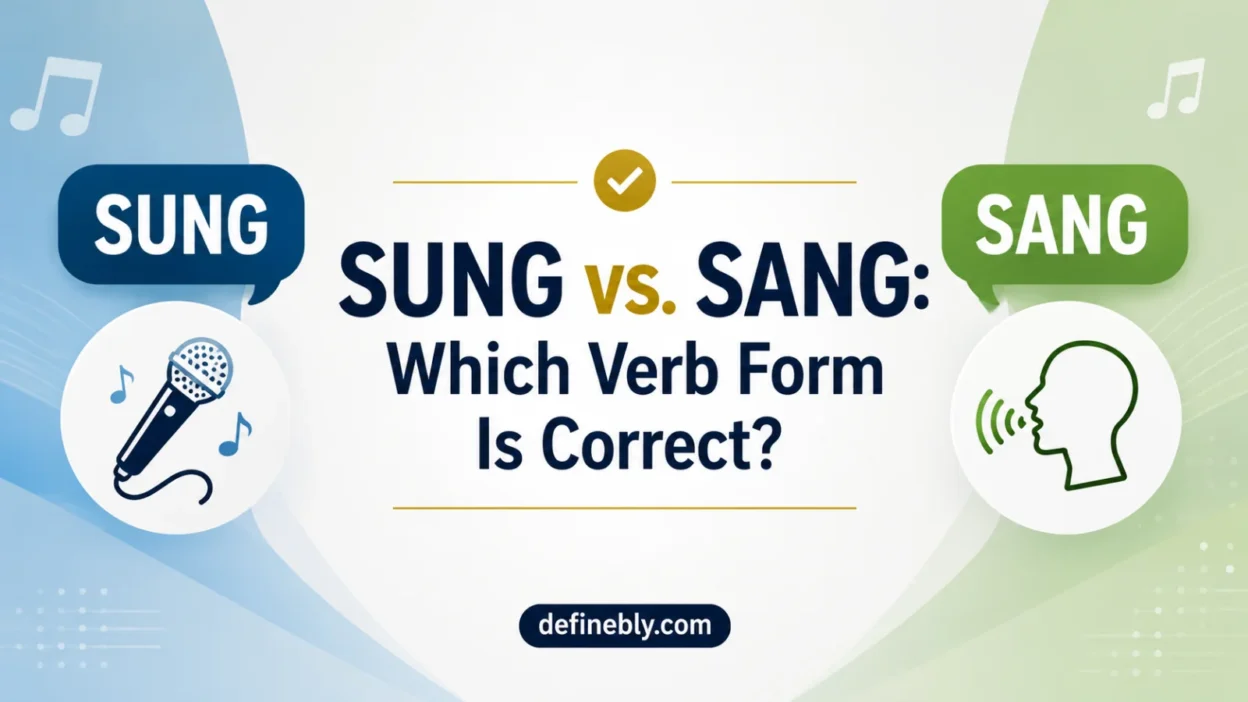
Sang is the simple past tense of sing. Use it when there is no helping verb: She sang at the ceremony.
Sung is the past participle. Use it with a helping verb — have, has, had, was, were, is, been — or as an adjective before a noun: She has sung at every ceremony. The anthem was sung beautifully. A sung Mass.
The one error to know by heart: “I have sang” is always wrong. Have/has/had require the past participle, which is sung, never sang.
Where These Forms Come From
Sing descends from Old English singan, a strong class III verb. Strong verbs in Old English — and in the Germanic languages generally — did not form their past tenses by adding -ed. Instead, they used ablaut: a systematic vowel shift that changed the root vowel to signal tense.
The pattern for singan followed the i/a/u sequence:
Present stem: i (singan)
Past stem: a (sang)
Past participle stem: u (sungen/sung)
This i/a/u vowel shift is not peculiar to sing. It is the same pattern that runs through an entire family of related verbs in English, all of which work by identical rules.
The Full Tense Chart
| Tense | Form | Example |
|---|---|---|
| Present | sing | She sings every morning. |
| Simple past | sang | She sang at the ceremony last night. |
| Present perfect | has/have sung | She has sung here before. |
| Past perfect | had sung | She had sung before the power went out. |
| Present participle | singing | She is singing now. |
| Passive voice | was/were/is sung | The anthem was sung by a soloist. |
The helping-verb test: if any form of have, has, had, is, was, were, or been precedes the verb, use sung. Without a helping verb and without a noun following, use sang.
Passive Voice — Where Writers Freeze
The original rule — sung needs a helping verb — applies equally to passive constructions, and this is where writers most often pause in uncertainty.
The anthem was sung before the game. ✔ (was is the helping verb)
The lullaby has been sung in this family for generations. ✔ (has been are the helping verbs)
It will be sung again at the closing ceremony. ✔ (will be = helping verbs)
The anthem was sang before the game. ✗
It has been sang in this family for generations. ✗
The test is the same: sung is always the past participle. Any helping verb — including the passive was/were/is/are/will be — triggers the past participle form.
“Sung” as an Adjective
Sung also appears without any helping verb when it functions as an adjective before a noun. This use is particularly common in music and liturgical writing.
A sung Mass features music throughout the service.
The sung portions of the liturgy alternate with spoken prayer.
This is a sung melody, not a spoken recitative.
Here sung is not missing a helping verb — it is doing the work of an adjective, describing the noun that follows. This is a standard, documented use of the past participle and is correct without have or was.
The Sibling Verb Family
Sing/sang/sung belongs to a recognizable class of English verbs that all follow the same i/a/u vowel pattern. Once you know one, the others become predictable.
| Verb | Simple Past | Past Participle |
|---|---|---|
| sing | sang | sung |
| ring | rang | rung |
| drink | drank | drunk |
| swim | swam | swum |
| begin | began | begun |
| sink | sank | sunk |
| spring | sprang | sprung |
| shrink | shrank | shrunk |
All of these use the simple past form (sang, rang, drank) without a helping verb, and the past participle form (sung, rung, drunk) with one. “I have drank” is wrong for the same reason “I have sang” is wrong — both use the simple past where a past participle is required.
Why “I Sung” Sounds Natural but Isn’t Standard
In older English, sung appeared as a simple past tense — this is historically documented. Some dialects of American English have preserved that older use. But standard edited English has maintained the three-form distinction for centuries, and grammar authorities — Merriam-Webster, Garner’s, CMOS — treat sung as a simple past as nonstandard.
The persistence of “she sung” in casual speech is not random: it follows the same pattern as ring → rung and drink → drunk, where some speakers regularize to the past participle in conversation. That regularization is understandable; it just hasn’t been accepted in formal writing.
Common Mistakes and Quick Fixes
Mistake: I have sang that song a hundred times.
Fix: I have sung that song a hundred times. — have requires the past participle.
Mistake: She sung the national anthem at the stadium.
Fix: She sang the national anthem at the stadium. — no helping verb; simple past form.
Mistake: He had sang before the curtain rose.
Fix: He had sung before the curtain rose. — had requires the past participle.
Mistake: The ballad was sang by the opening act.
Fix: The ballad was sung by the opening act. — passive voice requires the past participle.
Mistake: They sung Happy Birthday and brought out the cake.
Fix: They sang Happy Birthday and brought out the cake. — no helping verb present.
Examples in Context
She sang in the school play last spring. (simple past — no helping verb)
She has sung in the school play every year since sixth grade. (present perfect — has)
She had sung two songs before the accompanist arrived. (past perfect — had)
The opening number was sung by the full cast. (passive — was)
This is a sung tradition, not a spoken one. (adjective — modifying tradition)
We sang along the entire way home. (simple past — no helping verb)
Quick Practice
Choose the correct form.
- The soloist [sang / sung] three songs before the intermission.
- I have never [sang / sung] in front of an audience before.
- The chorus [sang / sung] the same piece at the funeral.
- The hymn has been [sang / sung] at this church for over a century.
- By the time we arrived, they had already [sang / sung] the opening number.
- It was a [sang / sung] prayer, not a spoken one.
Answers: 1. sang — 2. sung — 3. sang — 4. sung — 5. sung — 6. sung (adjective)
FAQs
Is it “I have sang” or “I have sung”?
I have sung is always correct. Have, has, and had require a past participle, and sung is the past participle of sing. Sang is the simple past and never follows a helping verb.
When do you use “sang” vs. “sung”?
Sang when there is no helping verb — reporting a completed event at a specific past moment. Sung whenever a helping verb (have, has, had, was, were, is, been, will be) precedes the verb form.
Is “she sung the song” ever acceptable?
Not in standard edited writing. It appears in casual speech and reflects an older dialect pattern, but Merriam-Webster and all major style authorities treat it as nonstandard. Use she sang the song.
Can “sung” appear without a helping verb?
Yes, in one case: as an adjective before a noun. “A sung Mass” and “the sung portions of the service” are correct because sung there is an attributive adjective, not a past participle missing its auxiliary.
What verbs follow the same pattern as sing/sang/sung?
All verbs following the i/a/u Germanic ablaut pattern: ring/rang/rung, drink/drank/drunk, swim/swam/swum, begin/began/begun, sink/sank/sunk, spring/sprang/sprung. All use the middle form (rang, drank) for simple past and the final form (rung, drunk) for past participle — exactly as sing/sang/sung does.
Is “was sung” correct?
Yes. “The anthem was sung by a soprano” is correct passive voice — sung is the past participle, and was is the helping verb. “The anthem was sang” is always wrong.
The Bottom Line
Sang is the simple past — no helping verb, one completed action in the past. Sung is the past participle — always used with a helping verb (have, has, had, was, were, is, been) or as an adjective before a noun. The one error everyone makes: “I have sang” pairs the wrong form with a helping verb. Change sang to sung anywhere a helping verb appears, and the entire sang/sung question resolves itself.
Conclusion
The sang/sung split comes down to one simple check: look for a helping verb. No helper means “sang.” A helper like have, has, or had means “sung.” Once that test becomes automatic, the confusion disappears for good.