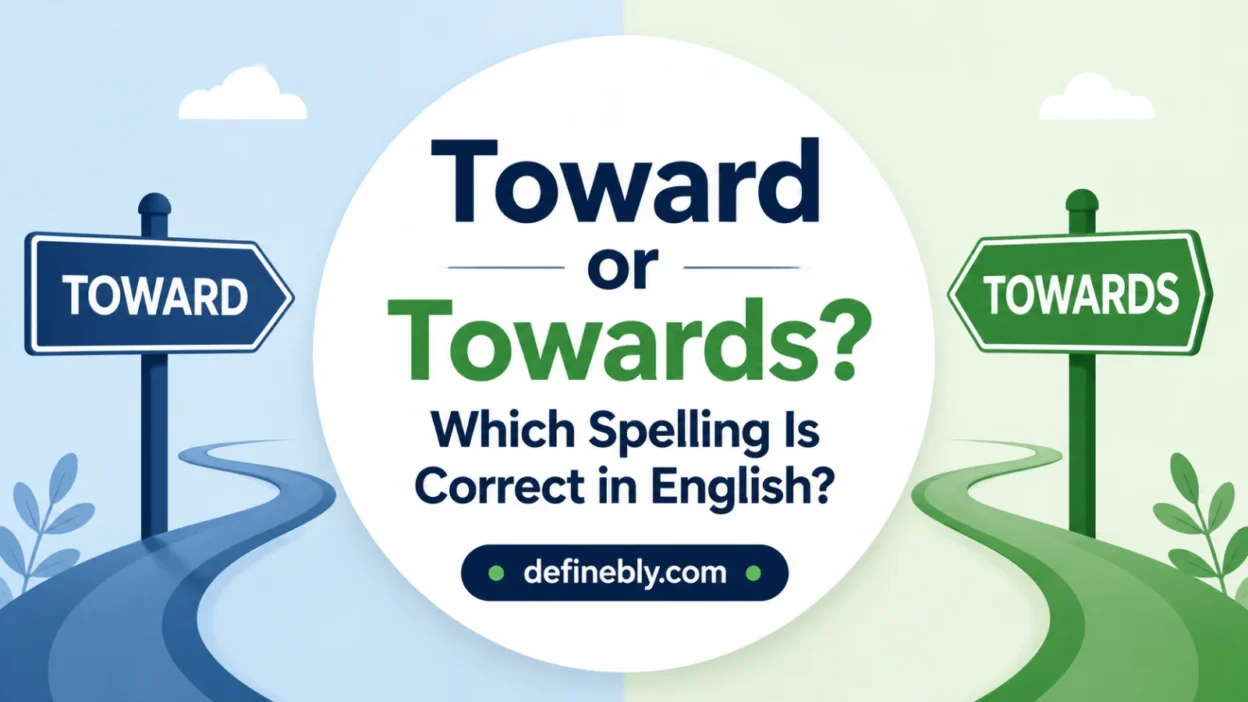
Many English learners and writers wonder whether they should use toward or towards. The good news is that both spellings are standard English.
The main difference is regional preference rather than meaning.
Quick Answer
Both toward and towards are correct English words. They have the same meaning and can usually be used interchangeably.
The main difference is regional preference:
- Toward is the preferred spelling in American English.
- Towards is more common in British English, Australian English, and other Commonwealth varieties.
If you’re writing for a US audience, toward is usually the better choice.
Which Spelling Is Correct?
The simple answer is that both spellings are correct.
Neither word changes the meaning of a sentence. Both function as prepositions that indicate direction, movement, relation, or approach.
Consider these examples:
- She walked toward the station.
- She walked towards the station.
The meaning remains exactly the same.
The choice depends primarily on the spelling conventions of your audience.
Why Do Both Forms Exist?
English has long allowed two versions of several directional words.
Historically, some words developed both a shorter form and an -s ending form. Over time, different English-speaking regions developed different preferences.
This pattern appears in other word pairs as well:
| American English | British English |
|---|---|
| toward | towards |
| forward | forwards |
| backward | backwards |
| afterward | afterwards |
American English generally favors the shorter form, while British English often prefers the version ending in -s.
American English Vs British English Usage
American English
Most American publications, universities, newspapers, and style guides prefer toward.
Examples:
- The company is moving toward renewable energy.
- Public opinion shifted toward stricter regulations.
- We drove toward the coast before sunrise.
You’ll see toward throughout academic writing, journalism, business communication, and professional publications in the United States.
British English
British writers often choose towards, although toward is not considered incorrect.
Examples:
- The audience turned towards the stage.
- Investment is moving towards sustainable industries.
- Her attitude changed towards the proposal.
In the UK, the version ending in -s is generally more common in everyday writing.
Style Guide Preferences
Many American editorial standards favor toward.
This preference appears frequently in:
- Newspaper writing
- Academic publications
- Business communication
- Government documents
- Professional editing standards
British publishers, on the other hand, often prefer towards as part of their broader spelling conventions.
The important point is consistency. Once you choose one form, use it throughout the document.
When To Use Toward
Choose toward when:
- Writing for a US audience
- Following American spelling conventions
- Creating academic papers for US institutions
- Writing content for American publications
- Following most US editorial style guides
Examples
- She stepped toward the door.
- The discussion moved toward a solution.
- Investors are shifting toward safer assets.
- The organization is working toward long-term goals.
Notice that the word works for both physical and abstract movement.
When To Use Towards
Choose towards when:
- Writing for a British audience
- Following UK spelling conventions
- Creating content for Commonwealth publications
- Matching a publication’s established style
Examples
- The crowd moved towards the exit.
- The government is working towards reducing emissions.
- His feelings towards the project improved over time.
- The company is moving towards digital operations.
Again, the meaning is identical to toward.
Common Uses Beyond Physical Direction
Many learners associate these words only with movement, but they are often used in abstract ways.
Attitudes And Feelings
- Her attitude toward the issue changed.
- Their response towards customers improved.
Goals And Progress
- We are working toward a common objective.
- The team is moving towards greater efficiency.
Relationships
- His behavior toward colleagues was respectful.
- Their approach towards employee development evolved over time.
Common Mistakes
Assuming One Form Is Wrong
Both spellings are standard English.
Mixing Forms In The Same Document
Switching between toward and towards can make writing appear inconsistent.
Thinking The Meaning Changes
The meaning stays the same regardless of spelling.
Ignoring Audience Expectations
A US audience generally expects toward, while UK readers often expect towards.
How To Choose The Right Form
Use this simple rule:
- Writing for Americans → toward
- Writing for British readers → towards
- Writing for an international audience → either form is acceptable
- Following a publication style guide → follow that guide consistently
When in doubt, match the spelling system used throughout the rest of your document.
Frequently Asked Questions
Is toward or towards correct?
Both are correct English spellings. The difference is mainly regional preference.
Is towards wrong in American English?
No. Americans understand and occasionally use it, but toward is generally preferred.
Do toward and towards mean different things?
No. They have the same meaning and perform the same grammatical function.
Which form is more common in the United States?
Toward is significantly more common in American publishing, education, and professional writing.
Which form is more common in the United Kingdom?
Towards is generally more common in British English.
Should students use toward or towards?
Students should follow the spelling conventions required by their school, instructor, or publication. For US academic writing, toward is usually preferred.
Can I use both spellings in one article?
It’s better to choose one form and remain consistent throughout the piece.
Are there other words with similar differences?
Yes. Similar American and British variations include forward/forwards, backward/backwards, and afterward/afterwards.
Conclusion
Both toward and towards are correct English spellings with identical meanings. The difference comes down to regional preference rather than grammar or definition.
For American English, toward is the standard choice and appears most often in professional, academic, and published writing. For British English, towards is generally more common.
Whichever form you choose, the most important rule is consistency. Matching your audience’s expectations will make your writing look polished, professional, and natural.