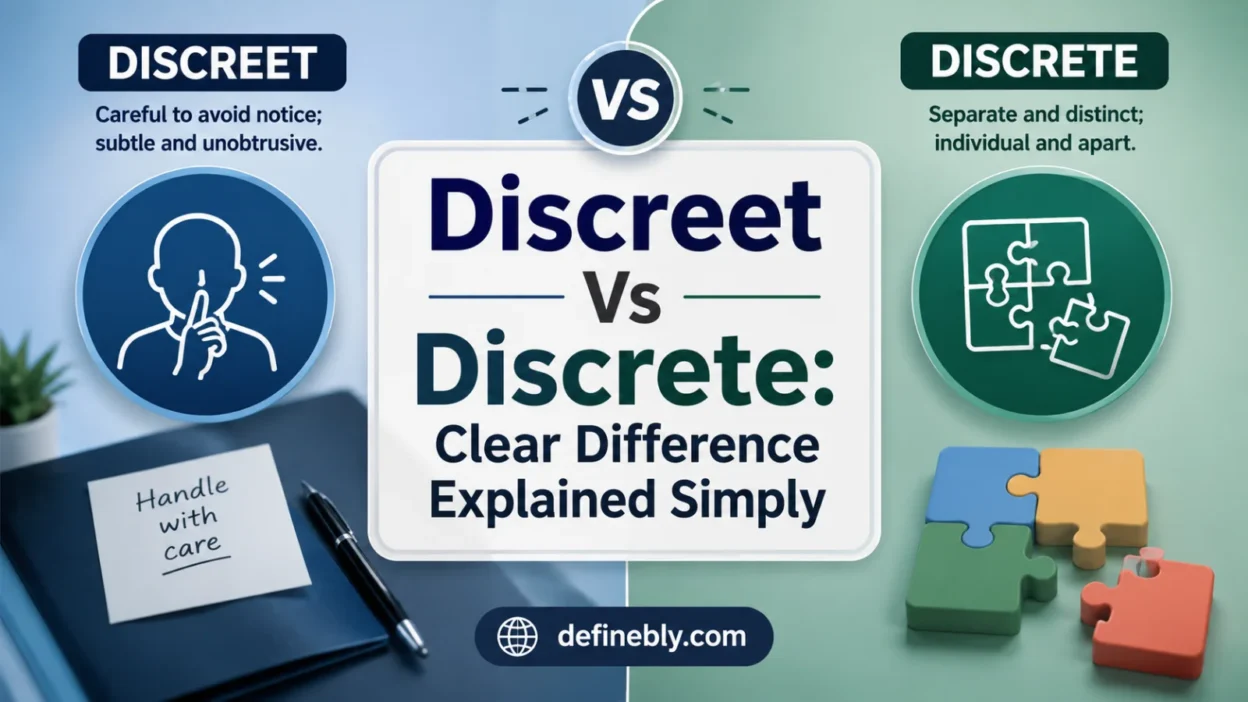
“Discreet” and “discrete” are often confused because they sound identical and differ by only one letter. However, they have completely different meanings.
- Discreet refers to being careful, private, or not attracting attention.
- Discrete means separate, distinct, or individually divided.
Understanding this difference is important in writing, especially in professional, academic, and technical contexts where a small spelling error can change the meaning entirely.
Quick Answer
Discreet means careful, private, or subtle behavior that avoids attention.
Discrete means separate, distinct, or individually defined things.
Example:
- She was very discreet about the surprise party.
- The system stores discrete data points.
Why People Confuse Discreet And Discrete
These words are confusing for three main reasons:
- They sound exactly the same when spoken
- They differ by only one letter
- They appear in completely different contexts, so learners don’t connect them
In fast writing or editing, the spelling difference is easy to miss, which leads to common mistakes in professional documents.
Pronunciation Confusion
Both words are pronounced the same: /dɪˈskriːt/.
Because there is no audible difference, writers must rely entirely on spelling and context to choose the correct word.
Discreet Vs Discrete At A Glance
| Context | Correct Word | Meaning |
|---|---|---|
| Private or careful behavior | discreet | not attracting attention |
| Secret actions or manners | discreet | subtle and cautious |
| Separate categories or parts | discrete | individually distinct |
| Data or technical systems | discrete | separate units or values |
| Mathematics or computing | discrete | non-continuous elements |
What Does Discreet Mean?
Discreet describes behavior that is careful, subtle, or designed not to attract attention.
It is commonly used in social, personal, and professional situations where privacy or sensitivity matters.
Examples
- She gave a discreet smile during the meeting.
- The lawyer was discreet about client details.
- He made a discreet phone call outside the room.
Key Idea
Discreet behavior = avoiding attention or protecting privacy.
What Does Discrete Mean?
Discrete means separate, distinct, or individually divided.
It is widely used in mathematics, science, technology, and data analysis.
Examples
- The dataset contains discrete values.
- The system is divided into discrete modules.
- Each user action is recorded as a discrete event.
Discrete In Science, Math, And Technology
In technical fields, “discrete” has a more specific meaning:
Discrete Data Vs Continuous Data
- Discrete data = separate values (e.g., number of students, number of cars)
- Continuous data = smooth, measurable values (e.g., height, temperature)
Example:
- Number of emails received → discrete
- Temperature changes → continuous
Computing And Systems
In computing:
- A system may have discrete components
- Events are often recorded as discrete actions
- AI systems analyze discrete inputs in structured form
This usage is extremely common in modern technology writing.
Discreet Vs Discrete In Real Life
Discreet (Behavior And Privacy)
- avoiding gossip
- keeping secrets
- professional confidentiality
Example:
- The doctor was discreet about patient information.
Discrete (Separation And Structure)
- categories
- data points
- system components
Example:
- The application breaks tasks into discrete steps.
Common Mistakes And Fixes
Using “Discrete” Instead Of “Discreet”
Incorrect:
- She was very discrete about the surprise.
Correct:
- She was very discreet about the surprise.
Using “Discreet” In Technical Contexts
Incorrect:
- The system uses discreet data points.
Correct:
- The system uses discrete data points.
Treating Them As Interchangeable
Incorrect:
- He made a discrete conversation with the client.
Correct:
- He made a discreet conversation with the client.
Sentence Correction Practice
- ❌ She handled the situation in a discrete way.
✔ She handled the situation in a discreet way. - ❌ The model works with discreet variables.
✔ The model works with discrete variables. - ❌ He was discrete about his plans.
✔ He was discreet about his plans.
Memory Tricks To Remember The Difference
- Discreet = extra “e” for extra privacy (secret behavior)
- Discrete = separated “parts” (things apart)
Another simple rule:
- Discreet = people behavior
- Discrete = systems and structure
Synonyms And Related Words
Discreet
- careful
- subtle
- private
- reserved
- tactful
Discrete
- separate
- distinct
- individual
- independent
- unconnected
Common Professional Usage
Business And Workplace
- discreet handling of sensitive information
- discrete project phases in workflows
Science And Engineering
- discrete signals
- discrete systems
- discrete variables in analysis
Data And AI
- discrete datasets
- discrete classifications
- discrete model outputs
Why This Spelling Matters
Using the wrong word can:
- confuse readers
- weaken professional credibility
- change technical meaning entirely
For example, in data science, “discreet data” is incorrect and misleading, while “discrete data” is a standard technical term.
FAQ
What is the difference between discreet and discrete?
Discreet means careful and private behavior, while discrete means separate or distinct elements.
Why are discreet and discrete so confusing?
They are homophones (same pronunciation) and differ by only one letter, which makes them easy to mix up.
What is an example of discreet behavior?
A discreet person avoids drawing attention, such as keeping private information confidential.
What is discrete data?
Discrete data consists of separate, countable values like number of students or cars.
Is it discrete or discreet in science?
In science and math, the correct word is “discrete,” not “discreet.”
How can I remember discreet vs discrete?
Think: discreet = private behavior, discrete = separate parts.
Conclusion
The difference between “discreet” and “discrete” comes down to meaning, not spelling similarity.
- Use discreet for privacy, caution, and subtle behavior.
- Use discrete for separation, structure, and technical concepts.
Once you connect discreet with “privacy” and discrete with “separation,” the confusion disappears and your writing becomes more accurate and professional.