To, too, and two sound the same, but they have different meanings.
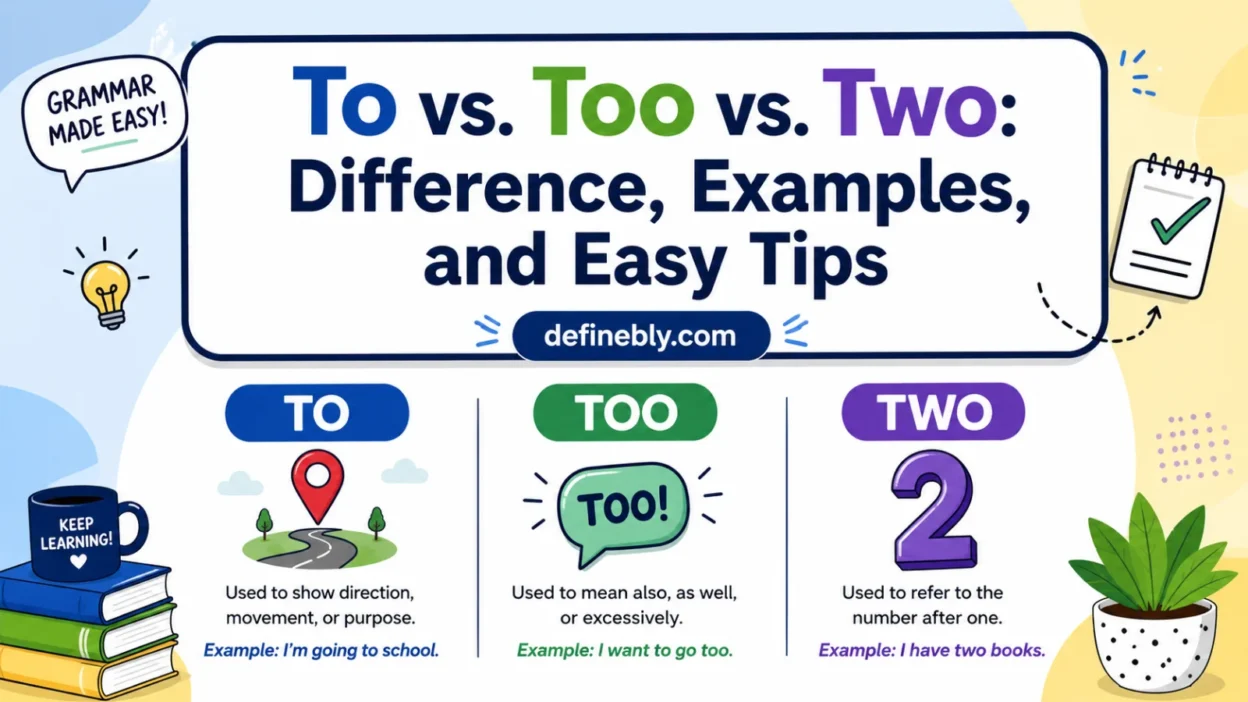
Use to for direction, destination, transfer, purpose, or before a verb. Use too when you mean also or more than needed. Use two when you mean the number 2.
Correct:
- I am going to the store.
- I want to go too.
- I bought two tickets.
The easiest rule is this: to points, too adds, and two counts.
Quick Answer
Use to when the sentence shows where something goes, who receives something, why something happens, or what action follows.
Correct:
- We drove to Boston.
- Send the file to Maya.
- I need to study tonight.
Use too when the sentence means also or excessively.
Correct:
- I want one too.
- This coffee is too hot.
Use two when the sentence means the number 2.
Correct:
- We need two chairs.
Quick test:
- To = direction, transfer, purpose, or verb marker
- Too = also or more than needed
- Two = 2
Why People Confuse Them
To, too, and two are homophones.
Homophones sound the same but have different spellings and meanings.
When spoken aloud, these three words usually sound identical. In writing, the spelling tells the reader what you mean.
Compare:
- We went to lunch.
- We went too.
- We went with two friends.
The first sentence shows destination. The second means we also went. The third gives a number.
Because all three words sound alike, reading a sentence out loud may not catch the mistake. You need to check the meaning.
Key Differences At A Glance
| Context | Best Choice | Why |
|---|---|---|
| Direction or destination | to | It points toward a place or person. |
| Transfer or receiver | to | It shows who gets something. |
| Before a verb | to | It helps form an infinitive. |
| Meaning also | too | It adds another person, thing, or idea. |
| Meaning excessively | too | It means more than wanted or needed. |
| The number 2 | two | It names the number. |
| Counting people or things | two | It gives an exact quantity. |
Meaning And Usage Difference
To often shows direction or destination.
Correct:
- She walked to school.
- We are driving to the airport.
- I sent the package to my brother.
- The dog ran to the door.
In these sentences, to points toward a place, person, or destination.
To can also come before a verb.
Correct:
- I need to study tonight.
- She wants to call later.
- We tried to finish early.
- He forgot to lock the door.
In these examples, to helps form the verb phrase.
Too means also.
Correct:
- I want one too.
- Can I come too?
- She likes that song too.
- We ordered dessert too.
Too can also mean more than needed, more than wanted, or excessively.
Correct:
- The soup is too hot.
- This bag is too heavy.
- It is too late to call.
- The price is too high.
Two is the number 2.
Correct:
- We have two dogs.
- She bought two tickets.
- The meeting starts in two hours.
- I have two questions.
Tone, Context, And Grammar
To is often a preposition.
Common patterns:
- go to school
- drive to work
- give it to me
- send it to Ava
- walk to the door
- talk to a teacher
Examples:
- Please give the form to the receptionist.
- We walked to the park after lunch.
- I sent the reminder to the team.
To can also mark an infinitive before a verb.
Common patterns:
- to eat
- to sleep
- to learn
- to finish
- to answer
- to understand
Examples:
- I forgot to answer the email.
- She wants to learn Spanish.
- We need to leave soon.
Too is an adverb. It adds meaning to a sentence.
When too means also, it often appears near the end of a sentence.
Examples:
- I’m going too.
- They want dessert too.
- My sister is coming too.
When too means excessively, it usually comes before an adjective or adverb.
Examples:
- too cold
- too expensive
- too quickly
- too late
- too much
Two is a number. It describes quantity.
Common patterns:
- two books
- two people
- two days
- two slices
- two choices
- two times
Examples:
- We waited two hours.
- She has two brothers.
- I need two copies of the form.
Which One Should You Use?
Use to if the sentence shows direction, destination, transfer, purpose, or a verb action.
Ask:
- Is someone going somewhere?
- Is something being sent or given?
- Does a verb come next?
- Does the phrase explain purpose?
Correct:
- I am going to class.
- Send the receipt to my email.
- I need to call my doctor.
- She saved money to buy a car.
Use too if the sentence means also.
Ask:
- Can I replace it with also or as well?
Correct:
- I want to go too.
- I want to go as well.
Use too if the sentence means more than needed.
Ask:
- Does it mean excessively?
- Does it come before an adjective or adverb?
Correct:
- The room is too cold.
- The room is colder than wanted.
Use two if the sentence means the number 2.
Ask:
- Can I replace it with the numeral 2?
Correct:
- We need two chairs.
- We need 2 chairs.
When One Choice Sounds Wrong
Use to, not too, before most verbs.
Incorrect:
- I want too go home.
Correct:
- I want to go home.
The word to belongs before the verb go.
Use too, not to, when the meaning is also.
Incorrect:
- I want one to.
Correct:
- I want one too.
The sentence means I also want one.
Use two, not to or too, for the number.
Incorrect:
- I have too brothers.
Correct:
- I have two brothers.
The sentence gives a number.
Use too, not to, in phrases like too much, too many, too late, and too expensive.
Incorrect:
- This costs to much.
Correct:
- This costs too much.
The sentence means the cost is more than expected or wanted.
Common Mistakes And Quick Fixes
Using Too Before A Verb
Incorrect:
- I need too leave early.
- She forgot too call.
- We tried too finish on time.
- He wants too apply today.
Correct:
- I need to leave early.
- She forgot to call.
- We tried to finish on time.
- He wants to apply today.
Quick fix:
If a verb comes next, to is usually correct.
Using To When You Mean Also
Incorrect:
- Me to.
- I’m coming to.
- She wants dessert to.
- We liked it to.
Correct:
- Me too.
- I’m coming too.
- She wants dessert too.
- We liked it too.
Quick fix:
If also fits, use too.
Using To Instead Of Too For Excess
Incorrect:
- It is to late.
- This bag is to heavy.
- The music is to loud.
- You are speaking to fast.
Correct:
- It is too late.
- This bag is too heavy.
- The music is too loud.
- You are speaking too fast.
Quick fix:
If the meaning is more than wanted, use too.
Using Too Instead Of Two For The Number
Incorrect:
- I bought too tickets.
- We need too chairs.
- She has too dogs.
- The class lasts too hours.
Correct:
- I bought two tickets.
- We need two chairs.
- She has two dogs.
- The class lasts two hours.
Quick fix:
If you can replace the word with 2, use two.
Using Two Instead Of To Or Too
Incorrect:
- I need two leave now.
- Can I come two?
- This is two expensive.
Correct:
- I need to leave now.
- Can I come too?
- This is too expensive.
Quick fix:
Use two only for the number.
Everyday Examples
To In Sentences
- I am going to class.
- Please send this to Ava.
- We drove to the beach.
- I need to call my doctor.
- She wants to finish early.
- Give the keys to your brother.
- The kids ran to the bus.
- I saved the file to my desktop.
Too In Sentences
- Can I come too?
- I want dessert too.
- This coffee is too sweet.
- The box is too heavy.
- You are too kind.
- It is too late to cancel.
- She is coming too.
- The instructions were too confusing.
Two In Sentences
- She has two meetings today.
- We bought two pizzas.
- I need two minutes.
- The office has two entrances.
- He ordered two coffees.
- The form needs two signatures.
- We have two options.
- The trip lasted two days.
To, Too, And Two In The Same Sentence
- It is too late to buy two tickets.
- We went to lunch with two friends, and they came too.
- I need to send two emails too.
- She wants to bring two guests too.
- Please send this to the two people who asked too.
- We were too tired to watch two movies.
Common Phrases With To, Too, And Two
Use to in direction, transfer, and verb phrases:
- go to school
- drive to work
- send to a friend
- give to me
- need to leave
- want to help
- try to understand
- ready to start
Use too in addition and excess phrases:
- me too
- you too
- too much
- too many
- too late
- too soon
- too expensive
- too quickly
Use two in counting phrases:
- two people
- two days
- two tickets
- two choices
- two reasons
- two times
- two dollars
- two examples
These phrase patterns are often the fastest way to choose the right spelling.
Synonyms Or Closest Alternatives
Closest alternatives for to depend on the sentence.
Possible alternatives include:
- toward
- into
- for
- in order to
Examples:
- We drove to Boston.
- We drove toward Boston.
- I saved money to buy a laptop.
- I saved money in order to buy a laptop.
Closest alternatives for too include:
- also
- as well
- overly
- excessively
- more than needed
Examples:
- I want dessert too.
- I want dessert as well.
- This soup is too salty.
- This soup is overly salty.
Closest alternative for two is:
- 2
Example:
- We need two seats.
- We need 2 seats.
These alternatives are mainly tests. They are not always the smoothest replacements in real sentences.
Quick Proofreading Checklist
Before choosing to, too, or two, ask these questions:
- Does the sentence show direction or destination?
- Is something being sent, given, or transferred?
- Does a verb come next?
- Does the word mean also?
- Does the word mean more than needed?
- Does the word mean the number 2?
- Can I replace it with also?
- Can I replace it with 2?
Use to for direction, transfer, purpose, or before a verb.
Use too for also or excessively.
Use two for the number 2.
Quick Memory Fix Or Rule Of Thumb
Use this simple rule:
To = points.
Too = adds or overdoes.
Two = counts.
Memory tricks:
Too has an extra o, so it can mean something extra or excessive.
Two starts with tw, like twice.
To is the short default for direction and verbs.
Examples:
- I went to the store.
- I went too.
- I bought two things.
FAQs
What is the difference between to, too, and two?
To shows direction, destination, transfer, purpose, or comes before a verb.
Too means also or more than needed.
Two means the number 2.
Examples:
- I went to class.
- I went too.
- I have two classes today.
When should I use to?
Use to for direction, destination, transfer, purpose, or before a verb.
Examples:
- We drove to work.
- Give this to Mia.
- I need to study.
When should I use too?
Use too when you mean also or excessively.
Examples:
- I want one too.
- This bag is too heavy.
If also or more than needed fits, use too.
When should I use two?
Use two when you mean the number 2.
Examples:
- We need two chairs.
- She has two dogs.
- The meeting starts in two hours.
Is it me to or me too?
The correct phrase is me too.
Correct:
- I like that song.
- Me too.
It means I also like that song.
Is it to much or too much?
The correct phrase is too much.
Correct:
- This costs too much.
It means the amount is more than wanted or expected.
Is it to late or too late?
The correct phrase is too late.
Correct:
- It is too late to call.
It means the time is later than it should be.
Is it to go or too go?
The correct phrase is to go.
Correct:
- I need to go home.
Use to before the verb go.
Is it two people or too people?
The correct phrase is two people.
Correct:
- Two people are waiting outside.
Use two because the sentence gives a number.
Do to, too, and two sound the same?
Yes. In normal speech, to, too, and two usually sound the same.
That is why the mistake is common in writing. Use meaning, not sound, to choose the correct word.
Conclusion
Use to for direction, destination, transfer, purpose, or before a verb.
Use too when you mean also or more than needed.
Use two when you mean the number 2.
The easiest rule is simple: to points, too adds or overdoes, and two counts.