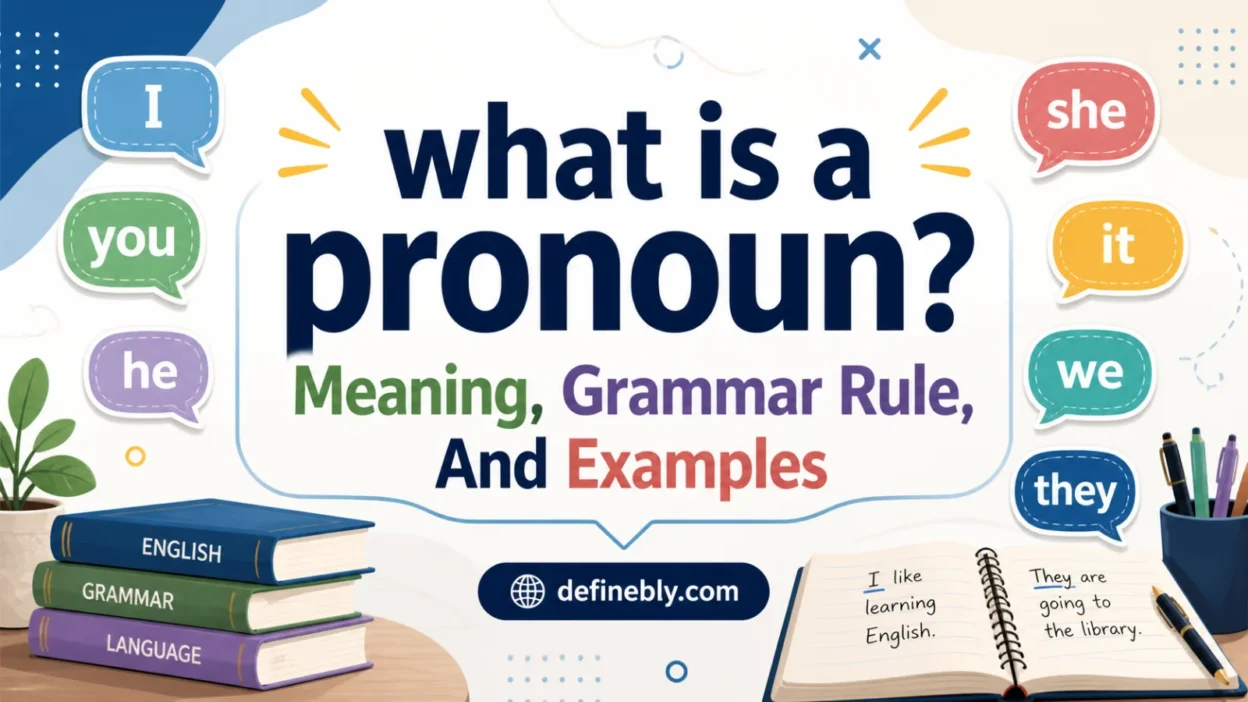
A pronoun is a word that replaces or refers to a noun or noun phrase. Pronouns help avoid repetition, connect ideas, and make sentences clearer.
Instead of writing this:
- Maya lost Maya’s keys because Maya left Maya’s bag at school.
You can write this:
- Maya lost her keys because she left her bag at school.
The words her and she are pronouns. They refer to Maya, so the sentence sounds natural instead of repetitive.
Quick Answer: What Is A Pronoun?
A pronoun is a word used in place of a noun or noun phrase.
Examples of pronouns include:
- I
- you
- he
- she
- it
- we
- they
- me
- him
- her
- us
- them
- mine
- yours
- this
- that
- who
- someone
Example:
- Jordan forgot his laptop.
The pronoun his refers to Jordan.
Pronouns can act as subjects, objects, possessives, questions, connectors, or words that point to people, things, places, ideas, and situations.
Why Pronouns Matter
Pronouns make writing easier to read. Without them, sentences become repetitive and awkward.
Repetitive:
- The teacher gave the teacher’s students the teacher’s notes.
Better:
- The teacher gave her students their notes.
Pronouns also help identify who is doing something, who receives an action, what belongs to whom, and which person or thing a sentence is about.
Examples:
- She called me.
- I called her.
- That book is mine.
- Who left the door open?
- The laptop that I bought is already broken.
What Is An Antecedent?
An antecedent is the noun or noun phrase that a pronoun refers to.
Example:
- Elena said she was ready.
The antecedent is Elena. The pronoun she refers to Elena.
Another example:
- The dog chased its tail.
The antecedent is dog. The pronoun its refers to the dog.
A pronoun should clearly point to its antecedent. If the reader cannot tell what a pronoun means, the sentence needs to be rewritten.
Unclear:
- Lena told Sofia that she was late.
Who was late, Lena or Sofia?
Clear:
- Lena told Sofia, “I am late.”
- Lena told Sofia that Sofia was late.
Common Pronoun Examples
| Pronoun | Type | Example Sentence |
|---|---|---|
| I | Subject Pronoun | I need a pen. |
| me | Object Pronoun | Please call me. |
| she | Subject Pronoun | She is ready. |
| him | Object Pronoun | I saw him outside. |
| we | Subject Pronoun | We won the game. |
| them | Object Pronoun | I invited them. |
| mine | Possessive Pronoun | That jacket is mine. |
| this | Demonstrative Pronoun | This is delicious. |
| who | Interrogative Pronoun | Who called? |
| someone | Indefinite Pronoun | Someone left a note. |
| herself | Reflexive Pronoun | She blamed herself. |
| each other | Reciprocal Pronoun | They helped each other. |
Types Of Pronouns
Pronouns come in several types. Each type has a different job in a sentence.
Personal Pronouns
Personal pronouns refer to specific people, things, groups, or the speaker and listener.
| Person | Subject Pronouns | Object Pronouns | Possessive Pronouns |
|---|---|---|---|
| First Person Singular | I | me | mine |
| Second Person Singular | you | you | yours |
| Third Person Singular | he, she, it, they | him, her, it, them | his, hers, its, theirs |
| First Person Plural | we | us | ours |
| Second Person Plural | you | you | yours |
| Third Person Plural | they | them | theirs |
Examples:
- I sent the email.
- The manager called me.
- She finished early.
- I spoke with him.
- They arrived late.
- The decision was theirs.
Subject Pronouns
Subject pronouns act as the subject of a sentence. They perform the action or are being described.
Subject pronouns include:
- I
- you
- he
- she
- it
- we
- they
Examples:
- She opened the window.
- They are waiting outside.
- We need more time.
- He forgot his password.
Use subject pronouns before the main verb when the pronoun is doing the action.
Correct:
- She and I are going to the meeting.
Incorrect:
- Her and me are going to the meeting.
Object Pronouns
Object pronouns receive the action of a verb or follow a preposition.
Object pronouns include:
- me
- you
- him
- her
- it
- us
- them
Examples:
- The teacher called me.
- I saw him yesterday.
- Please help us.
- The package is for them.
Use object pronouns after verbs and prepositions.
Correct:
- The invitation is for Anna and me.
Incorrect:
- The invitation is for Anna and I.
A simple test is to remove the other noun:
- The invitation is for me.
- The invitation is for I.
The first version is correct, so Anna and me is correct.
Possessive Pronouns
Possessive pronouns show ownership. They stand alone and do not come before a noun.
Possessive pronouns include:
- mine
- yours
- his
- hers
- ours
- theirs
Examples:
- That backpack is mine.
- The red car is hers.
- This table is ours.
- The final choice is theirs.
Do not confuse possessive pronouns with possessive determiners.
| Possessive Determiner | Possessive Pronoun |
|---|---|
| my book | the book is mine |
| your idea | the idea is yours |
| her jacket | the jacket is hers |
| our house | the house is ours |
| their car | the car is theirs |
Correct:
- That is my phone.
- That phone is mine.
Incorrect:
- That is mine phone.
Demonstrative Pronouns
Demonstrative pronouns point to specific people, things, ideas, or situations.
Demonstrative pronouns are:
- this
- that
- these
- those
Examples:
- This is my favorite song.
- That was a mistake.
- These are fresh.
- Those belong to my sister.
Use this and these for things that are near or current. Use that and those for things that are farther away or already mentioned.
Singular:
- This is expensive.
- That looks better.
Plural:
- These are clean.
- Those are broken.
A demonstrative pronoun stands alone. A demonstrative adjective comes before a noun.
Pronoun:
- This is useful.
Adjective:
- This guide is useful.
Pronoun:
- Those are mine.
Adjective:
- Those shoes are mine.
Interrogative Pronouns
Interrogative pronouns ask questions.
Common interrogative pronouns include:
- who
- whom
- whose
- what
- which
Examples:
- Who called you?
- Whom did you invite?
- Whose is this?
- What happened?
- Which do you prefer?
Use who for the subject of a question.
Correct:
- Who wrote this report?
Use whom for the object of a verb or preposition.
Formal:
- Whom did you call?
- To whom should I send this?
In everyday conversation, many speakers use who instead of whom, but whom is still useful in formal writing.
Relative Pronouns
Relative pronouns introduce clauses that describe a noun.
Common relative pronouns include:
- who
- whom
- whose
- which
- that
Examples:
- The woman who called is my doctor.
- The book that you recommended was excellent.
- The laptop which I bought last year still works.
- The student whose essay won the contest is in my class.
Use who for people.
- The teacher who helped me retired.
Use that or which for things.
- The movie that we watched was boring.
- The rule, which confused everyone, was rewritten.
In American English, that is often used for essential information, and which is often used for extra, nonessential information.
Essential:
- The file that contains the contract is missing.
Nonessential:
- The file, which contains the contract, is missing.
Indefinite Pronouns
Indefinite pronouns refer to nonspecific people, things, amounts, or places.
Examples include:
- anyone
- someone
- everyone
- no one
- anybody
- somebody
- everybody
- nobody
- anything
- something
- everything
- nothing
- each
- either
- neither
- few
- many
- several
- all
- some
- none
Examples:
- Someone left a message.
- Everybody needs a ticket.
- Nothing was missing.
- Several agreed with the plan.
- Few understood the instructions.
Some indefinite pronouns are singular, some are plural, and some can be either depending on context.
Singular:
- Everyone is ready.
- Each has a role.
Plural:
- Many are concerned.
- Several have replied.
Context-dependent:
- All of the cake is gone.
- All of the cookies are gone.
Reflexive Pronouns
Reflexive pronouns refer back to the subject of the sentence.
Reflexive pronouns include:
- myself
- yourself
- himself
- herself
- itself
- ourselves
- yourselves
- themselves
Examples:
- I taught myself Spanish.
- She blamed herself.
- The cat cleaned itself.
- We introduced ourselves.
Use a reflexive pronoun when the subject and object are the same person or thing.
Correct:
- Daniel hurt himself.
Incorrect:
- Daniel hurt him.
The incorrect sentence could mean Daniel hurt another male person. Himself makes the meaning clear.
Intensive Pronouns
Intensive pronouns use the same forms as reflexive pronouns, but they add emphasis. They are not required for the sentence to make sense.
Examples:
- I wrote the speech myself.
- The CEO herself answered the email.
- They built the shed themselves.
If you remove the intensive pronoun, the sentence still works.
- I wrote the speech.
- The CEO answered the email.
- They built the shed.
That is the difference between reflexive and intensive pronouns: reflexive pronouns are necessary to the grammar of the sentence; intensive pronouns add emphasis.
Reciprocal Pronouns
Reciprocal pronouns show a shared action between two or more people or things.
The reciprocal pronouns are:
- each other
- one another
Examples:
- The two friends helped each other.
- The team members supported one another.
- The dogs chased each other around the yard.
Use reciprocal pronouns when each person or thing both gives and receives the action.
Dummy Pronouns
Dummy pronouns are pronouns that do not refer to a specific noun. They fill a grammatical position in a sentence.
Common dummy pronouns include it and there.
Examples:
- It is raining.
- It seems unfair.
- There is a problem.
- There are three options.
In “It is raining,” it does not refer to a specific thing. The sentence needs a subject, so English uses it.
In “There are three options,” there introduces the existence of something.
Pronoun-Antecedent Agreement
A pronoun should agree with its antecedent in number and meaning.
Singular:
- The student forgot her notebook.
- The dog lost its collar.
Plural:
- The students forgot their notebooks.
- The dogs lost their collars.
Incorrect:
- The students forgot his notebooks.
Correct:
- The students forgot their notebooks.
The noun students is plural, so the pronoun should also be plural.
Singular They
They can be used as a singular pronoun when a person’s gender is unknown, not relevant, or when a person uses they as their pronoun.
Examples:
- Someone left their phone on the desk.
- Each student should bring their laptop.
- Taylor said they would join us later.
Singular they is common, natural, and useful because it avoids awkward phrases like he or she.
Awkward:
- Each employee should submit his or her form.
Better:
- Each employee should submit their form.
In formal writing, make sure the sentence is clear and consistent.
Pronoun Case: I Vs. Me, He Vs. Him, She Vs. Her
Pronoun case shows how a pronoun functions in a sentence.
Use subject pronouns when the pronoun is doing the action.
Subject pronouns:
- I
- he
- she
- we
- they
Examples:
- I called Alex.
- She joined the meeting.
- They approved the plan.
Use object pronouns when the pronoun receives the action or follows a preposition.
Object pronouns:
- me
- him
- her
- us
- them
Examples:
- Alex called me.
- The manager thanked her.
- The email was sent to them.
The most common mistake happens in compound phrases.
Incorrect:
- Me and Sarah went to lunch.
Correct:
- Sarah and I went to lunch.
Incorrect:
- The teacher spoke to Sarah and I.
Correct:
- The teacher spoke to Sarah and me.
Test the sentence by removing the other person:
- I went to lunch.
- The teacher spoke to me.
Pronouns Vs. Nouns
A noun names a person, place, thing, animal, or idea. A pronoun replaces or refers to a noun.
Noun:
- Maria is calling.
Pronoun:
- She is calling.
Noun:
- The laptop is charging.
Pronoun:
- It is charging.
Noun:
- The students are outside.
Pronoun:
- They are outside.
Pronouns do not eliminate the need for nouns. A reader usually needs the noun first so the pronoun has a clear meaning.
Unclear:
- It was broken.
Clear:
- The printer was broken. It needed a new part.
Pronouns Vs. Determiners
Some words can be pronouns in one sentence and determiners in another. A pronoun stands alone. A determiner comes before a noun.
| Word | Pronoun Use | Determiner Use |
|---|---|---|
| this | This is helpful. | This article is helpful. |
| that | That was strange. | That sound was strange. |
| these | These are expensive. | These shoes are expensive. |
| those | Those are mine. | Those keys are mine. |
| my/mine | Mine is missing. | My wallet is missing. |
| your/yours | Yours is better. | Your answer is better. |
Correct:
- This is confusing.
Here, this is a pronoun.
Correct:
- This sentence is confusing.
Here, this is a determiner because it modifies the noun sentence.
Clear Pronoun Reference
A pronoun should clearly refer to one noun or idea. If a pronoun could point to more than one thing, rewrite the sentence.
Unclear:
- Emma called Rachel after she finished work.
Who finished work, Emma or Rachel?
Clear:
- After Emma finished work, she called Rachel.
- Emma called Rachel after Rachel finished work.
Unclear:
- The laptop was in the backpack, but it was broken.
What was broken, the laptop or the backpack?
Clear:
- The laptop was broken, and it was in the backpack.
- The backpack was broken, and it held the laptop.
Unclear:
- They said the policy would change.
Who are they?
Clear:
- The managers said the policy would change.
A pronoun is useful only when the reader can tell what it means.
When To Use Pronouns
Use pronouns when the noun is already clear.
Example:
- Ava made dinner. She also baked cookies.
Use pronouns to avoid unnecessary repetition.
Repetitive:
- The car is new, and the car is fast.
Better:
- The car is new, and it is fast.
Use pronouns when speaking directly to someone.
Example:
- You left your phone on the table.
Use pronouns when the person or thing is unknown.
Example:
- Someone left their jacket here.
Use pronouns when referring to a whole idea.
Example:
- The flight was canceled, and that changed our plans.
When Not To Use Pronouns
Do not use a pronoun when the meaning is unclear.
Unclear:
- Marcus told David that he had won.
Clear:
- Marcus told David, “I won.”
- Marcus told David that David had won.
Do not use a pronoun before identifying the noun if the sentence becomes confusing.
Unclear:
- When he arrived, Marcus opened the door.
Clearer:
- When Marcus arrived, he opened the door.
Do not use a pronoun just to avoid repeating a noun when repeating the noun would be clearer.
Unclear:
- The contract mentions the vendor, the client, and the contractor. They must sign by Friday.
Clear:
- The vendor, the client, and the contractor must sign by Friday.
Common Pronoun Mistakes
Using The Wrong Subject Or Object Pronoun
Incorrect:
- Me and Jordan are leaving.
Correct:
- Jordan and I are leaving.
Incorrect:
- The coach praised Riley and I.
Correct:
- The coach praised Riley and me.
Use I for the subject. Use me for the object.
Using An Unclear Pronoun
Unclear:
- Olivia texted Mia after she got home.
Clear:
- Olivia texted Mia after Olivia got home.
- Olivia texted Mia after Mia got home.
If the sentence can mean two different things, rewrite it.
Confusing Its And It’s
Its is a possessive determiner. It’s means it is or it has.
Correct:
- The dog wagged its tail.
- It’s raining.
- It’s been a long day.
Incorrect:
- The dog wagged it’s tail.
Confusing Your And You’re
Your shows ownership. You’re means you are.
Correct:
- Is this your book?
- You’re on the list.
Incorrect:
- Your going to love this.
Correct:
- You’re going to love this.
Confusing Their, They’re, And There
Their shows ownership. They’re means they are. There refers to a place or introduces something.
Correct:
- Their house is near the park.
- They’re moving next week.
- The keys are over there.
- There is one problem.
Forgetting Pronoun Agreement
Incorrect:
- Each student should bring their notebooks.
Better:
- Each student should bring a notebook.
- Each student should bring their notebook.
The second version uses singular they, which is natural and widely accepted. The key is to keep the sentence clear and consistent.
Incorrect:
- The team won their game, and it celebrated afterward.
Better:
- The team won its game and celebrated afterward.
- The players won their game and celebrated afterward.
Choose singular or plural meaning and stay consistent.
Using Myself Incorrectly
Do not use myself as a fancy replacement for I or me.
Incorrect:
- Please send the report to Sarah and myself.
Correct:
- Please send the report to Sarah and me.
Incorrect:
- John and myself reviewed the file.
Correct:
- John and I reviewed the file.
Use myself only when the subject and object are the same or when adding emphasis.
Correct:
- I reminded myself to call.
- I wrote the report myself.
Using Who And Whom Incorrectly
Use who for the subject. Use whom for the object.
Correct:
- Who called you?
- Whom did you call?
A simple test is to answer with he or him.
- He called you. → Who called you?
- You called him. → Whom did you call?
In casual speech, who is often used where formal grammar would use whom. In polished formal writing, keep the distinction when it sounds natural.
Using A Pronoun With No Clear Antecedent
Unclear:
- This proves the rule is unfair.
What does this refer to?
Clear:
- The company denied three appeals. This pattern proves the rule is unfair.
A pronoun can refer to a whole idea, but the idea should be clear.
How To Identify A Pronoun
Use this simple test:
Can the word replace or refer to a noun or noun phrase?
Example:
- Sophia is here.
Replace Sophia with she:
- She is here.
The word she is a pronoun.
Another example:
- The book is on the table.
Replace the book with it:
- It is on the table.
The word it is a pronoun.
Then ask one more question:
Is it clear who or what the pronoun refers to?
If the answer is no, use the noun instead.
Pronoun Examples In Sentences
| Sentence | Pronoun | What It Refers To |
|---|---|---|
| Mia said she was ready. | she | Mia |
| The laptop is old, but it still works. | it | laptop |
| Carlos texted me. | me | the speaker |
| We ordered pizza. | we | the speaker and others |
| That jacket is mine. | mine | the speaker’s jacket |
| Someone left their keys. | their | someone |
| This is my favorite. | this | a specific thing or idea |
| Who called you? | who, you | unknown caller, listener |
| The book that I borrowed is excellent. | that | book |
| The players congratulated each other. | each other | the players |
Quick Editing Checklist For Pronouns
Before publishing or submitting a sentence with pronouns, check these four things:
- Is the pronoun’s meaning clear?
- Does the pronoun agree with its antecedent?
- Is the pronoun in the correct case?
- Would repeating the noun be clearer?
Weak:
- They changed it after the meeting.
Stronger:
- The editors changed the headline after the meeting.
Pronouns should make writing smoother, not harder to understand.
FAQ
What is a pronoun in simple words?
A pronoun is a word that replaces or refers to a noun.
Examples:
- Maria is here.
- She is here.
The pronoun she replaces Maria.
What are five examples of pronouns?
Five examples of pronouns are:
- I
- you
- she
- it
- they
Example:
- They are waiting outside.
What are the main types of pronouns?
The main types of pronouns include personal, possessive, demonstrative, interrogative, relative, indefinite, reflexive, intensive, reciprocal, and dummy pronouns.
Examples:
- Personal: she
- Possessive: mine
- Demonstrative: this
- Interrogative: who
- Relative: that
- Indefinite: someone
- Reflexive: herself
What is an antecedent?
An antecedent is the noun or noun phrase that a pronoun refers to.
Example:
- Noah said he was tired.
The antecedent is Noah. The pronoun is he.
What is the difference between a noun and a pronoun?
A noun names a person, place, thing, animal, or idea. A pronoun replaces or refers to a noun.
Noun:
- Maria is calling.
Pronoun:
- She is calling.
What are subject pronouns?
Subject pronouns act as the subject of a sentence.
Subject pronouns include:
- I
- you
- he
- she
- it
- we
- they
Example:
- They arrived early.
What are object pronouns?
Object pronouns receive the action of a verb or follow a preposition.
Object pronouns include:
- me
- you
- him
- her
- it
- us
- them
Example:
- Please call me.
What are possessive pronouns?
Possessive pronouns show ownership and stand alone.
Examples:
- mine
- yours
- his
- hers
- ours
- theirs
Example:
- The blue bag is mine.
Is they a pronoun?
Yes. They is a pronoun. It can refer to more than one person, and it can also refer to one person when gender is unknown, not relevant, or when that person uses they.
Example:
- Someone left their phone. I hope they come back for it.
Is this a pronoun?
This can be a pronoun when it stands alone.
Pronoun:
- This is helpful.
But this can also be a determiner when it comes before a noun.
Determiner:
- This article is helpful.
Is my a pronoun?
My is usually a possessive determiner, not a possessive pronoun, because it comes before a noun.
Example:
- This is my book.
The possessive pronoun form is mine.
Example:
- This book is mine.
What is a reflexive pronoun?
A reflexive pronoun refers back to the subject of the sentence.
Examples:
- myself
- yourself
- himself
- herself
- itself
- ourselves
- themselves
Example:
- She taught herself to play piano.
What is the difference between reflexive and intensive pronouns?
Reflexive pronouns are necessary to the sentence meaning. Intensive pronouns add emphasis.
Reflexive:
- He blamed himself.
Intensive:
- He himself admitted the mistake.
In the intensive example, the sentence still works without himself.
How do I know which pronoun to use?
First, identify the noun the pronoun refers to. Then choose the pronoun that matches its role in the sentence.
Use a subject pronoun for the subject:
- She called.
Use an object pronoun for the object:
- I called her.
Use a possessive pronoun for ownership:
- The decision was hers.
Does every sentence need a pronoun?
No. A sentence can be complete without a pronoun.
Example:
- The dog barked.
Use a pronoun only when it makes the sentence clearer, smoother, or less repetitive.
Conclusion
A pronoun is a word that replaces or refers to a noun or noun phrase. Pronouns help sentences avoid repetition, but they must be clear, accurate, and easy to connect to the right noun.
The most important rule is simple: every pronoun should clearly point to the person, thing, idea, or situation it means. If a pronoun could confuse the reader, use the noun instead.