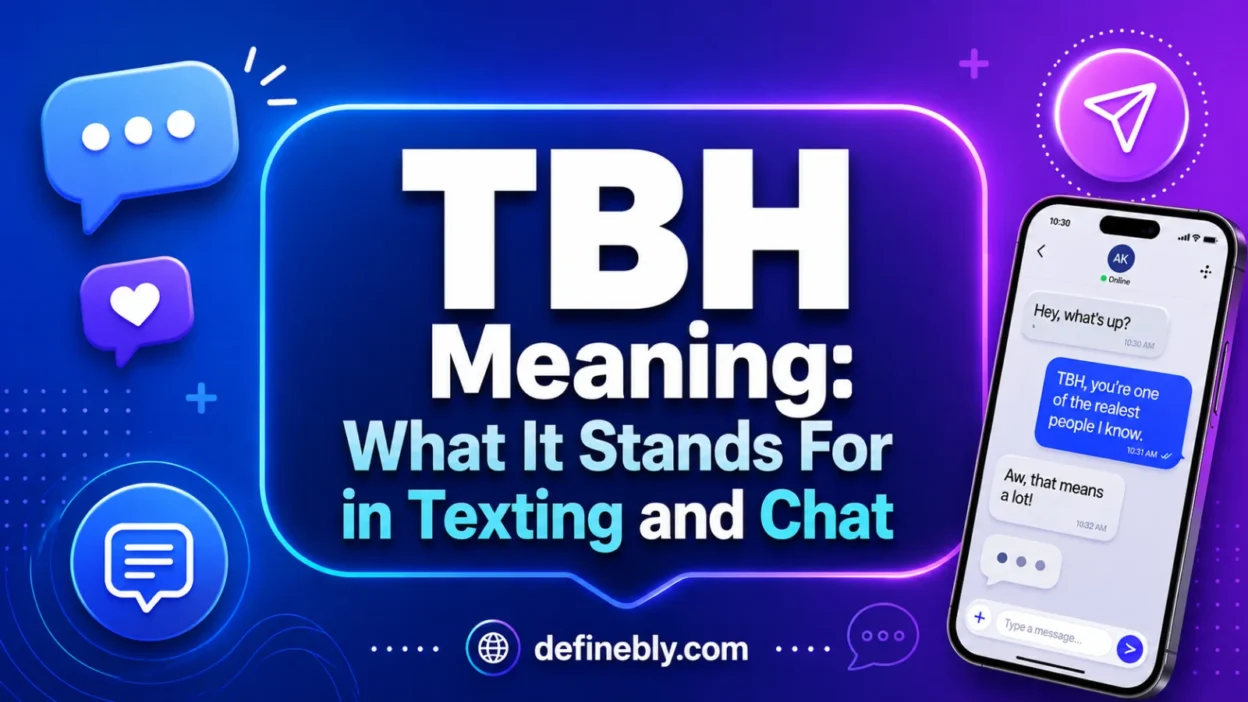
TBH Meaning: What Does TBH Mean in Texting and Chat?
TBH means “to be honest.” People use this abbreviation in text messages, social media posts, online chats, and comments when they want to share a sincere thought, personal feeling, or straightforward opinion.
For example, if someone texts, “TBH, I didn’t enjoy the movie,” they are expressing their genuine reaction. The message may sound more candid than a simple statement, depending on the context.
Although TBH often introduces an honest opinion, it does not always mean the person is revealing a secret or saying something negative. It can introduce a compliment, a confession, a preference, or an everyday observation.
What Does TBH Stand For?
TBH is short for “to be honest.” It is an informal abbreviation commonly used in digital communication.
Each letter represents part of the phrase:
- T — To
- B — Be
- H — Honest
Writers use TBH when they want to emphasize sincerity or introduce what they genuinely think about something.
Example: “TBH, I prefer the simpler design.”
This means the writer is openly sharing a personal preference. The abbreviation does not prove that the opinion is correct; it simply frames the statement as candid or sincere.
What Does TBH Mean in a Text Message?
In texting, TBH usually signals that someone is about to share a genuine reaction or speak more directly than usual. Its exact tone depends on the rest of the message and the relationship between the people communicating.
Here are three common ways people use it.
1. To Share an Honest Opinion
Someone may use TBH before expressing a preference, judgment, or criticism.
Example:
“TBH, I think the first option looks better.”
The sender is stating a personal opinion rather than presenting an objective fact.
2. To Express a Personal Feeling
TBH can introduce a feeling that someone wants to communicate openly.
Example:
“I’m a little nervous about tomorrow, tbh.”
Here, the abbreviation emphasizes the sender’s genuine emotional state. It makes the message feel personal and conversational.
3. To Admit Something
People also use TBH when admitting that they forgot something, made a mistake, or have a particular reaction.
Example:
“TBH, I completely forgot we had plans.”
The sender is openly acknowledging what happened instead of avoiding the admission.
How Is TBH Used on Social Media?
TBH appears on platforms where people share opinions, reactions, photos, videos, and personal updates. It is especially common in informal posts and comments.
In a comment:
“TBH, this is your best photo yet.”
The writer is giving a direct compliment.
In a discussion:
“TBH, I don’t think the new update fixed the main problem.”
The writer is expressing a candid view about a change.
In a caption:
“TBH, I needed a quiet weekend.”
The caption communicates a personal feeling or experience.
TBH can appear at the beginning or end of a sentence. It may also appear in lowercase as tbh. These variations generally carry the same meaning.
Does TBH Always Mean Someone Is Being Honest?
TBH literally stands for “to be honest,” but its everyday use is more flexible.
Sometimes, people use it to emphasize sincerity. In other cases, it functions as a casual conversational phrase without suggesting that the following statement is unusually revealing.
For example:
- “TBH, that was a great performance.” — A positive reaction.
- “I’m exhausted, tbh.” — A personal feeling.
- “TBH, I would choose the other restaurant.” — A preference.
- “TBH, I forgot to reply.” — An admission.
In each case, TBH introduces a candid statement, but the subject and emotional tone are different.
It is also worth remembering that using TBH does not guarantee that a statement is truthful. The abbreviation communicates how the writer frames the message, not whether the claim can be verified.
Is TBH Rude or Polite?
TBH is not inherently rude or polite. Its effect depends mainly on what follows it.
People sometimes use the abbreviation before criticism because it makes the statement feel more personal or direct. Others use it to introduce praise or reassure someone.
Compare these examples:
| Message | Likely Tone |
|---|---|
| “TBH, you did a great job.” | Supportive and positive |
| “TBH, I prefer the original version.” | Direct but generally neutral |
| “TBH, that comment hurt my feelings.” | Personal and sincere |
| “TBH, your idea is stupid.” | Harsh and insulting |
The final example shows why the abbreviation does not automatically soften a message. The wording can still sound disrespectful even when the writer introduces it with TBH.
If you want to disagree politely, focus on the way you express your point. For instance, “TBH, I see it differently because of these two issues” is more constructive than insulting another person’s idea.
TBH vs. IMO: What’s the Difference?
TBH and IMO are both used to introduce statements in casual conversation, but their emphasis is different.
- TBH means “to be honest” and highlights candor or a genuine reaction.
- IMO means “in my opinion” and identifies a statement as a personal viewpoint.
Consider these examples:
TBH: “I didn’t enjoy the ending.”
IMO: “IMO, the ending could have been stronger.”
The first focuses on the writer’s genuine reaction. The second frames an evaluation as an opinion.
In everyday use, the meanings can overlap. A person might use either abbreviation when discussing a movie, product, or decision. The difference is one of emphasis rather than a strict grammatical rule.
TBH vs. NGL: Are They the Same?
TBH and NGL are similar because both can introduce a candid statement. However, they expand to different phrases.
| Abbreviation | Full Form | Main Emphasis |
|---|---|---|
| TBH | To be honest | Sincerity or a straightforward opinion |
| NGL | Not gonna lie | A candid admission or frank reaction |
| IMO | In my opinion | A personal viewpoint |
| IMHO | In my humble opinion | A personal opinion framed with modesty |
TBH example: “TBH, I expected something different.”
NGL example: “NGL, that ending surprised me.”
Both messages express a genuine reaction. NGL often sounds especially conversational, while TBH can be used for opinions, admissions, and feelings.
The two abbreviations sometimes work in similar situations, but neither is required to make a sentence understandable.
Should You Write TBH or tbh?
Both TBH and tbh are widely recognizable forms of the same abbreviation in informal digital writing.
Examples:
- “TBH, I would wait before making a decision.”
- “tbh, I wasn’t expecting that result.”
- “That was a good idea, tbh.”
Uppercase letters can make the abbreviation stand out, while lowercase letters often blend naturally into casual texting. There is no major difference in meaning.
For formal writing, it is usually better to write the full phrase “to be honest” or choose wording that expresses your point directly.
Where Is TBH Appropriate?
TBH works best in informal communication, particularly when people are exchanging personal views or reactions.
Common settings include:
- Text messages between friends
- Group chats
- Social media comments and captions
- Direct messages
- Online forums
- Casual conversations with coworkers
In a formal report, academic paper, business proposal, or official email, TBH may look too casual. Depending on the situation, you can replace it with “honestly,” “in my view,” or a direct statement.
For example:
Casual: “TBH, I think we need more time.”
More professional: “I believe we need additional time to complete the project.”
The second version communicates the concern without relying on internet shorthand.
Where Did TBH Come From?
TBH belongs to the broader family of abbreviations that became popular in digital communication. Short forms such as TBH, BRB, and IMO made it easier to exchange messages in early internet chats, instant messaging, and text conversations.
As online communication expanded, TBH became familiar in social media posts, comments, and direct messages. Its continued usefulness comes from its flexibility: it can introduce praise, criticism, personal preferences, admissions, or feelings in just three letters.
There is no need to identify a single inventor to understand how it works today. In modern usage, its established meaning remains “to be honest.”
Examples of TBH in Everyday Conversations
The following examples show how TBH can fit different situations.
Sharing a Preference
“TBH, I like the blue version more.”
The writer is expressing a personal choice.
Giving a Compliment
“TBH, you handled that situation really well.”
The abbreviation introduces positive feedback.
Admitting a Mistake
“TBH, I should have checked the details first.”
The sender acknowledges something they could have done better.
Expressing Disappointment
“TBH, I expected the event to be more interesting.”
The message communicates an honest reaction without necessarily attacking anyone.
Talking About Feelings
“I’m worried about the interview tomorrow, tbh.”
The writer shares a personal concern.
Disagreeing With a Friend
“TBH, I don’t think that’s the best solution.”
The sender expresses disagreement. Whether it sounds respectful depends on the surrounding conversation and how the disagreement is explained.
Responding to a Recommendation
“TBH, that restaurant wasn’t as good as I expected.”
The writer gives a straightforward assessment based on their experience.
Sharing a Small Confession
“TBH, I haven’t finished the book yet.”
The abbreviation introduces an admission.
Common Mistakes to Avoid When Using TBH
TBH is easy to understand, but using it appropriately helps keep messages clear.
Assuming TBH Always Introduces Criticism
TBH can precede positive, negative, or neutral statements. It does not automatically mean someone is about to say something unpleasant.
Using TBH as Proof of Truth
The abbreviation signals candor, but it cannot establish whether a statement is accurate. Important claims still need evidence.
Adding TBH to Every Sentence
Repeatedly using the abbreviation can make writing feel unnecessary or repetitive. Use it when it adds a meaningful tone or context.
Confusing TBH With IMO
TBH emphasizes honesty or directness, while IMO specifically means “in my opinion.” They can overlap in casual conversation, but their core meanings are different.
Using TBH in Formal Documents
In formal writing, the abbreviation may seem too casual. Spell out the phrase or communicate the idea directly instead.
Frequently Asked Questions
What does TBH mean in texting?
TBH means “to be honest.” People use it in text messages to introduce a sincere opinion, personal feeling, admission, or candid reaction.
What does TBH mean from a girl or a guy?
TBH means “to be honest,” regardless of who sends it. The abbreviation alone does not reveal romantic interest or a person’s hidden intentions. The surrounding message provides more context.
Is TBH a good thing or a bad thing?
Neither. TBH is a neutral abbreviation. It can introduce a compliment, an ordinary opinion, a confession, or criticism. The message that follows determines its likely tone.
What does TBH mean at the end of a sentence?
At the end of a sentence, TBH usually adds emphasis to the writer’s candid opinion or feeling.
For example, “I prefer the first version, tbh” means the writer is honestly expressing that preference.
Is TBH the same as being brutally honest?
No. TBH means “to be honest,” but it does not necessarily imply harshness. Brutal honesty usually refers to expressing the truth very directly, sometimes without much concern for how the words affect others.
What is the difference between TBH and NGL?
TBH stands for “to be honest,” while NGL means “not gonna lie.” Both can introduce candid statements, and their uses sometimes overlap. The choice often comes down to personal writing style.
Is TBH still used?
Yes. TBH remains a recognizable abbreviation in informal digital communication, including text messages, social media, and online discussions.
How should you respond when someone says TBH?
Respond to the message itself. If the person shares an opinion, you can agree or respectfully disagree. If they offer a compliment, you can say thank you. TBH does not require a special response.
Conclusion
TBH means “to be honest.” It is an informal abbreviation used in texting, social media, online chats, and comments to introduce a sincere thought, personal opinion, feeling, or admission.
Its tone depends on context. TBH can make a message feel candid and personal, but it does not automatically make criticism polite or prove that a statement is true.
Remember the distinction: TBH emphasizes honesty or directness, while IMO marks a personal opinion and NGL introduces a frank admission or reaction. Using the right expression helps your message sound natural and clear.
TBH stands for “to be honest.” People use it in texts, chats, comments, captions, and other informal digital writing to introduce a candid thought, opinion, or feeling. That is the standard meaning reflected in Merriam-Webster, Cambridge, and Collins.
Quick Answer
TBH means “to be honest.” In real use, it usually signals that the speaker is about to say what they really think, often in a more direct, personal, or sincere way.
What TBH Stands For
The expansion itself is simple: TBH = to be honest. Merriam-Webster defines it that way directly, and Cambridge says it is a written abbreviation used, for example, on social media and in text messages when telling someone your opinion. Collins gives the same core meaning in social-media and messaging language.
What TBH Means In Real Messages
In actual conversation, TBH usually does more than repeat the literal phrase to be honest. It often tells the reader, “I’m about to say what I really think.” Current usage explainers describe it as a signal of sincerity, candor, or straightforwardness.
That is why messages like these sound natural:
- “TBH, I liked the old design better.”
- “I’m tired, tbh.”
- “That movie was kind of boring, TBH.”
In each case, the abbreviation frames the statement as personal, candid, and slightly more direct than the same sentence without it.
How People Usually Place TBH
One useful detail many weak pages miss is position. How-To Geek notes that most people use TBH at the beginning or end of a sentence. That matters because placement changes the feel slightly:
- Beginning: “TBH, I don’t think that plan will work.”
- End: “I don’t think that plan will work, tbh.”
The first sounds a little more deliberate. The second often feels lighter and more conversational.
Tone, Context, And What TBH Signals
The tone of TBH depends on what comes after it. It can sound:
- sincere
- casual
- confessional
- blunt
- critical
- supportive
Modern usage pages consistently note that TBH is not always a dramatic truth reveal. Sometimes it is gentle. Sometimes it softens a criticism. Sometimes it makes a compliment feel more genuine. And sometimes it introduces a line that is still rude even though it is framed as “honest.”
That is why “TBH, you did a great job” sounds warm, while “TBH, that idea makes no sense” still sounds harsh. The abbreviation frames tone, but it does not automatically make a statement polite.
Where People Use TBH
TBH is most common in informal digital communication, especially:
- text messages
- group chats
- social media comments
- captions
- direct messages
- casual online discussion
Cambridge explicitly places it in social media and text messages, while Collins frames it as messaging and social-media language. It is much less natural in formal writing, business reports, or academic work.
TBH Vs. IMO
These two abbreviations are related, but they do different jobs.
- TBH means to be honest and usually introduces candor or a real feeling.
- IMO means in my opinion and marks a statement as a personal viewpoint.
That means TBH often sounds more emotional or more direct, while IMO sounds more neutral and discussion-oriented.
Compare:
- “IMO, the first version is stronger.”
- “TBH, I like the first version more.”
Both are opinions, but the second sounds more personal.
TBH Vs. NGL
NGL means not gonna lie, and it overlaps with TBH because both introduce honesty. But NGL often sounds more conversational, more modern, and sometimes a little more performative or emphatic. How-To Geek’s explanation of NGL shows that it works like a spoken phrase carried into digital shorthand.
In everyday use:
- TBH often feels slightly cleaner and more neutral.
- NGL often feels more casual and more voice-like.
Origin And History
Dictionary.com’s origin note for TBH is brief but useful: it traces the term to digital communications. Modern language explainers expand on that by linking it to early internet, texting, SMS, and chat culture. That broader pattern is consistent across current usage pages.
So while the exact first use is not the main point, TBH clearly belongs to the long-running family of internet abbreviations built for fast, informal written conversation.
Example Sentences
- “TBH, I’m really tired today.”
- “That movie was kind of boring, tbh.”
- “TBH, you handled that really well.”
- “I don’t think that plan will work, tbh.”
- “tbh, I forgot about the meeting.”
These examples work because they show TBH introducing honesty in different ways: opinion, confession, praise, and mild criticism.
Similar Short Forms
A few related abbreviations include:
- IMO — in my opinion
- NGL — not gonna lie
- IMHO — in my humble opinion
- FYI — for your information
The closest casual alternative is usually NGL, but TBH often feels a little more neutral and less stylized.
FAQ
Is TBH rude?
Not usually. TBH itself is neutral. But it can sound rude if the “honest” statement after it is unnecessarily harsh. Several current usage pages point out that the tone depends more on the message than on the abbreviation itself.
Is TBH formal?
No. Cambridge and Collins both place it in social media, text messages, and messaging language. It works best in informal digital writing, not formal prose.
Is TBH the same as IMO?
Not exactly. TBH means to be honest and often introduces candor, while IMO means in my opinion and mainly marks a view as personal rather than factual.
What is the simplest meaning of TBH?
The simplest meaning is to be honest. That is the direct definition in Merriam-Webster, Cambridge, and Collins.
Conclusion
TBH means “to be honest.” In modern digital conversation, it usually signals a candid opinion, a real feeling, or a more direct statement than the rest of the chat might suggest. That is why it remains so common in texts, comments, and social media: it is short, familiar, and useful for framing what someone really thinks without having to spell out the full phrase every time.