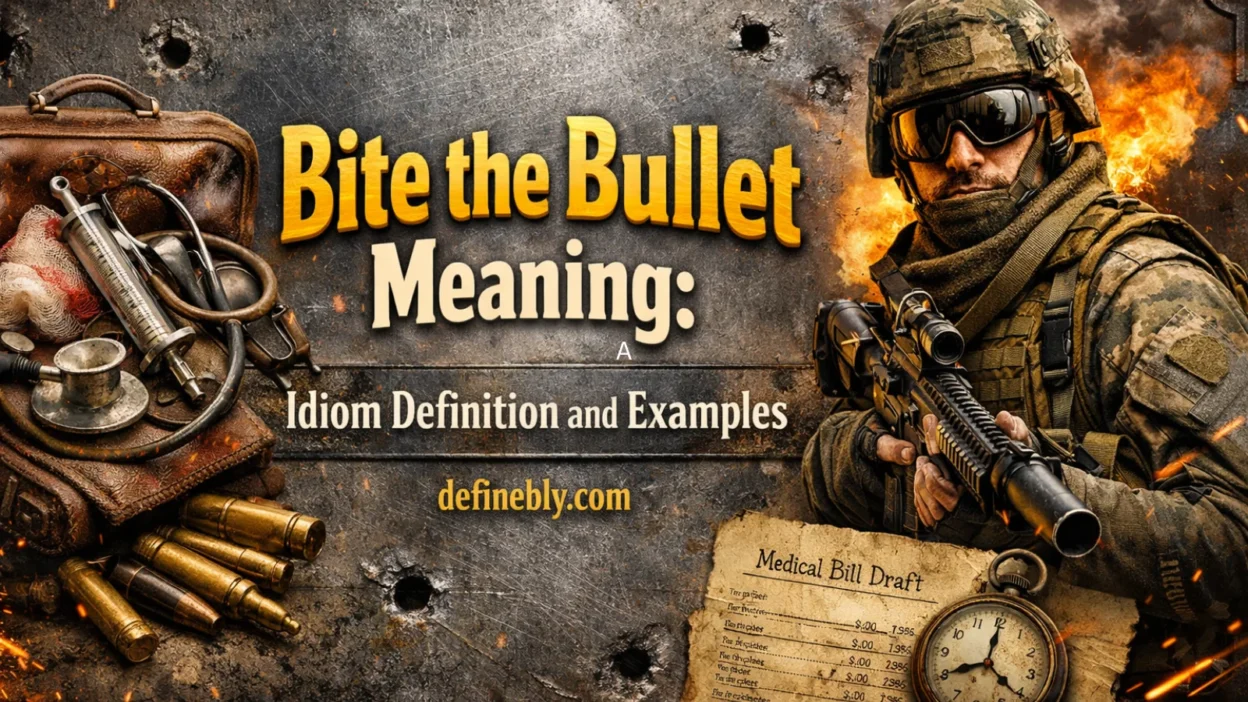
Bite the Bullet Meaning: What Does This Idiom Mean?
If you bite the bullet, you decide to do something difficult, unpleasant, or stressful because you know it needs to be done. The phrase usually suggests that you would rather avoid the situation, but you finally accept it and move forward.
For example:
I didn’t want to spend the money, but I finally bit the bullet and replaced my old car.
The speaker did not want to spend the money, but replacing the car became necessary. That combination of reluctance and acceptance is central to the meaning of bite the bullet.
What Does “Bite the Bullet” Mean?
Bite the bullet means to force yourself to do something unpleasant or difficult because you cannot reasonably avoid it anymore.
The idiom is commonly used when someone has been delaying, avoiding, or worrying about something and finally decides to deal with it.
In simple terms:
Bite the bullet = accept something difficult and do it anyway.
For example:
- I hate making difficult phone calls, but I need to bite the bullet and call the bank.
- She didn’t want to apologize, but she bit the bullet and admitted she was wrong.
- We can’t keep delaying the repair. We need to bite the bullet and pay for it.
The expression does not necessarily mean that the situation is extremely serious. It can describe anything from an uncomfortable conversation to an expensive repair.
What Does the Idiom Suggest?
The phrase usually contains three ideas:
- The situation is unpleasant or difficult.
- You would prefer to avoid it.
- You decide to deal with it anyway.
That is why bite the bullet is more specific than simply saying do something difficult.
Compare these sentences:
- I did the difficult task.
- I bit the bullet and did the difficult task.
The second sentence tells us more about the speaker’s attitude. It suggests that the person did not really want to do it but accepted that it had to be done.
How Do You Use “Bite the Bullet” in a Sentence?
The expression is usually used when someone is facing a problem, decision, expense, responsibility, or uncomfortable situation.
For Difficult Decisions
I didn’t want to move, but I finally bit the bullet and found a new apartment.
We need to bite the bullet and decide what we’re going to do.
For Unpleasant Tasks
I hate cleaning out the garage, but I guess I’ll bite the bullet this weekend.
She bit the bullet and finished the paperwork.
For Expenses
The repair is expensive, but we’ll have to bite the bullet and pay for it.
I finally bit the bullet and bought a new laptop.
For Difficult Conversations
I was nervous about telling him, but I bit the bullet and had the conversation.
She bit the bullet and apologized.
For Health-Related Situations
I don’t like going to the dentist, but I need to bite the bullet and make an appointment.
He had been putting off the procedure, so he finally bit the bullet.
The common thread is that the person would rather not deal with the situation but recognizes that avoiding it is no longer a good option.
Is “Bite the Bullet” a Positive or Negative Expression?
The expression is usually neutral to slightly negative in tone because it refers to something unpleasant.
However, it can also suggest determination, acceptance, or resolve.
For example:
I didn’t want to move away from my family, but I bit the bullet and took the job.
The decision is difficult, but the phrase does not necessarily criticize the person. It simply emphasizes that they accepted an uncomfortable situation and acted.
So bite the bullet is not exactly a synonym for be brave. Bravery can be part of the situation, but the main idea is accepting something unpleasant and doing what needs to be done.
When Should You Use “Bite the Bullet”?
Use bite the bullet when there is a clear reason for reluctance.
Good examples include:
- paying an unexpected bill
- having an uncomfortable conversation
- admitting a mistake
- dealing with an unpleasant task
- making a difficult decision
- facing a problem that has been delayed
- accepting an unavoidable cost
- doing something you have been nervous about
For example:
I don’t want to tell my boss about the mistake, but I need to bite the bullet.
This sounds natural because the speaker is reluctant but knows the conversation needs to happen.
When Does “Bite the Bullet” Sound Wrong?
The idiom is not normally used simply because something is enjoyable, easy, or voluntarily chosen.
These examples sound unnatural:
- I bit the bullet and went on vacation.
- She bit the bullet and ate her favorite dessert.
- We bit the bullet and bought concert tickets.
There is no obvious unpleasantness or reluctant necessity in these examples.
A better rule is:
If there is nothing to dread, resist, or reluctantly accept, “bite the bullet” probably isn’t the right idiom.
Bite the Bullet vs. Face the Music
These expressions are related, but they are not interchangeable in every situation.
Bite the bullet means accepting and dealing with something difficult or unpleasant.
I don’t want to pay for the repair, but I’ll bite the bullet.
Face the music means accepting the consequences of something, especially something you have done wrong.
He lied to his manager, and now he has to face the music.
The main difference is necessity versus consequences.
You bite the bullet when you accept a difficult course of action. You face the music when you deal with the consequences of your actions.
Bite the Bullet vs. Suck It Up
Suck it up means to tolerate something unpleasant without complaining.
You’re tired, but you’ll have to suck it up and finish the job.
It can sound blunt or dismissive, depending on the situation.
Bite the bullet is generally less aggressive. It emphasizes accepting a difficult situation and getting through it.
I don’t want to spend the money, but I’ll bite the bullet.
Bite the Bullet vs. Get It Over With
Get it over with means finishing something unpleasant so that it is no longer hanging over you.
I hate making phone calls, so I’ll just get it over with.
Bite the bullet focuses more on accepting the unpleasant situation.
I hate making phone calls, but I’ll bite the bullet and call them.
The two expressions can sometimes work in the same situation, but they emphasize slightly different ideas.
Bite the Bullet vs. Take the Plunge
Take the plunge usually refers to making a significant decision or taking a major step after hesitation.
After years of renting, they finally took the plunge and bought a house.
It can have an exciting or optimistic feeling.
Bite the bullet usually has a more reluctant feeling:
The house needs major repairs, but they decided to bite the bullet and fix it.
So take the plunge often emphasizes taking a bold step, while bite the bullet emphasizes accepting something difficult.
Is “Bite the Bullet” Formal or Informal?
Bite the bullet is a common idiom and is generally more appropriate for everyday and conversational English than for highly formal writing.
It works naturally in:
- everyday conversations
- emails
- blogs
- articles
- interviews
- informal workplace communication
- general nonfiction writing
For very formal academic, legal, or technical writing, a more direct phrase may be clearer.
Instead of:
We need to bite the bullet and increase the budget.
A formal report might say:
We need to accept the additional cost and increase the budget.
The idiom itself is widely understood, but formal writing often benefits from more precise, literal wording.
What Is the Origin of “Bite the Bullet”?
The origin of bite the bullet is often connected to military medicine.
A popular explanation says that soldiers undergoing painful medical treatment without modern anesthesia were sometimes given a bullet to bite on. The idea is that biting the bullet helped a person endure pain without screaming or moving.
That story is widely repeated, but the exact origin of the modern idiom is not completely certain. Historical sources show the figurative expression in use by the nineteenth century, while the familiar surgical explanation is difficult to establish as the definite source.
For that reason, it is better to describe the medical-surgery story as a traditional or commonly repeated explanation, rather than as a proven fact.
The modern expression has long been used figuratively to describe accepting something painful, difficult, or unavoidable.
What Is the Past Tense of “Bite the Bullet”?
The past-tense form is:
bit the bullet
Examples:
- I bit the bullet and paid the bill.
- She bit the bullet and told the truth.
- They bit the bullet and replaced the roof.
The base form is:
bite the bullet
I need to bite the bullet and make the call.
For future situations, you can still use the base form after will, might, or similar verbs:
I’ll bite the bullet and finish it tonight.
We may have to bite the bullet and accept the cost.
Natural Examples of “Bite the Bullet”
Here are some everyday examples:
- I finally bit the bullet and canceled the subscription.
- We need to bite the bullet and replace the broken equipment.
- She bit the bullet and asked for a raise.
- I’ll bite the bullet and make the phone call.
- He didn’t want to move, but he bit the bullet and relocated for the job.
- They had been avoiding the problem for months, so they finally bit the bullet and dealt with it.
- I hate public speaking, but I’ll bite the bullet and give the presentation.
- We didn’t want to spend that much, but we had to bite the bullet.
- She knew the conversation would be uncomfortable, but she bit the bullet and started it.
- Sometimes you just have to bite the bullet and do what needs to be done.
Common Mistakes With “Bite the Bullet”
Using It for Every Difficult Situation
Not every challenging activity calls for this idiom.
I bit the bullet and studied for my favorite subject.
This may be grammatically possible, but it sounds odd if the studying was not particularly unpleasant or reluctant.
The phrase works better when there is genuine resistance or discomfort.
Treating It as a Synonym for “Be Brave”
Being brave can be part of biting the bullet, but that is not the complete meaning.
The key idea is accepting an unpleasant or difficult action because it needs to happen.
Using the Wrong Verb Form
In the present tense:
I need to bite the bullet.
In the past tense:
I bit the bullet.
Not:
I bited the bullet.
Because bite is an irregular verb, its simple past form is bit.
Taking the Phrase Literally
In normal modern English, someone saying “I need to bite the bullet” is almost certainly using an idiom.
They mean that they need to face a difficult situation, not literally bite a bullet.
FAQ
What does bite the bullet mean?
Bite the bullet means to accept and deal with something difficult, unpleasant, or stressful because it needs to be done.
Is bite the bullet a metaphor?
Yes. It is an idiomatic expression used figuratively. The words do not normally refer to literally biting a bullet.
Does bite the bullet mean being brave?
It can suggest courage or determination, but its main meaning is accepting an unpleasant or difficult situation and dealing with it anyway.
Is bite the bullet positive or negative?
It is usually neutral to slightly negative because the situation is unpleasant. However, the phrase can also suggest determination and practical acceptance.
Can I use bite the bullet in everyday conversation?
Yes. It is a familiar English idiom and sounds natural in everyday conversation and other relatively informal contexts.
What is another way to say bite the bullet?
Depending on the context, you could say face the situation, deal with it, accept the difficulty, get it over with, or do what needs to be done. The best alternative depends on the exact sentence.
What is the past tense of bite the bullet?
The past tense is bit the bullet.
I bit the bullet and told her the truth.
Where did bite the bullet come from?
Its exact origin is uncertain. A popular explanation connects the phrase with soldiers enduring painful medical procedures, but that explanation should not be treated as definitively proven.
Key Takeaway
Bite the bullet means to accept something difficult, unpleasant, or stressful and do it anyway because it needs to be done.
The phrase usually carries a sense of reluctance: you do not really want to deal with the situation, but avoiding it is no longer practical.
I didn’t want to have the conversation, but I bit the bullet and called him.
That is the basic idea behind the idiom: you face the difficult thing instead of continuing to avoid it.
Conclusion
Bite the bullet is a common English idiom for accepting an unpleasant or difficult situation and going through with it anyway. It is especially useful when someone has been delaying, resisting, or worrying about something that eventually has to be handled.
Remember the simplest meaning:
Bite the bullet = face something difficult because you know it has to be done.
If someone tells you to bite the bullet, they are not talking about doing something literal.
This phrase is a common English idiom. People use it when someone needs to do something hard, unpleasant, or stressful that cannot be avoided.
It is often used in everyday conversation, especially when a person has been delaying a difficult decision.
What Bite The Bullet Means
Bite the bullet means to make yourself do something difficult, unpleasant, or stressful because it is necessary and cannot be avoided any longer. It usually suggests reluctance, not enthusiasm. If you bite the bullet, you are not happy about the situation, but you accept it and go through with it anyway. Cambridge defines it as forcing yourself to do something unpleasant or difficult, while Merriam-Webster frames it as entering a difficult course of action with resignation.
A simple example is:
I didn’t want to spend the money, but I finally bit the bullet and replaced the car.
That sentence works because the action is:
- unpleasant
- necessary
- something the speaker likely delayed
What The Idiom Suggests In Real Use
The phrase does not just mean “do something hard.” It usually carries a more specific mix of meaning:
- You do not want to do it
- You know you probably have to
- Putting it off will not help much
- You decide to face it anyway
That combination is what makes the idiom sound natural. Britannica defines it as doing something unpleasant or painful because it is necessary even though you would rather avoid it, which captures the phrase well.
So when someone says, “I guess I have to bite the bullet,” the hidden meaning is usually:
I’ve been resisting this, but I know it’s time.
How Bite The Bullet Is Used In Everyday English
People use this idiom in situations where avoidance has run out.
Money And Expenses
- We finally bit the bullet and replaced the roof.
- I didn’t want to pay for the repair, but I had to bite the bullet.
Health And Appointments
- He bit the bullet and went to the dentist.
- I need to bite the bullet and schedule the test.
Work And School
- She bit the bullet and finished the report.
- I’m going to bite the bullet and take the harder class this semester.
Personal Decisions
- I bit the bullet and told him the truth.
- They finally bit the bullet and moved to a smaller apartment.
These examples sound natural because the action is uncomfortable but necessary. Cambridge and Collins both reflect that same idea in their examples and definitions.
When The Phrase Sounds Natural
Use bite the bullet when the action is clearly unpleasant, difficult, costly, or emotionally hard.
Natural:
- I bit the bullet and canceled the subscription.
- We may have to bite the bullet and cut prices.
- She bit the bullet and apologized.
These all suggest resistance followed by acceptance.
When The Phrase Sounds Wrong Or Awkward
The idiom sounds odd when the action is easy, enjoyable, or voluntary in a positive way.
Awkward:
- I bit the bullet and ordered dessert.
- He bit the bullet and went on vacation.
- We bit the bullet and bought concert tickets.
Those sentences feel off because there is no real sense of unpleasant necessity. That is one of the biggest usage mistakes learners make.
Literal Meaning Vs. Figurative Meaning
Taken literally, bite the bullet sounds like physically biting a real bullet. But in actual English use, it is an idiom, so the figurative meaning matters.
- Literal: biting an actual bullet
- Figurative: forcing yourself through something difficult because it must be done
This is why the phrase can sound strange at first to learners. The words are vivid, but the meaning is about reluctant action, not literal behavior.
Is Bite The Bullet Formal Or Informal?
Bite the bullet is generally informal to semi-formal. Britannica labels it informal, and that fits how most people use it. It sounds natural in conversation, journalism, blogs, business discussion, and everyday writing.
It is usually fine in:
- conversation
- emails with a casual tone
- blog posts
- interviews
- opinion writing
It is less suitable for:
- formal academic writing
- legal documents
- highly technical or policy-heavy writing where direct language is better
In formal contexts, a clearer alternative may be stronger, such as:
- accept the cost
- proceed despite the difficulty
- take the necessary step
- confront the issue directly
Does Bite The Bullet Mean Brave Or Necessary?
It means both, but necessity is usually the stronger idea.
Cambridge includes bravery in its definition, and Collins uses words like fortitude and stoicism. But in ordinary use, the phrase most often points to an unpleasant action that a person accepts because avoidance is no longer useful.
So this is close:
- She bit the bullet and made the phone call.
This is less exact:
- She was brave.
Bravery may be involved, but the idiom specifically emphasizes doing the hard thing because it has to be done.
Origin Of Bite The Bullet
A lot of articles repeat the story that soldiers once bit on a bullet during surgery without anesthesia, and Collins still includes that explanation in its dictionary entry.
But the origin is not fully settled. Phrase Finder notes that the figurative use appears in the nineteenth century, including an 1891 example from Rudyard Kipling, and Word Histories argues that there is no solid evidence proving the common surgery story as the true source. In other words, the famous explanation may be possible, but it should not be presented as certain fact.
That makes the safest editorial position this:
the phrase is old, the military-pain explanation is popular, but the exact origin is debated.
Similar Idioms And How They Differ
Face The Music
This means accepting consequences, especially after something has gone wrong.
- He lied, and now he has to face the music.
This is close, but it focuses more on consequences than reluctant necessity.
Suck It Up
This means endure something unpleasant without complaining.
- You’re tired, but you need to suck it up and finish.
This can sound harsher, less sympathetic, and more blunt than bite the bullet.
Take The Plunge
This means make a big decision after hesitation.
- They finally took the plunge and bought a house.
This can sound more voluntary, bold, or even exciting than bite the bullet, which usually carries more reluctance.
Get It Over With
This means do something now so it will be finished.
- Just get it over with and make the call.
This is very close in some contexts, but it is more direct and less idiomatic in tone.
Example Sentences
Present Tense
- I need to bite the bullet and call the bank.
- Sometimes you just have to bite the bullet and do the uncomfortable thing.
- We should bite the bullet and fix the problem now.
Past Tense
- She bit the bullet and asked for help.
- I finally bit the bullet and canceled the membership.
- They bit the bullet and sold the old house.
Future Use
- We may have to bite the bullet and raise prices.
- If it gets worse, I’ll bite the bullet and see a specialist.
These examples work because the action is clearly not pleasant, but it is necessary.
Common Mistakes With Bite The Bullet
One mistake is using the idiom for anything difficult at all. The phrase is stronger than that. It works best when the difficulty is tied to reluctance and necessity.
Another mistake is treating it as purely positive. It usually has a slightly negative or uncomfortable undertone because the action is something the speaker would rather avoid.
A third mistake is overstating the origin story as proven fact. Some sources still repeat the surgery explanation directly, but higher-care usage should note that the origin remains debated.
FAQ
What does bite the bullet mean?
It means forcing yourself to do something difficult, unpleasant, or stressful because it is necessary and delaying it will not help.
Does bite the bullet mean to be brave?
Partly, yes. But the phrase usually means more than simple bravery. It suggests accepting an unpleasant but necessary action with reluctance and determination.
Is bite the bullet positive or negative?
It is usually neutral to slightly negative in tone. The phrase often describes an unpleasant situation, but it can also imply maturity, toughness, or practical acceptance.
Can I use bite the bullet in everyday conversation?
Yes. It is common in spoken English, casual writing, news quotes, blogs, and general conversation.
Is bite the bullet formal?
Not fully. It is best described as informal to semi-formal. It is common and widely understood, but it is usually not the best fit for very formal academic or legal writing.
What is a good example of bite the bullet?
A natural example is: “I finally bit the bullet and went to the dentist.” It sounds right because the action is unpleasant, but necessary. Cambridge uses a dentist example for the same reason.
Where does bite the bullet come from?
The exact origin is debated. A popular explanation connects it to soldiers biting on a bullet during painful surgery, but some etymology sources say there is not enough evidence to treat that story as certain.
Conclusion
Bite the bullet means accepting an unpleasant but necessary action and going through with it anyway. The idiom works best when someone has been resisting, delaying, or dreading something, then finally decides to face it. That blend of reluctance, necessity, and resolve is what gives the phrase its real meaning.