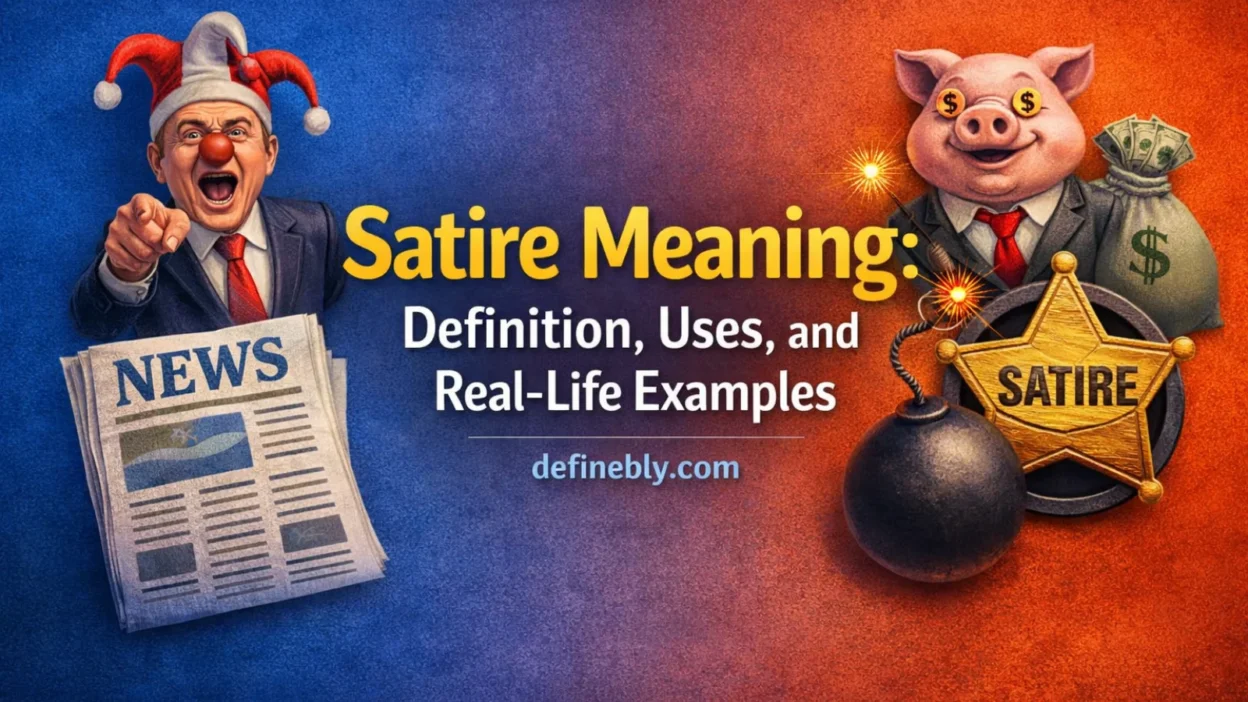
If you are asking what satire means, the short answer is simple: satire is a way of criticizing people, ideas, or society by using humor, irony, ridicule, or exaggeration. Major dictionaries and reference sources agree on that core idea.
Quick Answer
Satire means humorous or mocking criticism used to expose foolishness, weakness, corruption, or bad behavior. It can also mean a specific work, such as a book, film, article, or cartoon, that uses this style.
Satire means using humor, irony, exaggeration, ridicule, or imitation to expose what is foolish, false, corrupt, unfair, or absurd in people, ideas, institutions, or society. In simple English, satire is humor with criticism. It is not just meant to entertain. It is meant to make a point.
The word satire is a noun. It can mean both the critical style itself and the actual work that uses that style, such as a sketch, cartoon, article, film, novel, or play. Many standard dictionaries present both meanings.
What Does Satire Mean?
At its core, satire is a way of criticizing something by making it look ridiculous, exaggerated, hypocritical, or obviously flawed. The humor may be playful or sharp, but the deeper purpose is exposure. Satire points at a weakness and says, in effect, “Look how foolish this is.”
That is why not every joke is satire. A joke can exist only to amuse. Satire, by contrast, usually has a target and a purpose. It may criticize politics, social behavior, media culture, consumer habits, vanity, dishonesty, hypocrisy, or abuse of power.
Satire Meaning In Simple English
A simple way to remember the word is this:
- Comedy tries to make you laugh.
- Satire tries to make you laugh and notice a problem.
That problem might be small, like fake politeness or influencer vanity, or large, like corruption, propaganda, or public hypocrisy. The humor is the delivery system. The criticism is the point.
How Satire Works
Satire usually works by taking something flawed and making that flaw easier to see. It often uses tools such as:
- irony
- exaggeration
- ridicule
- parody
- caricature
- understatement
- imitation
For example, a satirical article might pretend that a bad policy is “the greatest idea ever” in order to show how harmful or absurd it really is. A political cartoon might enlarge one feature of a public figure to highlight greed, vanity, or arrogance. A comedy sketch might imitate corporate language to show how empty or dishonest it sounds.
What Satire Tries To Do
Satire does more than mock. Strong reference and explainer pages consistently describe it as a way to expose vice, folly, or abuse and to provoke thought. Some satire is light and clever. Some is harsh and angry. But most satire wants the audience to notice something wrong, silly, unfair, or dangerous.
In other words, satire is often funny on the surface and serious underneath.
Where Satire Appears
Satire is not limited to books. It appears in many forms, including:
- political cartoons
- fake news articles
- TV sketches
- stand-up and late-night comedy
- novels and short stories
- films
- plays
- essays
- online videos and social media posts
That is why people often use phrases like political satire, social satire, media satire, or satirical comedy.
Types Of Satire
Many modern educational pages now include the three main types of satire: Horatian, Juvenalian, and Menippean. This is useful because these labels explain the tone and target of the satire.
Horatian Satire
Horatian satire is light, witty, and amused. It gently mocks human foolishness rather than attacking it with rage. This kind of satire often feels clever, playful, or smiling rather than cruel.
Juvenalian Satire
Juvenalian satire is darker, harsher, and more openly critical. It attacks corruption, injustice, hypocrisy, or moral failure with anger, scorn, or moral seriousness.
Menippean Satire
Menippean satire often targets ways of thinking rather than just specific people. It criticizes attitudes, beliefs, pretension, or intellectual nonsense, sometimes in unusual or mixed forms.
Satire Vs. Sarcasm Vs. Parody Vs. Irony
These words are related, but they are not the same.
Satire is broad and purpose-driven. It uses humor or ridicule to criticize flaws in people, systems, or society.
Sarcasm is usually a sharp, cutting remark or tone in speech.
Parody imitates a specific work, creator, or style for comic effect.
Irony is a contrast between appearance and reality, or between what is said and what is meant. Satire may use irony, sarcasm, or parody, but it is not identical to any one of them.
A simple way to tell them apart:
- If the humor mainly imitates a recognizable style, it is probably parody.
- If the humor is a biting remark, it is probably sarcasm.
- If the humor exposes a bigger flaw or social absurdity, it is probably satire.
Real-Life Examples Of Satire
Here are some easy examples:
- A fake headline that says, “Nation Solves All Problems By Opening One More Productivity App.”
- A cartoon showing a politician standing under a sign that says “Transparency” while hiding stacks of secret documents.
- A sketch in which a company launches a “mindfulness retreat” but makes employees answer emails every five minutes.
- A film that exaggerates influencer culture to show how fake and performance-driven it can become.
Each example is funny on the surface, but each one is also criticizing something real: empty tech culture, political hypocrisy, corporate contradiction, or online vanity.
Tone And Context
Satire can be playful, dry, sharp, exaggerated, absurd, or bitter. Its tone depends on the creator’s goal. Some satire gently nudges the audience. Some satire tries to sting. That is why one satirical piece can feel light and clever while another feels almost angry.
Context matters too. The same joke may look like simple comedy in one setting and clear satire in another, depending on whether it targets a real flaw and pushes the audience to recognize it.
How To Use Satire In A Sentence
Here are natural examples in modern English:
- The article was satire, not real news.
- Her short film uses satire to mock influencer culture.
- The show mixes comedy and satire to criticize political spin.
- At first I thought the cartoon was only funny, but its satire was aimed at public hypocrisy.
- His novel uses satire to expose the emptiness of office politics.
Common Mistakes
Thinking Every Joke Is Satire
Not every joke is satire. If something is only silly, random, or funny, it may just be comedy. Satire usually needs a clear target and a critical point.
Using Satire As Another Word For Sarcasm
Sarcasm is often a speaking style or a single cutting line. Satire is broader and usually operates through a larger work, performance, or constructed joke with a social or cultural target.
Mixing Up Satire And Parody
Parody imitates a specific style, work, or creator. Satire focuses more on exposing flaws, folly, corruption, or absurdity. A parody can be satirical, but the two words are not exact synonyms.
Assuming Satire Must Be Funny In A Light Way
Some satire is hilarious. Some is uncomfortable. Some is angry. Humor is common, but the deeper goal is criticism, not just amusement.
Related Words And Similar Ideas
Satirical
Satirical is the adjective form. It describes something that uses satire. Cambridge gives examples such as satirical humor and satirical political work.
Satirize
Satirize is the verb form. It means to criticize or ridicule by using satire.
Lampoon
A lampoon is a mocking attack in writing or speech and is often treated as a sharp form of satire. Merriam-Webster notes an overlap between satire and lampoon.
Parody
A parody imitates a specific work or style, often for comic effect. It may be satirical, but it does not have to be.
Irony
Irony is about contrast between appearance and reality or between words and meaning. Satire often uses irony, but irony alone is not automatically satire.
Frequently Asked Questions
What is the simple meaning of satire?
Satire is humor or ridicule used to criticize something foolish, wrong, corrupt, or absurd. In simple English, it is humor with a critical point.
Is satire always funny?
It usually uses humor, but it does not always feel light. Some satire is playful, while some is dark, angry, or biting.
Is satire the same as sarcasm?
No. Sarcasm is usually a sharp remark or tone of speech. Satire is broader and usually works through a fuller piece of writing, performance, or media.
Can satire be about politics?
Yes. Cambridge specifically notes political satire, and many modern references describe satire as a common tool for criticizing public life, institutions, and social issues.
Does satire only refer to books?
No. Dictionaries and explainer pages define satire as both a style and a work that can appear in plays, films, articles, cartoons, shows, and other media.
What is the difference between satire and parody?
Parody mainly imitates a specific style or work. Satire is broader and focuses more on criticizing flaws, vice, or absurdity. A parody can also be satirical, but they are not the same thing.
Key Takeaways
Satire means using humor, irony, exaggeration, ridicule, or imitation to expose flaws in people, systems, or society. It is more than a random joke because it usually has a target and a critical purpose.
The easiest way to remember it is this:
- If the humor is only entertaining, it may just be comedy.
- If the humor exposes what is foolish, false, unfair, corrupt, or absurd, it is probably satire.
That is what makes satire useful: it entertains on the surface while saying something sharper underneath.
Conclusion
Satire means using humor, irony, exaggeration, or ridicule to expose a flaw or make a critical point. It is more than a random joke because it usually aims at something specific.
A simple way to remember it is this: if the humor is trying to expose what is foolish, false, unfair, or absurd, it is probably satire.