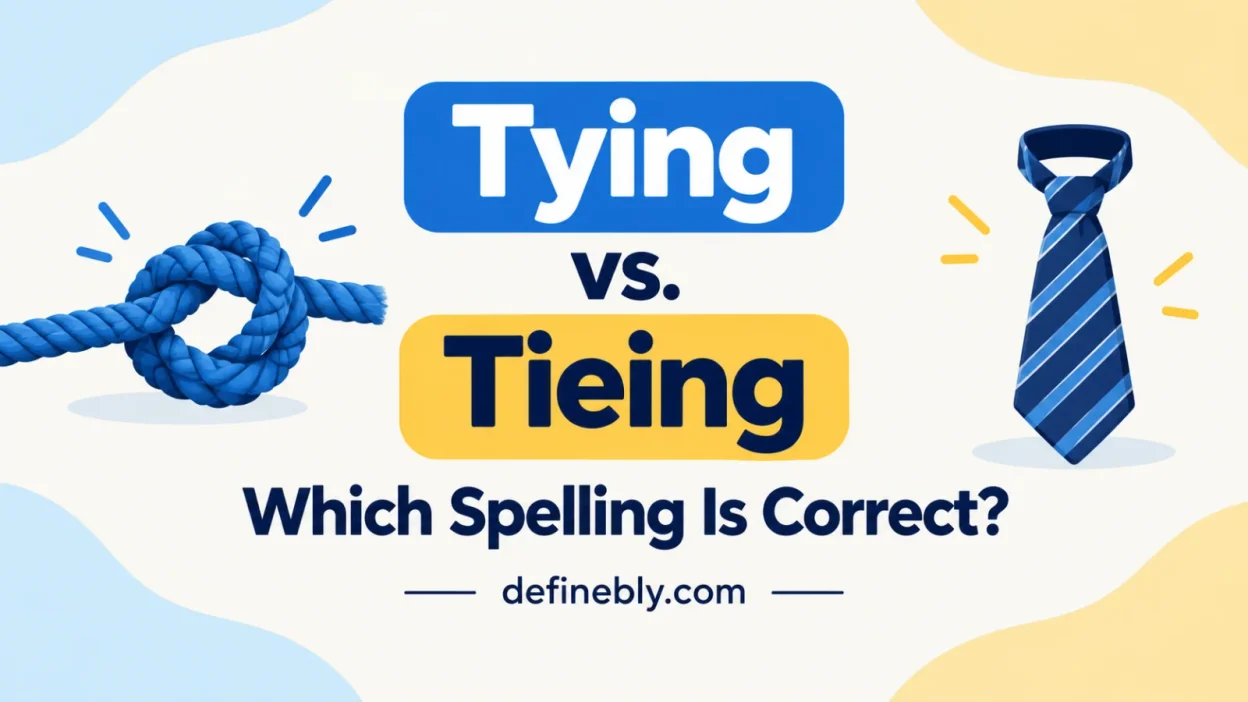
Tying is the correct spelling in standard English. Tieing is a misspelling that should be avoided in everyday, academic, and professional writing.
The difference comes down to one simple spelling rule: when adding -ing to the verb tie, drop the final e. This produces tying, which means fastening something, forming a knot, connecting things, or bringing a score level in a competition.
For example, write “She is tying her shoes,” not “She is tieing her shoes.”
Tying vs. Tieing: Quick Answer
Use tying whenever you need the -ing form of the verb tie. The spelling tieing is not standard modern English.
| Spelling | Correct? | Example |
|---|---|---|
| Tying | Yes | He is tying his shoelaces. |
| Tieing | No | He is tieing his shoelaces. |
The rule: Tie + -ing = tying.
The final e is removed before the suffix -ing is added. This spelling is the same in American and British English.
Why Is Tying Correct Instead of Tieing?
The verb tie ends in a silent e. In standard English spelling, a final silent e is generally dropped before adding -ing.
Applying this rule gives us:
- Tie → Tying
- Make → Making
- Write → Writing
- Take → Taking
- Drive → Driving
The word tying may look unusual because the letters ie remain together, but the spelling follows the standard pattern. Writing tieing incorrectly retains the final e.
This rule helps explain why tying is correct even though the base verb is spelled tie.
What Does Tying Mean?
Tying is the present participle or gerund form of the verb tie. Depending on the sentence, it can describe fastening something, connecting ideas or objects, or making a score equal.
1. Fastening or Securing Something
Tying commonly means fastening something with a string, rope, lace, ribbon, or similar material.
Examples:
- She is tying her shoes before leaving the house.
- He is tying a ribbon around the gift.
- The sailor is tying the boat to the dock.
- I am tying the package with a piece of string.
In each sentence, tying describes the action of fastening something.
2. Connecting Things or Ideas
The word can also describe linking objects, information, events, or ideas.
Examples:
- The researcher is tying the results to the original hypothesis.
- She is tying the decorations together with a ribbon.
- The teacher is tying the lesson to a real-world example.
Here, tying expresses a connection rather than simply making a knot.
3. Making a Score Equal
In sports, tying can describe bringing a score level with that of an opponent.
Examples:
- The team scored in the final minute, tying the game.
- Her goal is tying the match at two goals each.
- The player scored again, tying the competition.
In this context, tying still follows the same spelling rule.
How to Use Tying in a Sentence
Use tying when describing an action that is happening, an activity, or an action treated as a noun.
Present continuous tense
- She is tying her hair back.
- They are tying the boxes together.
Past continuous tense
- He was tying his shoes when the phone rang.
- We were tying decorations to the fence.
As a gerund
- Tying a secure knot takes practice.
- Tying your shoes correctly helps keep them from coming undone.
In figurative expressions
- The investigation is tying the evidence to the suspect.
- The final basket is tying the score.
These examples demonstrate how the word works in different grammatical structures without changing its spelling.
Tying vs. Tieing: Common Spelling Mistakes
The most common mistake is keeping the final e from tie when adding -ing. The correct form removes that letter.
| Incorrect | Correct |
|---|---|
| She is tieing her shoes. | She is tying her shoes. |
| He is tieing a knot. | He is tying a knot. |
| They are tieing the ropes together. | They are tying the ropes together. |
| I am tieing a ribbon around the box. | I am tying a ribbon around the box. |
Remember: The spelling changes when the suffix is added. The final e disappears, but the meaning of the original verb remains the same.
Is Tying Correct in American and British English?
Yes. Tying is the standard spelling in both American and British English. There is no regional spelling difference for this word.
| English Variety | Standard Spelling |
|---|---|
| American English | Tying |
| British English | Tying |
| Canadian English | Tying |
| Australian English | Tying |
Whether you are writing an American English article, a British English assignment, or a professional email, use tying.
Related Forms of the Verb Tie
Understanding the other forms of tie can help prevent spelling mistakes.
| Verb Form | Example |
|---|---|
| Tie | I tie my shoes every morning. |
| Ties | She ties her shoes before running. |
| Tied | He tied the rope to a post. |
| Tying | They are tying the packages together. |
Notice that tied and tying follow different spelling patterns. When forming the past tense, tie becomes tied. When adding -ing, it becomes tying.
Frequently Asked Questions
Is Tying or Tieing Correct?
Tying is correct in standard English. Tieing is a nonstandard misspelling and should not be used in ordinary writing.
Why Is Tying Spelled Without an E?
The final silent e in tie is dropped before adding -ing. This produces tying, following a common English spelling rule.
Is Tieing Ever Correct?
Tieing is not the accepted spelling in standard modern English. Use tying in essays, emails, articles, and other everyday writing.
Does Tying Have the Same Spelling in American and British English?
Yes. Both American and British English use tying. Neither variety uses tieing as the standard form.
What Is the Base Word of Tying?
The base verb is tie. Its common forms are tie, ties, tied, and tying.
What Is an Example of Tying in a Sentence?
“She is tying her shoelaces before going for a run” is a correct example. The word tying describes the action of fastening the shoelaces.
What Is the Difference Between Tying and Tied?
Tying usually describes an ongoing action or an activity, while tied is commonly used as the past-tense or past-participle form of tie.
Examples:
- She is tying the rope.
- She tied the rope yesterday.
How Can I Remember the Spelling of Tying?
Remember the pattern tie → tying. When you add -ing, drop the final e. The same general rule applies to words such as make → making and write → writing.
Conclusion
When comparing tying vs. tieing, the correct spelling is always tying in standard modern English. The word describes fastening, connecting, or bringing a score level, and its spelling follows the rule of dropping the final silent e before adding -ing.
Use tying in American and British English, and avoid tieing in standard writing.
Easy rule to remember: Tie + -ing = Tying.