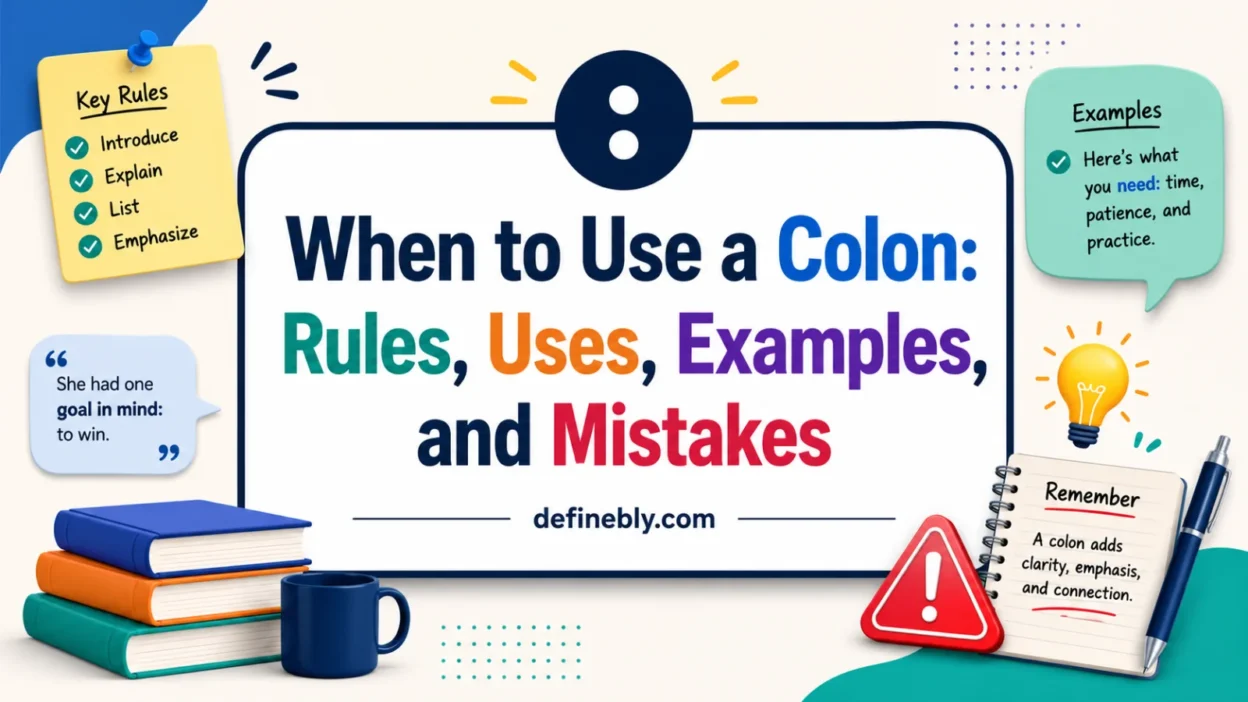
Use a colon when the first part of a sentence introduces, explains, names, or points to what comes next.
A colon is a forward-looking punctuation mark. It tells the reader, “Here comes the detail.”
Example:
- I need three things: coffee, my laptop, and a quiet room.
The words before the colon set up the list. The words after the colon deliver the details.
Quick Answer
A colon is used after a complete setup to introduce a list, explanation, example, quote, title detail, or emphasized idea.
Correct:
- She had one goal: finish the project by Friday.
The first part creates expectation. The second part answers it.
A colon can also appear in time, ratios, titles, subtitles, and formal greetings.
Examples:
- The meeting starts at 9:30.
- Mix the cleaner with water at a 1:4 ratio.
- Dear Ms. Carter:
The most important sentence rule is this: in most formal writing, the words before a colon should form a complete thought.
The Rule Explained
A colon works like a signal. It points to information that completes or expands the first part of the sentence.
Think of it as meaning here is what I mean, here is the list, or here is the exact detail.
Correct:
- The answer was simple: we needed more time.
The first part can stand alone:
- The answer was simple.
The second part explains the answer:
- We needed more time.
In formal writing, avoid placing a colon after an incomplete phrase.
Incorrect:
- We packed: towels, sunscreen, snacks, and water.
Correct:
- We packed towels, sunscreen, snacks, and water.
Also correct:
- We packed the essentials: towels, sunscreen, snacks, and water.
The corrected version works because we packed the essentials is a complete setup.
When To Use It
Use a colon when the first part of the sentence prepares the reader for what follows.
Before A List
Use a colon before a list when the words before it form a complete thought.
Correct:
- Please bring these items: a notebook, a pen, and your ID.
- We need three supplies: tape, scissors, and poster board.
- The recipe calls for four basics: flour, sugar, eggs, and milk.
Do not use a colon if the list directly completes the verb.
Incorrect:
- Please bring: a notebook, a pen, and your ID.
Correct:
- Please bring a notebook, a pen, and your ID.
The verb bring already leads directly into the items, so the colon interrupts the sentence.
Before An Explanation
Use a colon when the second part explains the first part.
Correct:
- The problem was clear: no one had checked the address.
- The delay had one cause: the shipment arrived late.
- The decision made sense: the old plan was too expensive.
The colon tells the reader that the explanation is coming next.
Before An Example
Use a colon when the second part gives a specific example of the first part.
Correct:
- I forgot one thing: my phone charger.
- She asked for one favor: a ride to the airport.
- We noticed one issue: the file would not open.
The colon adds focus. It makes the example feel direct and important.
Before A Quote
Use a colon before a quote when the first part formally introduces the quoted words.
Correct:
- The coach gave one final reminder: “Play smart and stay focused.”
- The sign said this: “Employees only.”
- Maya ended her email with one sentence: “Thank you for your time.”
A comma is often enough for short quoted speech.
Correct:
- She said, “I’ll call you later.”
Use a colon when the quote is introduced more formally or with stronger emphasis.
Between Two Complete Thoughts
A colon can connect two complete thoughts when the second explains, proves, or expands the first.
Correct:
- The plan failed: we started too late.
- She made the right choice: she asked for help.
- The answer was obvious: we needed a new schedule.
A semicolon can also connect related complete thoughts, but it does not introduce the second thought in the same way.
Semicolon:
- The plan failed; we started too late.
Colon:
- The plan failed: we started too late.
The colon puts more emphasis on the explanation.
For Emphasis
A colon can make the final word or phrase stand out.
Correct:
- She wanted only one thing: peace.
- The team had one priority: safety.
- His answer was final: no.
This use works best when the first part creates suspense or expectation.
When Not To Use It
Do not use a colon right after a verb when the words after the verb are its direct object.
Incorrect:
- My favorite snacks are: chips, grapes, and popcorn.
Correct:
- My favorite snacks are chips, grapes, and popcorn.
Do not use a colon right after a preposition.
Incorrect:
- The package was sent to: my office, my apartment, and my parents’ house.
Correct:
- The package was sent to my office, my apartment, and my parents’ house.
Do not use a colon after an incomplete phrase.
Incorrect:
- For dinner, we had: pasta, salad, and bread.
Correct:
- For dinner, we had pasta, salad, and bread.
Also correct:
- For dinner, we had a simple meal: pasta, salad, and bread.
Do not use a colon where a semicolon is needed.
Weak:
- I wanted to leave early: the meeting ran late.
Better:
- I wanted to leave early; the meeting ran late.
Best if the second part explains the first:
- I could not leave early: the meeting ran late.
A colon should introduce or explain. If the two thoughts are simply related, a semicolon may fit better.
Common Mistakes
One common mistake is using a colon before every list.
Incorrect:
- She bought: eggs, milk, and bread.
Correct:
- She bought eggs, milk, and bread.
Another mistake is using a colon after including, such as, or for example when the sentence already flows naturally.
Incorrect:
- The store sells many snacks, including: chips, crackers, and cookies.
Correct:
- The store sells many snacks, including chips, crackers, and cookies.
Another common mistake is capitalizing after every colon.
Usually correct:
- She had one request: please be on time.
Capitalize after a colon if the next word is a proper noun.
Correct:
- We visited one city: Chicago.
Some style guides allow or prefer capitalization when a complete sentence follows a colon. For general writing, the safest choice is to stay consistent with the style you are using.
A final mistake is using a colon when the second part does not clearly complete the first.
Weak:
- I opened my laptop: the weather was cold.
Better:
- I opened my laptop. The weather was cold.
The ideas are not closely connected, so a period works better.
Correct Examples
| Sentence | Why It Works |
|---|---|
| I need one favor: call me before noon. | The second part explains the favor. |
| Bring these supplies: paper, tape, and scissors. | The colon introduces a list. |
| She gave a simple answer: no. | The colon adds emphasis. |
| The reason was clear: the file was missing. | The second part explains the first. |
| He quoted his mom: “Always tell the truth.” | The colon introduces a quote. |
| The meeting starts at 9:30. | The colon separates hours and minutes. |
| The final score was 3:2. | The colon shows a ratio or score. |
| Dear Hiring Manager: | The colon is used in a formal greeting. |
More examples:
- The answer is obvious: we need more time.
- I have two priorities: family and health.
- The sign said one thing: “Keep out.”
- She made a smart choice: she asked for help.
- There was only one problem: the tickets were sold out.
- The report had a clear title: “Quarterly Budget Review.”
- We need one change: a shorter deadline.
- The class starts at 8:15 tomorrow morning.
Colon Vs. Semicolon, Comma, Dash, And Period
A colon is not interchangeable with other punctuation marks.
| Punctuation Mark | Main Job | Example |
|---|---|---|
| Colon | Introduces or explains what comes next | The reason was clear: we were late. |
| Semicolon | Connects related complete thoughts | We were late; the doors were closed. |
| Comma | Separates smaller parts of a sentence | We packed shoes, jackets, and snacks. |
| Dash | Adds a dramatic break or sudden detail | We needed one thing — more time. |
| Period | Ends a complete thought | We were late. The doors were closed. |
Use a colon when the second part answers, explains, names, or lists what the first part sets up.
Use a semicolon when the two thoughts are related but the second does not directly explain the first.
Colon:
- She had one concern: the cost.
Semicolon:
- The cost was high; we waited to decide.
The colon points forward. The semicolon balances two related thoughts.
Capitalization After A Colon
In everyday writing, do not capitalize the first word after a colon unless it is a proper noun.
Correct:
- I need one thing: sleep.
- She chose one city: Boston.
When a complete sentence follows the colon, capitalization depends on the style guide or publication style.
Lowercase style:
- The rule is simple: always check the address first.
Capitalized style:
- The rule is simple: Always check the address first.
For general US writing, consistency matters most. Do not switch styles within the same document.
Always capitalize proper nouns after a colon.
Correct:
- We visited one museum: The Met.
Special Uses Of A Colon
Colons appear outside regular sentence punctuation too.
Use a colon between hours and minutes.
- 7:45
- 10:30 a.m.
- 6:05 p.m.
Use a colon in ratios.
- Mix the solution at a 1:3 ratio.
- The team won 4:2.
Use a colon between a title and subtitle.
- Clean Writing: A Practical Guide
- Budget Basics: How To Plan Monthly Expenses
Use a colon after a formal salutation in a business letter or formal email.
- Dear Dr. Williams:
- Dear Hiring Committee:
- To Whom It May Concern:
In casual emails, a comma is more common.
- Hi Jordan,
Quick Memory Fix Or Rule Of Thumb
Use this simple rule:
A colon says, “Here it comes.”
Before using a colon, ask:
- Does the first part set up what follows?
- Can the first part stand strongly on its own?
- Does the second part name, explain, list, quote, or emphasize the first part?
If yes, a colon may work.
If the sentence reads smoothly without the colon, do not force one.
FAQs
When should I use a colon?
Use a colon when the first part of a sentence introduces what comes next.
A colon can introduce a list, explanation, example, quote, or emphasized detail.
Example:
- I need one thing: sleep.
What is a simple colon example?
A simple colon example is:
- She had one goal: pass the exam.
The first part sets up the idea. The second part identifies the goal.
Can I use a colon before a list?
Yes, use a colon before a list when the words before it form a complete thought.
Correct:
- We packed the basics: shirts, shoes, and jackets.
Do not use a colon if the list directly follows a verb.
Incorrect:
- We packed: shirts, shoes, and jackets.
Can I use a colon after “are”?
Usually, no. Do not use a colon after are when the list directly completes the sentence.
Incorrect:
- The winners are: Mia, Jordan, and Ava.
Correct:
- The winners are Mia, Jordan, and Ava.
You can rewrite the sentence so the colon works.
Correct:
- The winners are three students: Mia, Jordan, and Ava.
Do I capitalize after a colon?
Usually, do not capitalize after a colon unless the next word is a proper noun.
Correct:
- I chose one city: Boston.
Some styles allow capitalization when a full sentence follows the colon. The best choice depends on the style you are following.
Can a colon introduce a quote?
Yes. A colon can introduce a quote when the first part sets it up.
Correct:
- The note said this: “Meet me at noon.”
A comma is often enough for simple quoted speech.
Correct:
- She said, “Meet me at noon.”
What is the difference between a colon and a semicolon?
A colon introduces, explains, or emphasizes what comes next.
A semicolon connects two closely related complete thoughts.
Colon:
- She had one concern: the cost.
Semicolon:
- The cost was high; we waited to decide.
Can a colon be used for time?
Yes. A colon is used between hours and minutes.
Example:
- The meeting starts at 9:30.
This is a practical use of the colon, but it is different from using a colon inside a sentence.
Can I use a colon after “including”?
Usually, no. Do not use a colon right after including when the sentence already flows into the examples.
Incorrect:
- The kit includes: tape, gloves, and labels.
Correct:
- The kit includes tape, gloves, and labels.
Also correct:
- The kit includes three items: tape, gloves, and labels.
Can a colon connect two complete sentences?
Yes, a colon can connect two complete sentences when the second explains or expands the first.
Correct:
- The plan failed: we started too late.
The second sentence explains why the plan failed.
Conclusion
Use a colon when the first part of a sentence points forward to what comes next.
A colon can introduce a list, explanation, example, quote, or emphasized detail. It can also appear in time, ratios, titles, and formal greetings.
The easiest rule is simple: a colon says, “Here it comes.”