
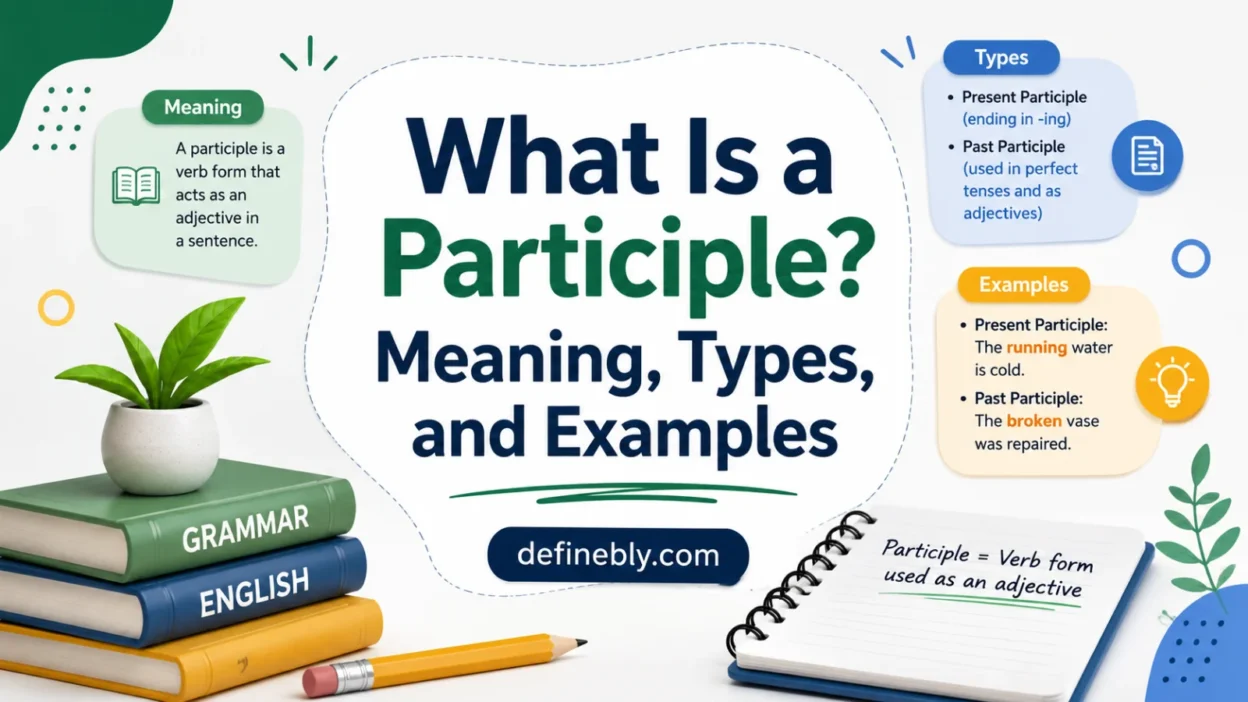
A participle can look confusing because it comes from a verb. But it does not always act like the main verb in a sentence.
In many sentences, a participle describes a noun. In other sentences, it helps form a verb phrase.
Quick Answer: What Is A Participle?
A participle is a form of a verb that can work like an adjective or help form a verb phrase.
In the broken window, the word broken comes from the verb break, but it describes the noun window.
In She is running, the word running helps form the verb phrase is running.
A participle is not always the main verb of a sentence. It often describes a noun, forms a tense with a helping verb, or appears in a participial phrase.
Simple Definition Of A Participle
A participle is a verb-based word that has adjective-like or verb-phrase functions. In English, participles commonly end in -ing, -ed, -en, -n, or -t, though irregular forms do not always follow a simple pattern.
Examples:
| Verb | Present Participle | Past Participle |
|---|---|---|
| walk | walking | walked |
| break | breaking | broken |
| write | writing | written |
| eat | eating | eaten |
| see | seeing | seen |
| build | building | built |
A participle keeps a connection to its verb, but its job changes depending on how it is used in the sentence.
The Two Main Types Of Participles
English has two main participle forms: present participles and past participles. Some grammar lessons also discuss perfect participles, which are built with having + past participle.
Present Participles
A present participle is formed by adding -ing to the base form of a verb.
Examples:
| Base Verb | Present Participle |
|---|---|
| run | running |
| smile | smiling |
| write | writing |
| swim | swimming |
| laugh | laughing |
Present participles are used in two common ways.
They can describe nouns:
- The barking dog woke the baby.
- The smiling teacher welcomed the class.
- The falling leaves covered the sidewalk.
They can also help form continuous verb tenses with a form of be:
- She is reading a novel.
- They were laughing at the joke.
- I am working from home today.
Past Participles
A past participle is often formed by adding -ed to a regular verb, but many common past participles are irregular.
Examples:
| Base Verb | Past Tense | Past Participle |
|---|---|---|
| clean | cleaned | cleaned |
| open | opened | opened |
| break | broke | broken |
| write | wrote | written |
| eat | ate | eaten |
| go | went | gone |
| see | saw | seen |
Past participles can describe nouns:
- The locked door would not open.
- The broken chair needs repair.
- The written instructions were easy to follow.
They can also help form perfect tenses with have, has, or had:
- I have finished my homework.
- She has written three emails.
- They had eaten before we arrived.
Past participles are also used in passive voice with forms of be:
- The cake was baked by Maria.
- The window was broken during the storm.
- The report was written last night.
Perfect Participles
A perfect participle uses having + past participle. It usually shows that one action happened before another action.
Examples:
- Having finished the test, Maya left the room.
- Having read the instructions, we started the project.
- Having seen the movie before, I knew the ending.
Perfect participles are common in formal writing, but they should be used carefully. In everyday writing, a simpler sentence is often clearer.
Formal:
- Having completed the application, Jordan submitted it online.
Simpler:
- After Jordan completed the application, he submitted it online.
How Participles Work In Sentences
Participles have three major jobs in English.
Participles Can Describe Nouns
When a participle describes a noun, it acts like an adjective.
Examples:
| Sentence | Participle | Noun It Describes |
|---|---|---|
| The crying baby needed a nap. | crying | baby |
| The cracked phone screen was hard to read. | cracked | screen |
| The boiling water spilled over the pot. | boiling | water |
| The painted wall looked fresh. | painted | wall |
| The missing keys were under the couch. | missing | keys |
In each sentence, the participle gives more information about a person, place, thing, or idea.
Participles Can Help Form Verb Tenses
A participle can join with a helping verb to form a full verb phrase.
Present participles help form continuous tenses:
| Sentence | Verb Phrase | Participle |
|---|---|---|
| She is studying for the exam. | is studying | studying |
| We were waiting outside. | were waiting | waiting |
| They are planning a trip. | are planning | planning |
Past participles help form perfect tenses:
| Sentence | Verb Phrase | Participle |
|---|---|---|
| I have seen that show. | have seen | seen |
| He has taken the test twice. | has taken | taken |
| We had finished dinner. | had finished | finished |
Participles Can Help Form Passive Voice
A past participle can appear after a form of be to show that the subject receives the action.
Examples:
| Active Voice | Passive Voice |
|---|---|
| Maria baked the cake. | The cake was baked by Maria. |
| Someone broke the window. | The window was broken. |
| The team completed the project. | The project was completed. |
In passive voice, the past participle is essential. Without it, the sentence is incomplete.
Incorrect:
- The cake was by Maria.
Correct:
- The cake was baked by Maria.
Participle Phrases
A participle phrase is a group of words that begins with a participle and describes a noun or pronoun.
Examples:
- Running down the street, Liam missed the bus.
- Broken by the storm, the fence leaned into the yard.
- The woman wearing the blue jacket is my aunt.
- The book written by Toni Morrison won wide praise.
A participle phrase can appear at the beginning, middle, or end of a sentence.
| Position | Example |
|---|---|
| Beginning | Smiling at the crowd, the singer walked onstage. |
| Middle | The singer, smiling at the crowd, walked onstage. |
| End | I watched the singer smiling at the crowd. |
Comma Rules For Participle Phrases
Use a comma after an introductory participle phrase.
Correct:
- Walking into the kitchen, I smelled fresh coffee.
- Exhausted after practice, the players sat on the bench.
Use commas around a participle phrase that adds nonessential information.
Correct:
- My brother, wearing a red hoodie, waved from across the street.
- The old house, damaged by the storm, needed repairs.
Do not use commas when the participle phrase is essential to identifying the noun.
Correct:
- The student sitting by the window raised her hand.
- The files stored on the laptop were deleted.
The phrase sitting by the window tells us which student. The phrase stored on the laptop tells us which files.
Participle Vs. Gerund
Present participles and gerunds both end in -ing, but they do different jobs.
A participle acts like an adjective or helps form a verb phrase.
A gerund acts like a noun.
| Sentence | -ing Word | Function |
|---|---|---|
| Swimming is my favorite exercise. | Swimming | Gerund; names an activity |
| The swimming child waved at us. | swimming | Participle; describes child |
| I enjoy reading. | reading | Gerund; object of enjoy |
| She is reading a book. | reading | Participle; part of verb phrase |
| The glowing candle lit the room. | glowing | Participle; describes candle |
A simple test helps: if the -ing word names an activity, it is probably a gerund. If it describes a noun or works with a helping verb, it is probably a participle.
Past Participle Vs. Past Tense
Past tense and past participle forms are easy to confuse because regular verbs often look the same.
Regular verb:
- Past tense: I walked home.
- Past participle: I have walked home.
The word walked looks the same in both sentences.
Irregular verbs are different:
| Base Verb | Past Tense | Past Participle |
|---|---|---|
| write | wrote | written |
| eat | ate | eaten |
| see | saw | seen |
| go | went | gone |
| take | took | taken |
| speak | spoke | spoken |
Incorrect:
- I have wrote the email.
Correct:
- I have written the email.
Incorrect:
- She has went home.
Correct:
- She has gone home.
Use the past participle after have, has, or had.
Common Mistakes With Participles
Using A Participle Without A Helping Verb
A participle cannot always stand alone as the main verb.
Incorrect:
- She running to the bus.
Correct:
- She is running to the bus.
Incorrect:
- They finished already?
Correct:
- Have they finished already?
The correct helping verb depends on the tense and meaning.
Confusing Bored And Boring
Many participles describe feelings or the causes of feelings.
Use -ing for the thing that causes the feeling:
- The movie was boring.
- The instructions were confusing.
- The news was surprising.
Use -ed for the person or thing that experiences the feeling:
- I was bored.
- The students were confused.
- We were surprised.
Creating A Dangling Participle
A dangling participle happens when a participle phrase does not clearly describe the right noun.
Unclear:
- Walking into the room, the lights were bright.
This sounds as if the lights were walking into the room.
Clear:
- Walking into the room, I noticed the bright lights.
Now the participle phrase clearly describes I.
Another unclear example:
- Driving to work, the rain started falling.
Clear:
- Driving to work, I saw the rain start falling.
To fix a dangling participle, place the noun or pronoun being described right after the participle phrase.
How To Identify A Participle
Use these steps to spot a participle.
First, look for a verb form ending in -ing, -ed, -en, -n, or -t.
Second, ask what the word is doing.
Does it describe a noun?
- The broken plate is on the table.
Does it work with a helping verb?
- She is cooking dinner.
- We have eaten lunch.
Does it begin a phrase that describes a noun?
- Covered in mud, the dog ran inside.
If the answer is yes, you are probably looking at a participle.
Examples Of Participles In Sentences
| Sentence | Participle | Type | Function |
|---|---|---|---|
| The barking dog woke me up. | barking | Present participle | Describes dog |
| The broken chair needs repair. | broken | Past participle | Describes chair |
| She is reading a book. | reading | Present participle | Forms verb phrase |
| We have eaten lunch. | eaten | Past participle | Forms perfect tense |
| The smiling teacher greeted us. | smiling | Present participle | Describes teacher |
| The stolen bike was found downtown. | stolen | Past participle | Describes bike |
| They were laughing at the joke. | laughing | Present participle | Forms continuous tense |
| The wall was painted yesterday. | painted | Past participle | Forms passive voice |
| Running late, I skipped breakfast. | running | Present participle | Begins participle phrase |
| Written in pencil, the note was hard to read. | written | Past participle | Begins participle phrase |
Quick Rule Of Thumb
A participle is a verb form doing one of these jobs:
- Describing a noun
- Helping form a verb tense
- Helping form passive voice
- Starting a phrase that describes a noun
Ask:
- Does it describe someone or something?
- Does it work with is, was, were, have, has, had, or another helping verb?
- Is it part of a phrase that modifies a noun?
If yes, it is probably a participle.
FAQs
What is a participle in simple words?
A participle is a verb form that can describe a noun or help make a verb phrase.
Examples include running, broken, written, finished, and seen.
What are the two main types of participles?
The two main types are present participles and past participles.
Present participles usually end in -ing, as in running or talking. Past participles often end in -ed, as in finished or opened, but many are irregular, such as broken, written, and seen.
Is “running” a participle?
Yes, running can be a participle.
In the running water, it describes water. In She is running, it helps form the verb phrase is running.
But in Running is good exercise, running is a gerund because it acts like a noun.
Is “broken” a participle?
Yes, broken is a past participle.
In the broken window, it describes the noun window. In The window was broken, it helps form a passive verb phrase.
What is the difference between a verb and a participle?
A verb can be the main action of a sentence. A participle comes from a verb, but it may describe a noun or work with a helping verb.
Example:
- She writes every day.
Here, writes is the main verb.
Example:
- The written note was clear.
Here, written describes note.
Can a participle be an adjective?
Yes. Participles often act like adjectives.
Examples:
- a barking dog
- a locked door
- a confusing question
- a written message
- a boiling pot
Are all “-ing” words participles?
No. Some -ing words are gerunds, which act like nouns.
Example:
- Reading helps me relax.
Here, reading names an activity, so it is a gerund.
Example:
- The reading lamp is on the desk.
Here, reading describes lamp, so it works like a participle.
What is a past participle example?
Examples of past participles include finished, broken, eaten, written, seen, gone, and taken.
In I have eaten, the word eaten is a past participle.
What is a participle phrase?
A participle phrase is a group of words that begins with a participle and describes a noun or pronoun.
Example:
- Carrying a heavy bag, Emma walked slowly.
The phrase carrying a heavy bag describes Emma.
What is a dangling participle?
A dangling participle is a participle phrase that does not clearly describe the right noun.
Unclear:
- Walking to school, the rain started.
Clear:
- Walking to school, I felt the rain start.
The corrected sentence makes it clear who was walking.
Conclusion
A participle is a verb form that can describe a noun, help form a verb tense, or help create passive voice. The two main types are present participles, such as running and smiling, and past participles, such as broken, written, and finished.
The easiest way to identify a participle is to check its job in the sentence. If a verb form describes a noun or works with a helping verb, it is probably a participle.