
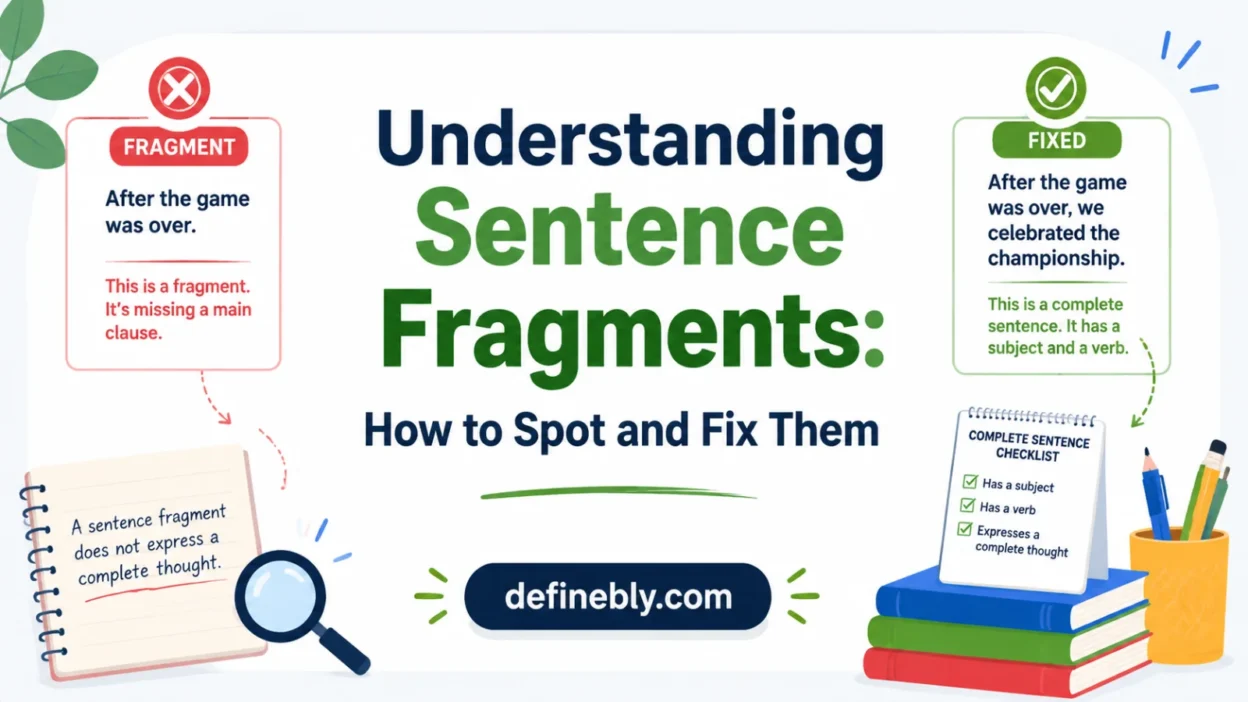
A sentence fragment is a group of words that appears to be a sentence but lacks one or more essential components, such as a subject, verb, or a complete thought. These incomplete sentences can confuse readers by leaving ideas unfinished and disrupting the flow of your writing.
Although sentence fragments are often seen as mistakes, they can be used intentionally in some forms of writing, such as dialogue or creative writing, to create emphasis or build suspense. However, in formal writing, sentence fragments should be avoided to ensure clarity and precision.
Quick Answer: What Is a Sentence Fragment?
A sentence fragment occurs when a group of words that looks like a sentence is missing one of the necessary elements to form a complete thought. Typically, it is missing a subject, verb, or both.
Example of a sentence fragment:
- Because I was late.
This leaves the reader wondering, “What happened because you were late?” It doesn’t provide enough information to stand alone.
What Makes a Complete Sentence?
A complete sentence has at least two things:
- A subject (the person or thing doing the action).
- A predicate (the action or verb).
For example:
- The dog barked.
This is a complete sentence because it has both a subject (the dog) and a predicate (barked).
Types of Sentence Fragments
There are two main types of sentence fragments: missing subjects or verbs and dependent clause fragments.
Missing Subject or Verb Fragments
This occurs when a part of the sentence is missing its subject or verb.
Fragment:
- Running down the street.
This fragment is missing a subject. Who is running down the street? We don’t know.
Corrected:
- The man was running down the street.
In the corrected sentence, we now have both a subject (the man) and a verb (was running), making it a complete thought.
Dependent Clause Fragments
A dependent clause cannot stand alone as a sentence because it does not express a complete idea.
Fragment:
- After the rain stopped.
The phrase starts with a dependent clause (After the rain stopped) but does not tell us what happened after the rain stopped.
Corrected:
- After the rain stopped, we went for a walk.
Now, the sentence includes an independent clause that completes the thought.
When to Use Sentence Fragments
While sentence fragments are generally avoided in formal writing, they can be effectively used in casual writing, dialogue, or to create emphasis.
For example, in dialogue:
- “You know what? I’m done.”
In informal contexts, fragments can help create a conversational tone or convey emotion quickly.
In formal writing (academic papers, business communication, etc.), fragments should be avoided, as they confuse the reader and reduce clarity.
When Not to Use Sentence Fragments
Sentence fragments should not be used when:
- You need to express a complete thought.
- You are writing formally, where clarity is essential.
- You need to present information clearly and logically.
Correcting Common Sentence Fragments
Using a Dependent Clause by Itself
A common mistake is using a dependent clause by itself without an independent clause.
Incorrect:
- When I arrived at the party.
This is a fragment because it leaves us hanging. We don’t know what happened when the speaker arrived.
Corrected:
- When I arrived at the party, everyone had already left.
The corrected sentence now provides a complete thought, with both a dependent clause and an independent clause.
Leaving Out the Subject or Verb
Some fragments are missing a subject or verb, making the sentence incomplete.
Incorrect:
- The car in the driveway.
This is a fragment because it lacks a verb. What about the car?
Corrected:
- The car in the driveway is red.
Now, the sentence has both a subject (the car) and a verb (is), making it a complete thought.
Correcting Sentence Fragments: Practical Tips
1. Use a Period
If you have two independent clauses, separate them with a period.
Fragment:
- I went to the store I bought some milk.
Corrected:
- I went to the store. I bought some milk.
2. Use a Semicolon
If the clauses are closely related, use a semicolon.
Fragment:
- I went to the store I bought some milk.
Corrected:
- I went to the store; I bought some milk.
3. Use a Coordinating Conjunction
You can also use a coordinating conjunction (and, but, so, or, yet, for, nor) to connect the clauses.
Fragment:
- I went to the store I bought some milk.
Corrected:
- I went to the store, and I bought some milk.
Quick Memory Fix or Rule of Thumb
To avoid sentence fragments, ensure that every sentence contains:
- A subject (who or what the sentence is about).
- A predicate (what the subject is doing or what is happening to it).
- A complete thought (the idea is not left unfinished).
FAQs
How do you fix a sentence fragment?
To fix a sentence fragment, add the missing subject, verb, or connect a dependent clause to an independent clause.
What causes sentence fragments?
Sentence fragments often occur when a dependent clause is used by itself, or when the sentence is missing either a subject or a verb.
Is a sentence fragment a mistake?
Yes, sentence fragments are considered a mistake in formal writing because they leave readers with incomplete thoughts.
Conclusion
Sentence fragments are incomplete thoughts that leave readers confused. They occur when a sentence lacks a subject, verb, or both, or when a dependent clause is used alone. By ensuring that your sentences contain both a subject and a predicate, you can avoid fragments and make your writing clearer and more professional.