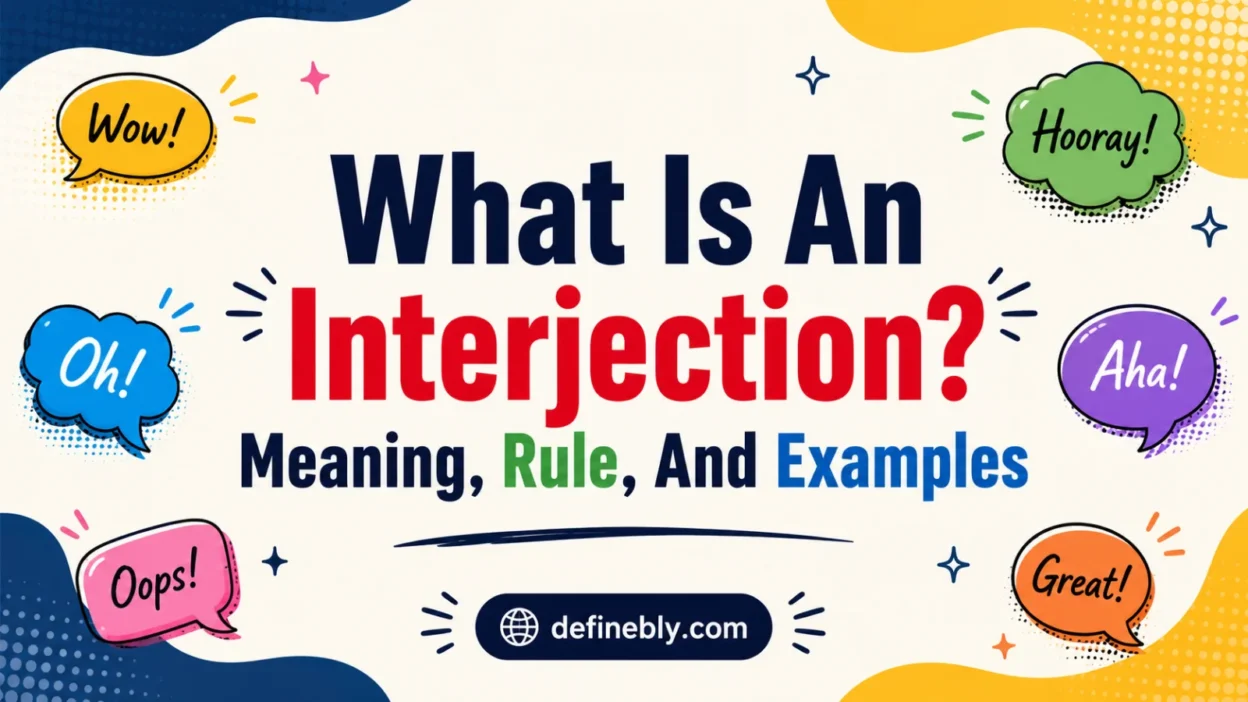
An interjection is a word, sound, or short phrase that expresses a quick emotion, reaction, or call for attention. Interjections often stand apart from the main grammar of a sentence.
Examples:
- Wow! That view is incredible.
- Ouch! That hurt.
- Hey, wait for me.
- Oops, I forgot my keys.
- Ugh, this line is moving slowly.
- Hmm, I need to think about that.
In “Wow! That view is incredible,” wow is the interjection. It shows surprise, excitement, or admiration.
Quick Answer: What Is An Interjection?
An interjection is a short expression that shows feeling, reaction, hesitation, or attention.
Common interjections include:
- wow
- ouch
- hey
- oops
- ugh
- oh
- yay
- yikes
- hmm
- well
- uh
- ew
- phew
- alas
Example:
- Oops, I sent the wrong file.
The interjection oops shows a mistake or mild regret. The sentence still makes grammatical sense without it:
- I sent the wrong file.
The interjection adds tone, not essential grammar.
How Interjections Work
Interjections are different from most other parts of speech. A noun, verb, adjective, or adverb usually plays a direct grammatical role in a sentence. An interjection often stands outside the main structure.
Example:
- Oh, I understand now.
Main clause:
- I understand now.
Interjection:
- Oh
The word oh is not the subject, verb, object, adjective, or adverb. It adds the speaker’s reaction.
Another example:
- Yikes! That was close.
The sentence That was close is complete. Yikes! adds alarm or surprise.
Why Interjections Matter
Interjections help writing sound more human, especially in speech, dialogue, texts, captions, comics, and informal writing. They can show emotion quickly without a long explanation.
Without an interjection:
- That was unexpected.
With an interjection:
- Whoa! That was unexpected.
Without an interjection:
- I made a mistake.
With an interjection:
- Oops, I made a mistake.
Interjections are powerful because they reveal tone immediately. They can make a sentence sound excited, annoyed, embarrassed, relieved, surprised, hesitant, or conversational.
Interjection Examples In Sentences
| Sentence | Interjection | What It Shows |
|---|---|---|
| Wow! You finished already. | Wow | Surprise or admiration |
| Ouch! That was sharp. | Ouch | Pain |
| Hey, are you coming? | Hey | Attention |
| Oops, I sent the wrong file. | Oops | Mistake or regret |
| Ugh, this traffic is awful. | Ugh | Frustration or disgust |
| Yay! We got the tickets. | Yay | Joy |
| Hmm, I need to think about that. | Hmm | Thought or hesitation |
| Well, that changes things. | Well | Pause or transition |
| Phew, that was close. | Phew | Relief |
| Ew, that smells terrible. | Ew | Disgust |
| Huh? What did you say? | Huh | Confusion |
| Shh, the baby is sleeping. | Shh | Request for silence |
Types Of Interjections
Interjections can be grouped by the feeling or function they express. These categories overlap because the same interjection can mean different things depending on context and tone.
Interjections Of Surprise
Interjections of surprise show shock, amazement, or disbelief.
Examples:
- Wow! That was fast.
- Whoa! I did not expect that.
- Oh! I forgot about the meeting.
- No way! You actually won?
- Good grief! That is a lot of paperwork.
Common surprise interjections include wow, whoa, oh, no way, really, and good grief.
Interjections Of Joy Or Excitement
These interjections show happiness, celebration, or enthusiasm.
Examples:
- Yay! We passed.
- Hooray! The package arrived.
- Awesome! That worked.
- Great! I’ll see you then.
- Woo-hoo! We did it.
Use these mainly in casual writing, dialogue, texts, or informal announcements.
Interjections Of Pain
Interjections of pain show physical or emotional discomfort.
Examples:
- Ouch! That hurt.
- Ow! I hit my elbow.
- Ah! My back hurts.
- Yow! That was sharp.
These are common in speech and dialogue because they capture an immediate reaction.
Interjections Of Disgust
These interjections show dislike, disgust, or rejection.
Examples:
- Ew, that smells bad.
- Yuck! This milk is sour.
- Ugh, I hate this traffic.
- Gross! Don’t touch that.
The punctuation depends on intensity. Ew, that smells bad is milder than Ew! That smells terrible!
Interjections Of Frustration Or Annoyance
These interjections show irritation, impatience, or disappointment.
Examples:
- Ugh, I forgot my password again.
- Argh! This app keeps crashing.
- Oh no! I missed the deadline.
- Darn, I left my wallet at home.
Some frustration interjections are informal or slangy, so use them carefully in professional writing.
Interjections Of Attention
These interjections get someone’s attention or signal that the speaker wants to be heard.
Examples:
- Hey, your phone is ringing.
- Listen, we need to talk.
- Ahem, may I say something?
- Psst, come here for a second.
- Yo, are you ready?
Some attention-getting words can sound rude or casual depending on context. Excuse me is usually more polite than hey in formal situations.
Interjections Of Greeting Or Farewell
Some interjections are greetings, responses, or parting expressions.
Examples:
- Hi, I’m Maya.
- Hello, welcome in.
- Hey, good to see you.
- Bye, see you tomorrow.
- Goodbye, and thanks again.
These are common in conversation, emails, messages, and dialogue.
Interjections Of Agreement Or Approval
These interjections show agreement, acceptance, encouragement, or approval.
Examples:
- Yes! That is exactly right.
- Sure, I can help.
- Okay, let’s begin.
- Great, that works for me.
- Absolutely, I agree.
Some of these words can also function as other parts of speech depending on the sentence. As interjections, they express a quick response.
Interjections Of Disagreement Or Refusal
These interjections show denial, disagreement, refusal, or correction.
Examples:
- No, that is not correct.
- Nope, I haven’t seen it.
- Nah, I’ll stay home.
- Uh-uh, that is not happening.
Use informal forms such as nope, nah, and uh-uh only when the tone allows it.
Interjections Of Hesitation Or Thought
These interjections show that a speaker is pausing, thinking, unsure, or searching for words.
Examples:
- Um, I’m not sure.
- Uh, can you repeat that?
- Hmm, I need to think.
- Well, that depends.
- Let’s see, the total should be $40.
These are common in speech. In polished writing, use them sparingly unless you are writing dialogue or trying to create a conversational voice.
Interjections Of Relief
These interjections show relief after worry, stress, or effort.
Examples:
- Phew, we made it on time.
- Whew! That was close.
- Thank goodness! Everyone is safe.
- Finally! The upload finished.
Interjections Of Realization
These interjections show recognition, discovery, or sudden understanding.
Examples:
- Oh, now I get it.
- Aha! I found the answer.
- Ah, that explains it.
- I see, that makes sense.
Primary And Secondary Interjections
Interjections can also be grouped by whether they are used only as interjections or can function as other parts of speech.
Primary Interjections
Primary interjections are words or sounds used mainly as interjections. They usually do not have another regular grammatical role.
Examples:
- ouch
- wow
- oops
- ugh
- ew
- hmm
- whoa
- yikes
- yay
Examples in sentences:
- Ouch! That hurt.
- Oops, I dropped it.
- Yikes! That was close.
Secondary Interjections
Secondary interjections are words or phrases that can act as interjections but may also have other uses.
Examples:
- well
- now
- good
- sure
- yes
- no
- please
- sorry
- great
- excellent
- dear me
- my goodness
Examples:
- Well, I did not expect that.
- Great! We can leave now.
- Sorry, I did not hear you.
- My goodness! That storm was loud.
In these examples, the words express tone or reaction rather than performing their usual grammatical role.
Mild Vs. Strong Interjections
The strength of an interjection depends on emotion, context, and punctuation.
Mild:
- Well, that was unexpected.
- Oh, I forgot.
- Hmm, I’m not sure.
Strong:
- Wow! That was incredible!
- Ouch! That really hurt!
- No! Don’t touch that!
Mild interjections usually take commas. Strong interjections often take exclamation points.
Punctuation Rules For Interjections
Interjection punctuation depends on tone. The same word can take different punctuation depending on how strongly the speaker reacts.
Use An Exclamation Point For Strong Emotion
Use an exclamation point when the interjection expresses strong feeling.
Examples:
- Wow! That is beautiful.
- Ouch! That hurt.
- Yikes! We almost missed the turn.
- Hooray! We won!
Do not overuse exclamation points. Too many can make writing look exaggerated or immature.
Weak:
- Wow!!! That was amazing!!!
Better:
- Wow! That was amazing.
Use A Comma For A Mild Interjection
Use a comma when the interjection is mild, conversational, or part of the sentence flow.
Examples:
- Oh, I didn’t know that.
- Well, we should probably leave.
- Hey, are you coming?
- Oops, I forgot the receipt.
A comma keeps the tone calmer than an exclamation point.
Use A Question Mark For Confusion Or A Questioning Reaction
Some interjections express confusion, disbelief, or a request for repetition.
Examples:
- Huh? What did you say?
- What? You already finished?
- Oh? I hadn’t heard that.
- Really? That happened today?
The question mark shows that the interjection itself has a questioning tone.
Use A Period For A Flat Or Controlled Reaction
A period can make an interjection sound dry, resigned, restrained, or final.
Examples:
- Oh. I see.
- Well. That changes things.
- Fine. We’ll do it your way.
Periods with interjections often create a deliberate pause.
Use Commas Around A Mid-Sentence Interjection
When an interjection appears in the middle of a sentence, set it off with commas.
Examples:
- I thought, well, we should try again.
- The answer is, hmm, harder than I expected.
- We can, uh, talk about that later.
This style is common in dialogue and conversational writing.
Use An Em Dash For A Sudden Interruption
An em dash can show a sharper interruption or sudden reaction.
Examples:
- I opened the bill and—yikes—it was higher than expected.
- The solution was—aha!—right in front of us.
- She turned the corner and—bam!—ran into the sign.
Use this sparingly. It creates a dramatic, informal effect.
Where Interjections Appear In A Sentence
Interjections often appear at the beginning of a sentence, but they can also stand alone, appear in the middle, or come at the end.
Interjections As Standalone Expressions
Examples:
- Wow!
- Ouch!
- No way!
- Phew.
- Huh?
Standalone interjections are common in dialogue, texts, captions, comics, and informal writing.
Interjections At The Beginning
Examples:
- Hey, can you help me?
- Oops, I forgot to attach the file.
- Yay! We got the tickets.
- Well, that was unexpected.
This is the most common position.
Interjections In The Middle
Examples:
- The meeting was, well, awkward.
- I was going to, uh, ask a question.
- The answer is, hmm, not obvious.
Middle-position interjections often show hesitation, uncertainty, or conversational rhythm.
Interjections At The End
Examples:
- That was close, phew.
- I forgot again, oops.
- You finished already, wow.
End-position interjections are casual and usually appear in speech-like writing.
Interjections In Dialogue And Informal Writing
Interjections are especially useful in dialogue because they make speech sound natural.
Flat dialogue:
- I did not expect you.
More natural dialogue:
- Oh, I did not expect you.
Flat dialogue:
- That was close.
More natural dialogue:
- Whoa, that was close.
Interjections can reveal a character’s emotion without explaining it.
Telling:
- She was annoyed that the line was long.
Showing through dialogue:
- Ugh, this line is moving so slowly.
Interjections also appear often in texts, social posts, captions, comics, scripts, and casual emails.
Examples:
- Yay! So proud of you.
- Oops, wrong chat.
- Wow, this place is beautiful.
- Hmm, I’ll think about it.
Interjections In Formal Writing
Interjections are usually rare in formal, academic, technical, and professional writing. They can sound too casual, emotional, or conversational.
Too casual:
- Wow! This report shows a major increase.
More formal:
- This report shows a major increase.
Too casual:
- Oops, I missed the deadline.
More professional:
- I missed the deadline and apologize for the delay.
This does not mean interjections are always wrong in professional communication. A mild interjection can sometimes work in a friendly email or brand voice.
Casual but acceptable in some contexts:
- Thanks, I’ll review this today.
- Great, I’ll send the updated file.
- Well, we may need another option.
Use the tone your audience expects.
Interjection Vs. Exclamation
An interjection is a word or phrase that expresses a quick reaction.
Examples:
- Wow!
- Ouch!
- Hey!
- Oh no!
An exclamation is a sentence or expression that shows strong feeling.
Examples:
- What a beautiful day!
- That was amazing!
- I can’t believe it!
Some interjections are exclamations, but not every exclamation is an interjection.
Interjection:
- Wow!
Exclamatory sentence:
- That was incredible!
Interjection plus exclamatory sentence:
- Wow! That was incredible!
Interjection Vs. Command
A command tells someone to do something. An interjection expresses emotion, reaction, or attention.
Command:
- Stop talking.
Interjection plus command:
- Hey! Stop talking.
In the second example, hey is the interjection. Stop talking is the command.
More examples:
Command:
- Be quiet.
Interjection:
- Shh!
The word shh functions as an interjection because it expresses a quick request for silence.
Interjection Vs. Adverb
Some words can look like adverbs or discourse markers, but they act as interjections when they express a quick reaction or transition.
Interjection:
- Well, I’m not sure.
Adverb:
- She performed well.
In the first sentence, well is a conversational interjection. In the second, well describes how she performed.
Interjection:
- Now, listen carefully.
Adverb:
- I need the answer now.
In the first sentence, now helps manage attention. In the second, now tells when.
When To Use Interjections
Use an interjection when you want to show quick emotion, reaction, or conversational tone.
Use one for surprise:
- Whoa! That was close.
Use one for pain:
- Ouch! I cut my finger.
Use one for attention:
- Hey, your bag is open.
Use one for hesitation:
- Um, I’m not sure.
Use one for relief:
- Phew, we made it.
Use one in dialogue:
- Oh, I didn’t realize you were here.
Interjections work best when the feeling matters.
When Not To Use Interjections
Do not use interjections when the tone should be formal, objective, or restrained.
Too casual:
- Yikes! Sales dropped by 18%.
More formal:
- Sales dropped by 18%.
Do not use an interjection when the feeling is already obvious.
Weak:
- Ouch! The injury was painful.
Better:
- The injury was painful.
Do not stack too many interjections.
Weak:
- Wow, oh no, yikes, that was bad.
Better:
- Yikes, that was bad.
Do not use interjections as a substitute for clear description.
Weak:
- Ugh, the meeting.
Better:
- Ugh, the meeting lasted three hours and solved nothing.
Common Interjection Mistakes
Thinking Every Interjection Needs An Exclamation Point
Not every interjection is intense.
Too dramatic:
- Well! I think we should begin!
Better:
- Well, I think we should begin.
Strong emotion may need an exclamation point.
Correct:
- Wow! That was incredible.
Mild reaction usually needs a comma.
Correct:
- Oh, I didn’t know that.
Using Too Many Interjections In Formal Writing
Too casual:
- Oops, we forgot to include the final chart.
More professional:
- We forgot to include the final chart.
Better professional version:
- The final chart was accidentally omitted.
Interjections can weaken formal writing when they make the tone sound careless or emotional.
Confusing Interjections With Commands
Command:
- Wait here.
Interjection:
- Hey! Wait here.
The command gives an instruction. The interjection gets attention or shows reaction.
Overusing Filler Interjections
Weak:
- Um, well, uh, I think we should leave.
Better:
- I think we should leave.
In dialogue, filler interjections can create a realistic voice. In polished writing, too many slow the reader down.
Treating Interjections As Main Sentence Parts
An interjection often stands outside the main grammar.
Example:
- Oh, I understand now.
Subject:
- I
Verb:
- understand
Interjection:
- Oh
Do not analyze oh as the subject or verb. It adds tone.
Using Interjections Without A Clear Tone
Weak:
- Wow, the policy has changed.
This may sound excited, sarcastic, or surprised.
Clearer:
- Wow, I didn’t expect the policy to change so quickly.
Better formal version:
- The policy changed more quickly than expected.
If the interjection creates confusion, replace it with a more precise sentence.
Overusing Exclamation Points
Weak:
- Yay!!! We won!!! This is amazing!!!
Better:
- Yay! We won. This is amazing.
One exclamation point is usually enough.
How To Identify An Interjection
Use this test:
Does the word or phrase show a quick feeling, reaction, hesitation, or call for attention?
Examples:
- Wow! shows surprise.
- Ouch! shows pain.
- Hey! gets attention.
- Oops! shows a mistake.
- Hmm shows thought.
- Phew shows relief.
- Ew shows disgust.
Then ask one more question:
Can the sentence usually work without it?
Example:
- Wow, that was close.
Without the interjection:
- That was close.
The sentence still works, but the emotion is weaker. That is a strong clue that wow is an interjection.
Common Interjections List
| Feeling Or Function | Interjections |
|---|---|
| Surprise | wow, whoa, oh, no way, really |
| Pain | ouch, ow, ah |
| Joy | yay, hooray, woo-hoo, great |
| Disgust | ew, yuck, ugh, gross |
| Frustration | ugh, argh, darn, oh no |
| Attention | hey, listen, ahem, psst |
| Hesitation | um, uh, hmm, well |
| Relief | phew, whew, thank goodness |
| Greeting | hi, hello, hey |
| Farewell | bye, goodbye, see ya |
| Agreement | yes, okay, sure, absolutely |
| Disagreement | no, nope, nah, uh-uh |
| Silence | shh, hush |
| Realization | aha, oh, ah, I see |
Quick Editing Checklist For Interjections
Before using an interjection, check these points:
- Does it add emotion, reaction, or voice?
- Is the tone right for the audience?
- Is the punctuation too strong, too weak, or just right?
- Would the sentence be clearer without it?
- Are there too many interjections close together?
- Is the interjection appropriate for formal or professional writing?
- Does it sound natural in context?
Weak:
- Wow! This report proves the market changed.
Better:
- This report shows that the market changed.
Good in dialogue:
- Wow, I didn’t expect the market to change that fast.
FAQ
What is an interjection in simple words?
An interjection is a word, sound, or short phrase that shows emotion, reaction, hesitation, or attention.
Examples:
- Wow!
- Ouch!
- Hey!
- Oops!
- Ugh!
Example:
- Oh, I didn’t know that.
The interjection oh shows surprise or realization.
What are five examples of interjections?
Five common interjections are:
- Wow!
- Ouch!
- Hey!
- Oops!
- Yay!
Examples:
- Wow! That was fast.
- Oops, I made a mistake.
What does an interjection do?
An interjection adds emotion, reaction, or attention to a sentence.
Example:
- Phew, we made it on time.
The interjection phew shows relief.
Is wow an interjection?
Yes. Wow is an interjection because it shows surprise, excitement, or admiration.
Example:
- Wow! That cake looks amazing.
Is hey an interjection?
Yes. Hey can be an interjection when it gets attention or shows a reaction.
Example:
- Hey, wait for me.
Is yes an interjection?
Yes can be an interjection when it gives a quick response or shows agreement.
Example:
- Yes! That is exactly what I meant.
It can also function in other ways depending on the sentence.
Is oh an interjection?
Yes. Oh is often an interjection. It can show surprise, realization, disappointment, or mild emotion.
Examples:
- Oh, I understand now.
- Oh no! I forgot the appointment.
Do interjections always use exclamation points?
No. Interjections can use exclamation points, commas, periods, or question marks depending on tone.
Examples:
- Wow!
- Well, I’m ready.
- Huh?
- Oh.
Use an exclamation point for strong emotion and a comma for milder reactions.
Are interjections complete sentences?
Some interjections can stand alone as sentence-like expressions.
Examples:
- Ouch!
- Wow!
- No way!
However, interjections are usually separate from the main grammar of a sentence.
Can an interjection be more than one word?
Yes. Some interjections are short phrases.
Examples:
- Oh no!
- No way!
- Good grief!
- My goodness!
- Thank goodness!
They still work as interjections because they express quick reactions.
Are interjections formal?
Interjections are usually informal. They are common in speech, texts, stories, dialogue, captions, and casual writing. In formal writing, they should be used rarely or avoided unless the tone allows them.
Too casual:
- Oops, the chart was missing.
More formal:
- The chart was missing.
What is the difference between an interjection and an exclamation?
An interjection is a word or phrase that shows a quick reaction.
Example:
- Wow!
An exclamation is a full sentence or expression that shows strong emotion.
Example:
- That was amazing!
An interjection can be part of an exclamation, but they are not always the same thing.
Does every sentence need an interjection?
No. Most sentences do not need interjections.
Example:
- The meeting starts at noon.
Add an interjection only when you want to show emotion, reaction, hesitation, or attention.
Conclusion
An interjection is a word, sound, or short phrase that expresses a quick feeling, reaction, hesitation, or call for attention. It often stands outside the main grammar of the sentence and can usually be removed without changing the basic meaning.
The best rule is simple: use an interjection when tone matters, punctuate it according to its strength, and remove it when the writing needs to sound formal, objective, or concise.