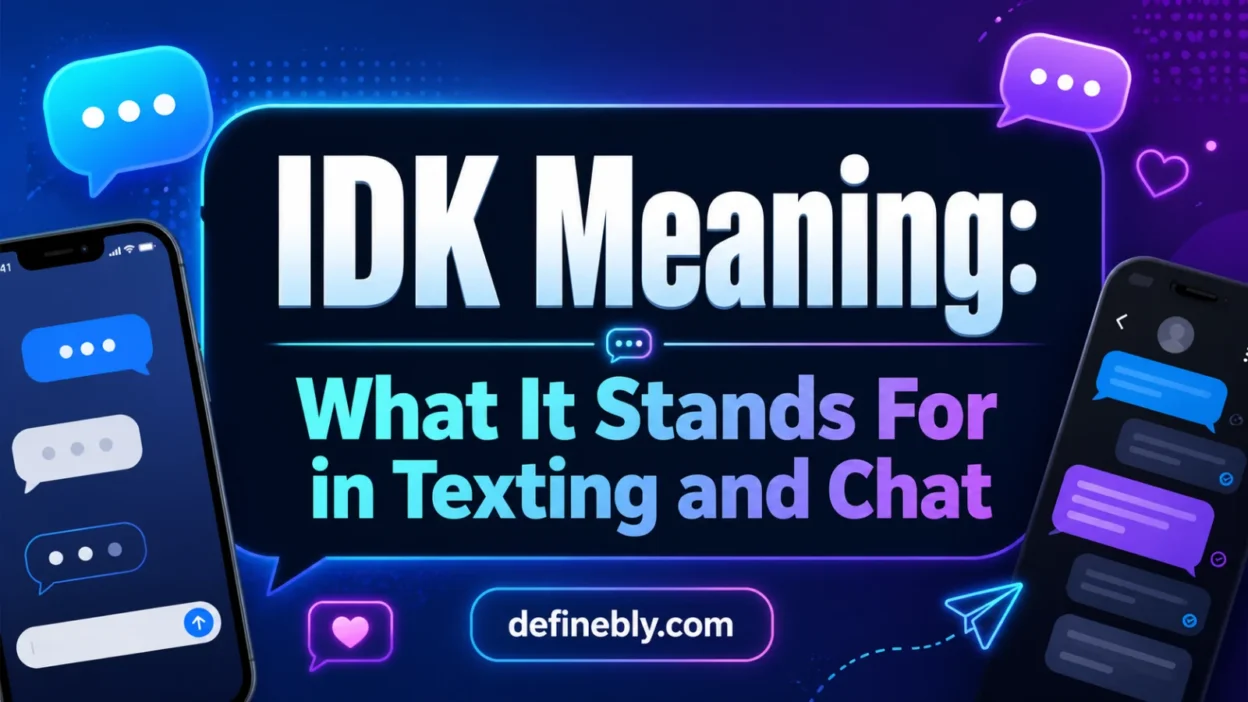
IDK stands for “I don’t know.” In texting, chat, and social media, people use it as a quick way to say they do not know something, are not sure, or do not have a clear answer yet. That is the standard meaning in Merriam-Webster, Cambridge, and Collins.
Quick Answer
IDK means “I don’t know.” It usually signals uncertainty, lack of information, or hesitation in a casual digital conversation.
What IDK Stands For
The expansion is simple: IDK = I don’t know. Merriam-Webster defines it that way directly, and Cambridge says it is an abbreviation used, for example, on social media and in text messages. Collins places it in messaging and social-media language.
What IDK Means In Context
In real messages, IDK often means more than a literal lack of knowledge. It can also signal uncertainty, indecision, or incomplete information. How-To Geek describes it as shorthand for expressing uncertainty when answering a question or describing something unknown, and Android Experto notes that it can suggest hesitation as well as not knowing.
That is why these all sound natural:
- “IDK what time the movie starts.”
- “IDK if I can make it tonight.”
- “IDK, maybe we should ask someone else.”
The first means the speaker lacks information. The second signals uncertainty. The third sounds more tentative than flatly uninformed.
Where People Use IDK
IDK is most common in informal digital communication, especially text messages, group chats, social-media comments, direct messages, and casual online discussion. Cambridge explicitly places it in social media and texting, while Collins labels it as messaging and social-media language.
It is much less natural in formal writing. In reports, essays, or polished professional emails, spelling out “I don’t know,” “I’m not sure,” or “I’ll check” usually sounds better. Grammarly makes the same broader point by treating idk as part of informal writing and text speak rather than formal prose.
Tone And Context
The tone of IDK is usually casual and neutral, but context matters. Used in a full sentence, it often sounds harmless and conversational. Used by itself as a one-word reply, it can sound brief, detached, or uninterested, especially in a serious conversation. Android Experto makes this contextual tone shift clear.
For example:
- “IDK, maybe traffic will be bad.” sounds relaxed.
- “idk” by itself can sound short or dismissive if someone expected a fuller answer.
So the abbreviation does not automatically sound rude, but it can feel that way if it is too blunt for the situation.
IDK Vs. idk
There is no strict rule here. Grammarly says capitalization in informal writing is loose, especially in text messages, so people often write IDK and idk interchangeably. It also notes that all caps can add emphasis or a louder tone.
In practice:
- idk often feels more relaxed and conversational.
- IDK can feel more emphatic or more noticeable.
That is a texting habit, not a grammar rule.
IDK Vs. IDC
These abbreviations look similar, but they mean very different things. IDK means “I don’t know.” IDC means “I don’t care” in messaging and social-media use, according to Collins. Mixing them up changes the tone completely.
- IDK = uncertainty or lack of information
- IDC = indifference
That distinction matters because IDK is usually neutral, while IDC can sound much colder.
Origin And History
IDK belongs to older internet and texting shorthand. Grammarly says it has been part of text speak since at least 2002, while How-To Geek and other explainers connect its growth to internet chat, SMS, and instant messaging culture. That history fits the abbreviation’s role: quick, efficient, low-friction digital communication.
Example Sentences
- “IDK what time the movie starts.”
- “I asked her, but she said idk.”
- “IDK if I can come tonight.”
- “That sounds familiar, but idk where I heard it.”
- “IDK, maybe we should wait a day.”
These work because they show the main real-world uses of IDK: not knowing, being unsure, and answering casually without sounding formal.
Similar Short Forms
A few nearby abbreviations often appear in the same kinds of messages:
- IDC — I don’t care
- IMO — in my opinion
- TBH — to be honest
- NVM — never mind
The closest lookalike is IDC, but it means something much harsher. That is why the distinction is worth learning.
FAQ
Is IDK rude?
Not usually. In most texts and chats, it is just a quick way to say “I don’t know.” But a bare idk with no added context can feel abrupt or uninterested in some conversations.
Is IDK formal?
No. Cambridge places it in social media and text messages, Collins labels it as messaging and social-media language, and Grammarly treats it as informal text speak.
What is the difference between IDK and IDC?
IDK means “I don’t know.” IDC means “I don’t care” in messaging use. The first signals uncertainty; the second signals indifference.
What is the simplest meaning of IDK?
The simplest meaning is “I don’t know.” That is the direct dictionary definition in Merriam-Webster and Cambridge.
Conclusion
IDK means “I don’t know.” In modern digital conversation, it is a fast, familiar way to show that you lack an answer, feel unsure, or want to respond casually without sounding formal. Its meaning is simple, but its tone depends on how you use it: inside a sentence it often sounds relaxed, while by itself it can sound brief or detached.