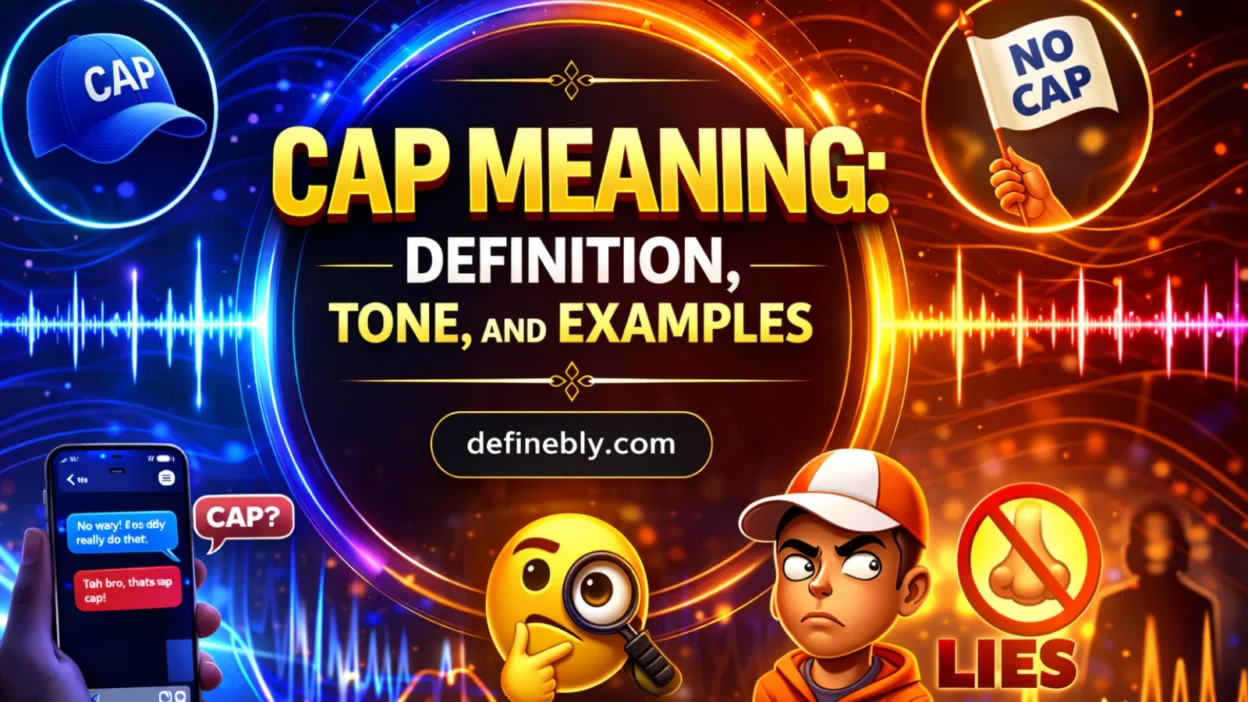
You’ve likely seen someone comment “that’s cap” or reply “no cap” online.
They aren’t talking about hats. In modern slang, cap is all about truth, exaggeration, and honesty. It’s commonly used in texting, social media, and casual conversations, especially among younger speakers.
Quick Answer
In slang:
- Cap = a lie, exaggeration, or something untrue
- No cap = honestly, for real, I’m serious
What Does Cap Mean In Slang?
Cap is a short way to call out dishonesty or exaggeration.
- As a noun: “That story is cap.”
- As a verb: “Stop capping.”
- No cap: Emphasizes honesty — “I finished the game in one hour, no cap.”
It’s used when a claim sounds too wild to be true or when someone wants to stress sincerity.
Origin And Cultural Background
“Cap” originated in African American Vernacular English (AAVE) and gained popularity in hip-hop music in the 2010s. Artists often used it to call out lies or exaggerations.
It spread widely through:
- Social media platforms like TikTok, X, and Instagram
- Online gaming and youth texting culture
- Memes and reaction comments
Its simplicity and punchy delivery made it perfect for quick, expressive communication.
Tone, Context, And Nuance
“Cap” is versatile but depends on tone and context.
Tone Spectrum
| Tone | Meaning | Example |
|---|---|---|
| Playful | Teasing or joking | “You met Beyoncé yesterday? That’s cap.” |
| Confrontational | Calling out obvious lying | “Stop capping, I know you didn’t do that.” |
| Serious/earnest | Truth emphasis with no cap | “I aced the test, no cap.” |
| Sarcastic | Mocking or ironic | “Yeah, you finished all that in 10 minutes? Cap.” |
Key Insight: Tone determines whether “cap” feels friendly, teasing, or confrontational.
Where And How People Use Cap
Common platforms:
- Text messages and group chats
- Social media comments or replies (TikTok, Instagram, X)
- Gaming chats and forums
- Casual spoken conversation
People use it to:
- Call out exaggeration
- Emphasize honesty
- React to unbelievable claims
Example Conversations:
- Friend 1: “I ran 10 miles before breakfast.”
- Friend 2: “Cap.”
- Friend 1: “No cap, I actually did!”
Other Common Variations
- Stop capping: Don’t lie or exaggerate
- Capping: Lying or exaggerating
- No cap fr: Really telling the truth
- Cap fr: Definitely lying
Cap Vs Related Slang Terms
| Slang | Meaning | Difference |
|---|---|---|
| Cap | Lie or exaggeration | Can be playful or confrontational |
| No cap | Truth, sincerity | Emphasizes honesty |
| Facts | Agreement with truth | Affirms statement rather than calling a lie |
| Say less | Understanding or agreement | Acknowledges without judgment |
| Real talk | Honest discussion | More formal than “no cap” |
When Not To Use Cap
Avoid in:
- Professional or formal writing
- Serious discussions about important matters
- Situations with people unfamiliar with slang
Use clear, direct words like “that’s not true” or “I’m serious” instead.
FAQs
What does “that’s cap” mean?
It means the statement is false or exaggerated.
What does “no cap” mean?
It signals honesty or sincerity — the speaker is serious.
Is cap rude?
Not usually. It can be playful with friends but may seem confrontational if used harshly.
Can cap be used in serious situations?
Mostly casual. For formal contexts, plain language about truth is better.
Who commonly uses cap slang?
Young people online, especially in TikTok, X, and gaming communities, use it frequently.
Conclusion
Cap is a modern slang term meaning a lie or exaggeration, while no cap signals truth.
Understanding tone, context, and platform helps you decode conversations and use the term appropriately. Whether teasing a friend or emphasizing honesty online, knowing “cap” gives you insight into casual, expressive communication.