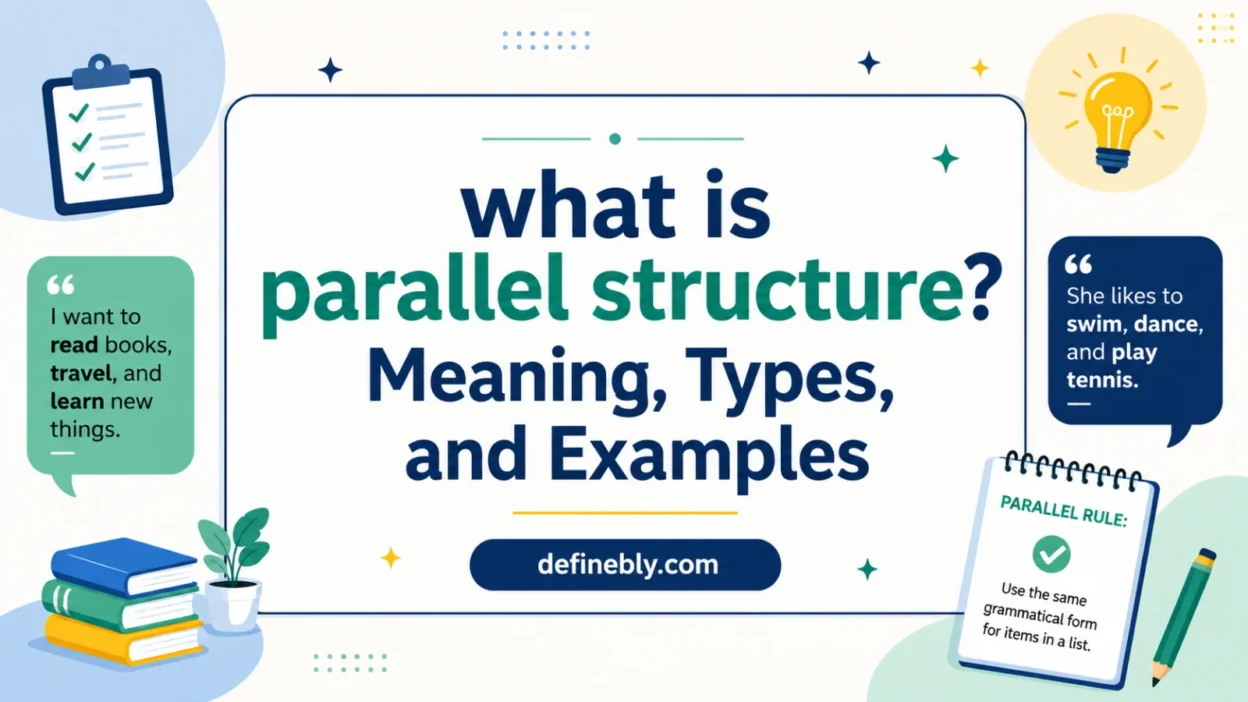
Parallel structure means using matching grammar patterns for related ideas in a sentence.
It is the reason I like hiking, biking, and swimming sounds natural, while I like hiking, biking, and to swim sounds uneven.
Parallel structure helps readers understand which ideas belong together. It also makes sentences cleaner, smoother, and easier to follow.
Quick Answer
Parallel structure is the use of the same grammatical form for two or more related words, phrases, or clauses.
Correct:
- She likes running, reading, and painting.
Each item uses the same -ing form.
Not parallel:
- She likes running, reading, and to paint.
The last item breaks the pattern because to paint does not match running and reading.
The simple rule is: related ideas should use matching grammar.
The Rule Explained
Parallel structure works when equal ideas have equal form.
That does not mean every word must look exactly the same. It means the connected parts should follow the same grammatical pattern.
| Pattern | Parallel Example |
|---|---|
| Words | The room was clean, bright, and quiet. |
| Phrases | We need to plan the event, to book the room, and to email the guests. |
| Clauses | She said that she was ready, that she was calm, and that she was prepared. |
Parallel structure often appears in lists, pairs, comparisons, and repeated sentence patterns.
It can connect nouns with nouns:
- The class taught patience, discipline, and teamwork.
It can connect verbs with verbs:
- He opened the laptop, checked his email, and joined the meeting.
It can connect adjective phrases with adjective phrases:
- The policy is easy to understand, quick to apply, and simple to explain.
The key is not length. The key is function. If the parts do the same job in the sentence, their grammar should match.
When To Use It
Use parallel structure when you write a list.
Correct:
- I need to call my doctor, finish my report, and buy groceries.
Each item starts with a base verb: call, finish, and buy.
Use parallel structure with paired ideas.
Correct:
- The job requires patience and focus.
Both words are nouns.
Use it with comparisons.
Correct:
- Running outside is better than walking on a treadmill.
Both sides use -ing phrases.
Use it with correlative conjunctions, such as either/or, neither/nor, both/and, and not only/but also.
Correct:
- She is not only talented but also hardworking.
Both parts describe the same person with adjectives.
Correct:
- We can either leave now or wait until morning.
Both parts use verb phrases.
Use it in professional writing, especially resumes and instructions.
Weak:
- Managed schedules, budget planning, and to train new hires.
Stronger:
- Managed schedules, planned budgets, and trained new hires.
The stronger version keeps all three items in the same verb form.
When Not To Use It
Do not force parallel structure if it changes the meaning.
Awkward:
- The speaker was clear, confident, and a person with experience.
Better:
- The speaker was clear, confident, and experienced.
This version works because all three words describe the speaker in the same way.
But sometimes ideas are not truly equal. In that case, do not make them look equal just for balance.
Unclear:
- The company values honesty, teamwork, and employees should arrive on time.
Better:
- The company values honesty and teamwork. Employees should also arrive on time.
The first sentence mixes a value list with a rule. The better version separates the ideas.
Do not choose a parallel form that sounds stiff when a simpler sentence is clearer.
Stiff:
- My goal is to learn quickly, to work carefully, and to communicate clearly.
Natural:
- My goal is to learn quickly, work carefully, and communicate clearly.
Both are parallel, but the second sentence is smoother.
Common Mistakes
Mixing Gerunds And Infinitives
A gerund is an -ing form used like a noun. An infinitive uses to + verb.
Not parallel:
- She enjoys cooking, reading, and to dance.
Parallel:
- She enjoys cooking, reading, and dancing.
You could also make all three items infinitives if the sentence allows it:
- She likes to cook, to read, and to dance.
Both versions are correct because each list follows one pattern.
Mixing Nouns And Verb Phrases
Not parallel:
- The workshop covered time management, goal setting, and how to write emails.
Parallel:
- The workshop covered time management, goal setting, and email writing.
The corrected version keeps all three items as noun phrases.
Breaking The Pattern With Correlative Conjunctions
Correlative conjunctions work in pairs. The words after each part should usually match.
Not parallel:
- The update is not only useful but also saves time.
Parallel:
- The update is not only useful but also time-saving.
Both parts now describe the update with adjective forms.
Not parallel:
- Either we leave now or staying home is better.
Parallel:
- Either we leave now or we stay home.
Both parts now use clauses with the same structure.
Making Comparisons Uneven
Comparisons need parallel structure because the reader must see what is being compared.
Not parallel:
- Running outside is better than a treadmill.
Parallel:
- Running outside is better than walking on a treadmill.
The corrected sentence compares one activity with another activity.
Not parallel:
- Her writing is clearer than John.
Parallel:
- Her writing is clearer than John’s writing.
The corrected sentence compares writing with writing, not writing with a person.
Changing Clause Patterns Mid-Sentence
Not parallel:
- The manager said that we should arrive early, that we should bring notes, and to silence our phones.
Parallel:
- The manager said that we should arrive early, that we should bring notes, and that we should silence our phones.
Each item now begins with that we should.
You can also make the sentence shorter:
- The manager said we should arrive early, bring notes, and silence our phones.
This version is also parallel.
Correct Examples
| Not Parallel | Parallel |
|---|---|
| I like texting, calling, and to email. | I like texting, calling, and emailing. |
| The plan is simple, useful, and it saves time. | The plan is simple, useful, and time-saving. |
| She wants to travel, to learn, and meeting people. | She wants to travel, to learn, and to meet people. |
| He was tired, hungry, and needed water. | He was tired, hungry, and thirsty. |
| The job requires patience, focus, and to communicate well. | The job requires patience, focus, and strong communication. |
| We need someone who can write clearly, edit quickly, and has good judgment. | We need someone who can write clearly, edit quickly, and judge carefully. |
More correct examples:
- The app is fast, simple, and reliable.
- We packed snacks, water, and jackets.
- He promised to listen, to help, and to follow up.
- They cleaned the kitchen, washed the car, and folded the laundry.
- The course helps students plan essays, revise drafts, and avoid common errors.
- She is both thoughtful and practical.
- The team wanted not only to finish on time but also to improve the final design.
How To Fix Faulty Parallelism
Faulty parallelism happens when related sentence parts do not match in form.
Use this process to fix it.
First, find the related items.
- The role involves writing reports, team meetings, and to analyze data.
The related items are writing reports, team meetings, and to analyze data.
Second, identify the pattern.
The first item is an -ing phrase. The second is a noun phrase. The third is an infinitive phrase.
Third, choose one pattern.
Parallel:
- The role involves writing reports, attending team meetings, and analyzing data.
Now all three items use -ing phrases.
Another possible correction:
- The role involves report writing, team meetings, and data analysis.
Now all three items are noun phrases.
Many faulty sentences can be fixed in more than one way. Choose the version that sounds clearest and most natural.
Quick Memory Fix Or Rule Of Thumb
Use this rule:
Same Job, Same Form.
If words, phrases, or clauses do the same job in a sentence, make their grammar match.
Check for parallel structure near these words:
- and
- or
- but
- than
- as
- both/and
- either/or
- neither/nor
- not only/but also
Read the sentence aloud. If one part sounds like it does not belong, the structure may not be parallel.
FAQs
What is parallel structure in simple words?
Parallel structure means using matching grammar patterns for related ideas.
Example:
- I like running, cooking, and reading.
The three items match because they all use -ing forms.
What is an example of parallel structure?
Here is a simple example:
- The movie was funny, exciting, and surprising.
The words funny, exciting, and surprising are all adjectives. They describe the movie in the same way.
What is faulty parallelism?
Faulty parallelism happens when related parts of a sentence do not match.
Not parallel:
- She likes singing, dancing, and to paint.
Parallel:
- She likes singing, dancing, and painting.
The corrected sentence keeps all three items in the same form.
Why is parallel structure important?
Parallel structure makes writing clearer and easier to read.
It shows that ideas are connected and equal. It also prevents sentences from sounding awkward or unfinished.
Is parallel structure only used in lists?
No. Lists are common, but parallel structure also appears in pairs, comparisons, clauses, and repeated sentence patterns.
Example:
- He wanted not only to win but also to improve.
Both parts use infinitive phrases.
What words often need parallel structure?
Parallel structure often appears near connecting words such as and, or, but, than, and as.
It is also common with paired expressions such as both/and, either/or, neither/nor, and not only/but also.
How do you fix parallel structure?
Find the related ideas first. Then make them follow the same grammar pattern.
Not parallel:
- We need planning, teamwork, and to communicate clearly.
Parallel:
- We need planning, teamwork, and clear communication.
Are parallel structure and parallelism the same?
In grammar, parallel structure and parallelism usually mean the same thing.
Both refer to matching grammar patterns in related words, phrases, or clauses.
Can a sentence be parallel in more than one way?
Yes. Many sentences can be corrected in more than one parallel form.
Not parallel:
- I like running, swimming, and to bike.
Parallel:
- I like running, swimming, and biking.
Also parallel:
- I like to run, to swim, and to bike.
Both corrected versions work.
Conclusion
Parallel structure means using matching grammar patterns for related ideas. It often appears in lists, pairs, comparisons, and repeated clauses.
The goal is not to make every word identical. The goal is to make equal ideas look and sound equal.
When in doubt, use the simplest rule: same job, same form.