Ambiguous Meaning: Definition, Usage, Tone, and Examples
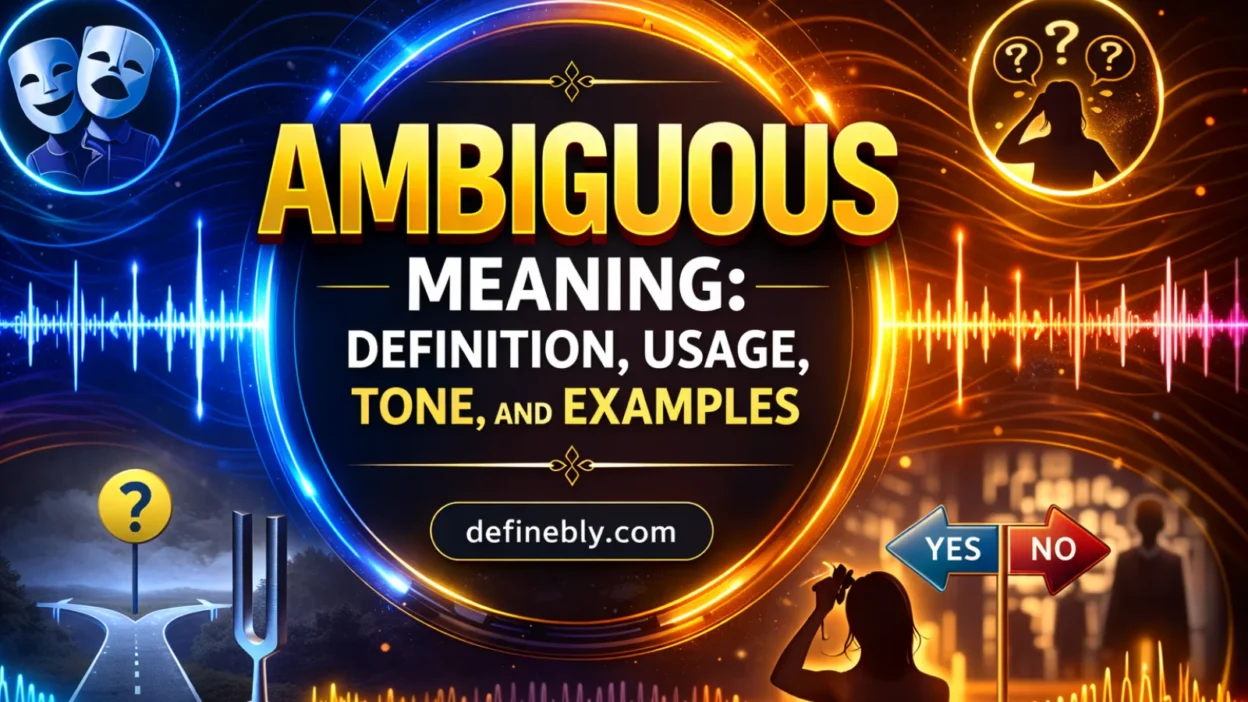
If something is ambiguous, it has more than one possible meaning or it is not clear enough to point to one definite meaning. In simple English, people use ambiguous when a word, sentence, answer, message, or situation can be understood in different ways. That unclear double meaning is the core idea behind the word.
Quick Answer
Ambiguous means open to more than one interpretation, sometimes intentionally. It usually describes wording, statements, replies, endings, or situations that do not clearly lead to just one meaning.
What Does Ambiguous Mean?
Ambiguous is an adjective. Major dictionaries agree on two main ideas:
- something can be ambiguous because it has two or more possible meanings
- something can also be ambiguous because it is unclear, indefinite, or hard to classify
The first sense is the most important for this keyword and for everyday use.
Pronunciation
The common pronunciation is am-BIG-yoo-uhs. Cambridge and Oxford both give the standard pronunciation as /æmˈbɪɡ.ju.əs/.
Core Meaning In Plain English
In plain English, ambiguous usually means not fully clear because more than one meaning seems possible.
For example, if someone says, “I’ll think about it,” that reply may feel ambiguous because it does not clearly mean yes or no. If a headline says “Squad helps dog bite victim,” readers may not know whether the squad helped a victim of a dog bite or helped a dog bite someone. That is ambiguity: one wording, two possible readings.
How Ambiguous Is Used
People often use ambiguous with words like:
- answer
- statement
- reply
- wording
- message
- instructions
- role
- policy
- ending
- comment
That pattern matters because the word most naturally describes language, wording, or a situation, not just general confusion. Oxford and Cambridge both show examples like ambiguous words, statements, accounts, endings, and agreements.
Can Ambiguity Be Accidental Or Intentional?
Yes, both.
Sometimes ambiguity happens by accident. Poor wording, unclear pronouns, or missing detail can leave the reader unsure which meaning is correct. Oxford even gives an example of ambiguity caused by careless pronoun use.
Other times, ambiguity is deliberate. Cambridge explicitly notes that something may have more than one possible meaning sometimes intentionally. In politics, literature, diplomacy, and storytelling, speakers or writers may choose ambiguity because they do not want to commit to one clear position or because they want to leave room for interpretation.
Is Ambiguous Positive, Negative, Or Neutral?
The word itself is usually neutral in definition. It simply describes unclear or multi-layered meaning. But in real-world use, it often sounds negative when clarity matters.
For example:
- an ambiguous contract
- an ambiguous instruction
- an ambiguous email
- an ambiguous answer
In these cases, the word usually suggests a problem because the wording may cause confusion or disagreement. Cambridge’s business entry and Cornell’s legal explanation both show why ambiguity matters when the stakes are practical or legal.
In art, literature, or film, though, ambiguity can feel thoughtful, layered, or interesting. An ambiguous ending may invite discussion instead of simply frustrating the audience.
Ambiguous Vs. Vague
These words overlap, but they are not exact twins.
- Ambiguous means there is more than one possible interpretation
- Vague means something is not clear or not precise enough
Merriam-Webster’s synonym note puts this well: vague suggests a lack of clear formulation, while ambiguous applies to language capable of more than one interpretation. Grammarly makes a similar point by warning writers not to use hedging in a way that becomes vague or ambiguous.
A sentence can be vague because it lacks detail. A sentence can be ambiguous because it points in two directions at once.
Ambiguous Vs. Ambivalent
This is one of the most common mistakes.
- Ambiguous is about meaning
- Ambivalent is about feelings
If a message can be understood in two ways, it is ambiguous. If a person has mixed feelings, they are ambivalent. Merriam-Webster and Dictionary.com both make this distinction clearly.
Examples:
- The instructions were ambiguous.
- She felt ambivalent about the decision.
Ambiguous Vs. Equivocal
These words can be close, but equivocal often sounds more formal and more strategic.
Merriam-Webster says equivocal applies to language left open to differing interpretations with the intention of deceiving or evading. Dictionary.com also says it usually suggests a deliberate intent to mislead by avoiding clarity. That makes equivocal a stronger word when someone seems evasive on purpose.
Why Ambiguity Matters In Real Life
Ambiguity is not just a dictionary idea. It matters in everyday communication.
In writing, ambiguous wording can confuse readers. In arguments, an ambiguous word can change meaning halfway through and weaken the logic. In contracts, ambiguity can become serious because different parties may read the same sentence in different ways. Cornell explains that contract ambiguity exists when a reasonably intelligent person could interpret the language in more than one way. Scribbr shows how ambiguity can also create the equivocation fallacy in reasoning.
That is why teachers, editors, lawyers, and business writers all care about ambiguity.
Example Sentences
Here are some natural examples:
- The teacher’s instructions were ambiguous, so half the class did the wrong assignment.
- His reply was ambiguous, and I still did not know whether he agreed.
- The movie has an ambiguous ending that people still debate.
- The contract wording was ambiguous and led to an argument.
- Her statement was deliberately ambiguous because she did not want to take a clear side.
- The headline was ambiguous and easy to misunderstand.
- His role in the project remained ambiguous for weeks.
- The paragraph became ambiguous because the pronoun could refer to two different people.
These examples reflect the most common real uses shown across learner and dictionary sources.
Common Mistakes
One common mistake is confusing ambiguous with ambivalent. The first is about unclear meaning; the second is about mixed feelings.
Another mistake is treating ambiguous and vague as exact synonyms. They overlap, but they are not identical. Ambiguous suggests multiple meanings, while vague suggests weak precision.
A third mistake is assuming ambiguity is always bad writing. Sometimes it is. But sometimes it is a deliberate creative or strategic choice. Cambridge explicitly allows for intentional ambiguity.
Opposite Of Ambiguous
The clearest opposite is unambiguous, which means clear and open to only one meaning. Vocabulary.com also notes related opposites such as unequivocal and clear.
FAQs
What does ambiguous mean in simple words?
It means something is unclear because it can be understood in more than one way.
Is ambiguous always negative?
No. The definition is neutral, but the word often sounds negative when people need a clear answer. In literature or film, it can be intentional and effective.
Is ambiguous the same as vague?
Not exactly. Ambiguous suggests multiple interpretations. Vague suggests a lack of precision or detail.
Is ambiguous the same as ambivalent?
No. Ambiguous describes unclear meaning. Ambivalent describes mixed feelings.
Can a statement be deliberately ambiguous?
Yes. Cambridge and Oxford both support deliberate ambiguity, especially when someone wants to avoid a fully direct answer or leave room for interpretation.
What is the opposite of ambiguous?
The usual opposite is unambiguous, which means clear and capable of only one interpretation.
Conclusion
Ambiguous means open to more than one meaning or not clear enough to point to one definite interpretation. Most of the time, people use it for wording, statements, answers, instructions, roles, and situations that can be read in different ways. In practical communication, ambiguity often causes confusion. In creative work, it can add depth. The simplest way to recognize it is to ask one question: Does this point clearly in one direction, or could a reasonable person read it in more than one way?