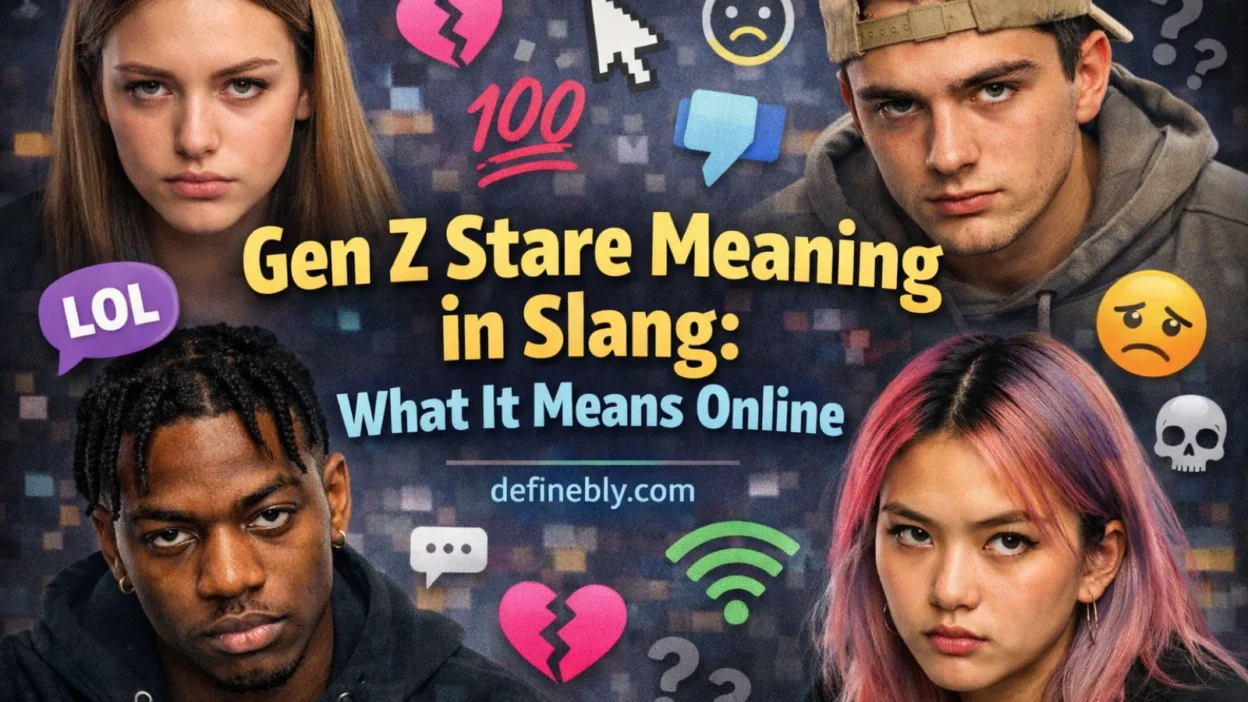
In slang, gen z stare means a blank, unblinking, or vacant look given when a person would normally say something.
People use the phrase online to describe moments when someone just stares instead of greeting, answering, or reacting. It often comes up in jokes about customer service, classrooms, and awkward real-life interactions.
Quick Answer
Gen Z stare is slang for a blank, silent, unreadable look someone gives in a moment when a normal verbal response would usually happen. People use the phrase online to describe situations where someone seems to just stare instead of greeting, answering, reacting, or making small talk. The tone is usually teasing, critical, or mocking, though some people use it jokingly about themselves.
What Gen Z Stare Means In Slang
The phrase describes a very specific kind of expression: flat, quiet, and hard to read. It is not just any stare. In slang, Gen Z stare usually means someone gives a blank look in a moment where another person expected a quick spoken response, such as “hi,” “yes,” “what can I get for you,” or some other basic acknowledgment. Merriam-Webster’s current entry defines it as a vacant expression given where a spoken response would be expected, which is the clearest starting point.
Online, though, the phrase usually carries more judgment than that bare definition suggests. When people say they got the Gen Z stare, they often mean the moment felt awkward, passive, detached, or mildly rude. In other words, the term does not just describe a face. It describes how the interaction landed for the other person.
Where The Term Came From
The phrase spread widely online in 2025 through short videos, meme pages, reaction posts, and commentary about awkward public interactions, especially in customer-service settings. Wikipedia’s summary of the topic notes that the term drew broad mainstream attention in July 2025, while Know Your Meme treats it as an established meme and slang label with alternate names like Zoomer Stare and Gen Z Gaze.
By March 2026, Merriam-Webster had published a dedicated slang entry for the term. That matters because it shows how quickly the phrase moved from social media chatter into mainstream language coverage.
Where People Use It
Most people use Gen Z stare online when talking about offline interactions. The term shows up most often in stories about classrooms, restaurants, stores, coffee shops, front desks, and other short public exchanges where someone expects a greeting or answer and instead gets silence. Merriam-Webster explicitly places the phrase in classrooms, restaurants, and other social settings, while broader coverage links it strongly to customer-service and workplace moments.
That is what makes the term different from purely digital slang. It may have spread through social media, but it usually points to a face-to-face moment that people later describe online.
What The Phrase Usually Implies
Most uses of Gen Z stare imply one or more of these ideas:
- silence where speech was expected
- awkwardness
- detachment
- low-effort social engagement
- mild judgment
- refusal to perform friendliness or small talk
That does not mean the stare always means all of those things. It means the slang label is usually applied when the interaction feels socially off to the observer. In practice, the phrase often says as much about the other person’s frustration as it does about the person being described.
Is Gen Z Stare Rude, Negative, Or Neutral?
Most of the time, the phrase is negative or teasing. People usually use it to complain, joke, or vent about a social interaction that felt blank, weird, or unfriendly. Merriam-Webster notes that the expression often appears judgmental to those on the receiving end, and Wikipedia describes the phrase itself as generally pejorative.
Still, the phrase is not always fully hostile. Some people use it lightly or self-awarely:
- “I think I accidentally do the Gen Z stare when I’m tired.”
- “My professor asked a question and the whole class hit him with the Gen Z stare.”
In those cases, the phrase works more like internet shorthand than a serious insult. But even then, it still carries a mildly critical edge.
Why The Phrase Is Controversial
This is where most weaker articles stop too early. Gen Z stare is not just a definition question. It is also a fairness question.
Some people use the phrase to criticize what they see as rude, disengaged, or low-effort communication. Others argue that the label unfairly stereotypes younger people and can misread awkwardness, exhaustion, social anxiety, deadpan humor, or resistance to fake cheerfulness as a character flaw. Forbes frames the expression as a workplace-relevant phenomenon with deeper meaning than a blank face, while Psychology Today treats it as a subject of broader cultural and psychological interest. Harper’s Bazaar Australia goes further and interprets it as a kind of restraint or refusal to perform.
The safest way to understand the phrase is this: it is a viral slang label for a recognizable kind of blank, silent reaction, but it is not a precise explanation for why a person behaved that way.
Examples Of Gen Z Stare In Real Use
Here are natural examples in modern US English:
- “I said good morning and got the full Gen Z stare back.”
- “That cashier wasn’t rude exactly, but the Gen Z stare made the whole exchange awkward.”
- “The teacher asked a simple question and got ten Gen Z stares.”
- “People call it the Gen Z stare, but sometimes it’s just social awkwardness.”
- “That video is funny because it nails the Gen Z stare at the front desk.”
- “I’m not mad, but that was absolutely a Gen Z stare.”
These examples work because they show the phrase in the settings most often linked to it: counters, classrooms, brief service exchanges, and awkward public moments.
When Not To Use It
Do not use Gen Z stare in formal writing, workplace documentation, school assignments, or serious conversations about a specific person’s behavior. It is internet slang, and it can sound unfair, shallow, or stereotyped outside casual discussion.
It is especially worth avoiding when:
- the situation may involve anxiety, stress, or neurodivergence
- you are speaking about a real person in a professional setting
- you want accuracy more than humor
- you are trying to de-escalate rather than criticize
In those cases, clearer language is better:
- “They gave a blank look and did not respond.”
- “There was a pause where I expected an answer.”
- “The reaction felt awkward and hard to read.”
Related Terms And Variants
A few nearby terms often show up around Gen Z stare, but they are not identical.
Zoomer Stare and Gen Z Gaze are close variants of the same phrase. Blank stare is the neutral, non-slang version. Deadpan suggests an intentionally flat expression, while awkward is broader and less judgmental. Millennial pause is a different generational meme, but it belongs to the same internet habit of naming tiny communication quirks and turning them into trend language.
Faqs
What does gen z stare mean on social media?
It means a blank, silent, expressionless look given when a normal greeting, answer, or reaction would usually happen. Online, people use the phrase to label awkward real-world moments and talk about them jokingly or critically.
Is gen z stare an insult?
Often, yes. It is usually used teasingly, critically, or mockingly, even when framed as a joke. The label tends to imply that the person looked detached, rude, or socially off.
Is gen z stare always rude?
No. The phrase is usually critical, but the behavior being described is not always simple rudeness. Current commentary suggests it can also reflect awkwardness, fatigue, anxiety, deadpan affect, or generational differences in communication style.
Where did gen z stare come from?
The phrase took off online in 2025 through viral videos, posts, and commentary about customer-service and public-interaction awkwardness. It later spread into mainstream coverage and dictionary-style slang references.
Do people use gen z stare as a joke?
Yes. Many people use it jokingly, including about themselves, but it still usually carries a critical edge because it points to a socially awkward or unreadable reaction.
Is gen z stare formal English?
No. It is casual, internet-driven slang. It belongs in informal conversation, trend coverage, and social commentary, not in formal or professional communication.
Bottom Line
In slang, Gen Z stare means a blank, silent look that replaces the kind of quick verbal response people usually expect in everyday social situations. The phrase spread online through videos and stories about awkward customer-service, classroom, and public interactions, and it is usually used teasingly or critically. The most accurate way to understand it is as a viral label for a recognizable kind of unreadable reaction, not as a definitive judgment about an entire generation.
Conclusion
In slang, gen z stare means a blank, unblinking look given when a spoken response would normally happen.
It is mostly used online, and the tone is usually teasing or critical. Sometimes it is funny. Sometimes it is unfair. The safest way to understand it is as a modern slang label for a silent, flat reaction that people notice and talk about online.